


Company culture defines the shared identity of a business. It shows up in the collective values and behaviors of the team.
The shift to remote and hybrid work changed how these connections form. You can’t rely on physical proximity to build a cohesive environment anymore. It requires an intentional operating model to create a work culture where it once came naturally.
The guide explores the elements of workplace culture, why it matters, its various types, and the red flags that signal when you need to course-correct. It also provides methods to improve your company culture through learning.
What is company culture?
Company culture lives in the collective actions of a team. It’s not the written organization’s values but the actual behavior of each employee. It appears in the choices employees make when leadership steps away, how they handle challenges, innovate, and communicate with each other. A great company culture is the shared identity that drives the business forward.
Types of company culture (with examples)
Most organizations fit into one of four categories from the Competing Values Framework. You can use these archetypes to identify your current company culture and decide where to shift next or to double down on.
Clan culture (collaborative) + example
Best for: Startups, small businesses, and legacy family-owned companies.
Clan culture is a lot like a large family, where everyone collaborates and communicates freely. Business leaders and managers act as mentors or parent figures, and the team prioritizes mutual support.
Such a supportive environment builds deep loyalty and high morale because engaged employees feel seen and valued. But it can sometimes slow down decision-making, since you often need the whole group to agree before the ship turns.
Southwest Airlines proves the value of the clan culture model. They put employees first based on the belief that happy staff treat passengers better, which has led to many awards and top reviews.
Adhocracy culture (innovative) + example
Best for: Tech startups, creative agencies, and industries requiring rapid evolution.
Adhocracy culture values creation over control. It encourages employees to take risks and challenge standard procedures to find a better way. Teams experiment constantly and accept failure as a necessary cost of doing business, which is why you see individual initiatives rewarded over strict adherence to a hierarchy.
Tesla uses this model to stay ahead of legacy automakers. They set aggressive, seemingly impossible production deadlines to force engineers to invent new manufacturing methods on the fly. The company pushes software updates that change how the car drives while the owner sleeps. That relentless pace demands that every employee thinks like an inventor rather than a cog in a machine.
Market culture (results-driven) + example
Best for: Sales organizations, competitive industries, and multinational corporations.
Market culture operates as a results-oriented workplace where the bottom line dictates every decision. Leaders act as hard-driving competitors who measure success by impact rather than internal cohesion.
An external focus on beating the (internal and external) competition fuels high-performance and rapid growth. But the intense pressure to deliver numbers can strain relationships.
Amazon uses this model effectively through leadership principles like “Deliver Results” and “Bias for Action.” The company relies on rigorous real-time data to track performance so that it remains the dominant player in retail.
Hierarchy culture (structured) + example
Best for: Government agencies, healthcare systems, and industries requiring strict safety protocols.
Hierarchy culture prioritizes control and consistent procedures. It works through a defined chain of command where everyone knows their specific role. You’ll often find detailed manuals and strict protocols guiding every decision to prevent errors.
McDonald’s built an empire on this rigid adherence to process. They use precise checklists to make sure a Big Mac tastes the same in Tokyo as it does in New York. The training system drills employees on specific operational steps to remove any chance of variation or surprise.

Why company culture matters more than ever
In a world where everyone has access to the same technology, your team’s behavior remains the only true competitive advantage. It drives revenue, sparks innovation, and defines your reputation.
Company culture and employee engagement
When the ideal company culture clicks, people do more than the minimum. They put in extra effort everywhere—fixing problems without being asked, or staying late to help a team member simply because they want to. That energy transforms a standard project into something special.
On the flip side, in a toxic workplace environment, people put up walls. They do exactly what the job description says and nothing more. This “check-the-box” mentality spreads quickly. Before you know it, you have a workforce that operates on autopilot, killing customer satisfaction and stalling growth.
Company culture and performance
If employees worry about blame, they hide mistakes and triple-check irrelevant details, slowing everything down.
Psychological safety removes that drag. When people trust their environment, they flag errors instantly and experiment without hesitation. That transparency lets the business iterate faster than the competition, turning “fail fast” from a buzzword into a profitable reality.
Company culture and retention
The importance of positive company culture can be seen in your retention rates. If your workplace culture feels stagnant or hostile, your best talent will walk out the door. New employees might also see you as a “stepping stone” company.
A corporate culture focused on growth changes that dynamic. According to the TalentLMS 2026 Annual L&D Benchmark Report, 95% of HR managers agree that better training and development improve retention. When employees see a future for themselves within your walls, they stay.
Key elements of a strong company culture
A healthy culture requires a deliberate framework to function. The best organizations rely on specific operational pillars to guide behavior and drive results, like:
Clear company values and expectations
In a company, core values act just like a North Star. They’re the tools employees use to make decisions when the boss isn’t watching.
- Without strong company values: Employees have to ask permission for everything because they don’t know the “right” way to act.
- With strong company values: Everyone knows exactly what to do.
For example, if a company’s core value is “Customer Obsession,” and a delivery driver realizes a package is damaged, they don’t need to call a manager. They know the value tells them to fix it for the customer immediately, perhaps by buying a replacement on the spot, rather than ignoring it to save money.
Trust and psychological safety
Low-trust environments force employees to waste energy hiding faults or not feeling safe enough to innovate. Psychological safety frees up that brainpower for actual work. Your team also innovates more freely and quickly because they feel safe enough to take risks. They are essentially free to thrive.
Google proved this with “Project Aristotle.” They studied 180 teams and found that psychological safety was the single biggest predictor of success. It mattered far more than individual IQ or talent.
The other side of psychological safety is feeling secure at a job. It’s about knowing you have somewhere to dig your roots into for the future, which isn’t as common as it needs to be. According to the TalentLMS Quiet Cracking Survey, 82% of employees feel secure in their jobs today—but that drops to 62% when asked about their future with the company. Offering them that reassurance in a way is a good way to boost their commitment to your company.
TalentLibrary — Skills that matter, courses that deliver
With TalentLibrary, you set the foundation for a strong, aligned workforce—soft skills, compliance, and workplace essentials, from day one (and beyond).
Leadership behavior and accountability
A healthy company culture is set by the leader’s behavior, not their words.
If you tell your kids, “Don’t eat sugar,” but you’re eating a donut right in front of them, what will they do? They’ll eat the donuts.
It’s the same in business. This concept is called “Walking the Talk.”
Learning and growth opportunities
Offering clear learning paths turns your business into a talent magnet for new hires and employee retention. It signals that you view your people as assets to appreciate, not just resources to deplete.
There’s a famous business quote about this:
CFO: “What happens if we spend money training our people and then they leave?”
CEO: “What happens if we don’t, and they stay?”
Communication and transparency
Communication isn’t just sending emails. It’s ensuring everyone understands the company’s mission.
It connects the dots between a single employee’s job and the company’s big goal.
Transparency is the antidote to gossip. In the absence of information, people make up their own stories (and they’re usually bad ones).
Imagine being a passenger in a car.
- Low transparency: The driver (CEO) puts up a curtain so the employees can’t see the road. They feel anxious every time the car bumps.
- High transparency: The employees can see out the windshield. They see the bump coming, so they aren’t scared when you hit it.
Signs your company culture needs improvement
Cultural issues rarely explode out of nowhere. They start as small cracks in daily operations that eventually compromise the structural integrity of the business. You need to treat these signs as immediate operational red flags:
- High turnover of top talent: Look specifically at your “regrettable attrition.” If your highest performers are walking out the door, you have a major problem.
- The sound of silence: A quiet meeting room often signals resignation rather than agreement. Silence also signals a kind of fake obedience, where employees do what they are told even when they know it’ll fail, because they don’t care enough to save the project.
- Heavy resistance to organizational change: Every new initiative feels like an uphill battle when trust is low. Resistance usually stems from fear rather than laziness.
- Tolerance of toxic “stars”: Watch out for the “brilliant jerk” phenomenon. Leadership often ignores a high-revenue generator who bullies others because they fear losing the numbers. Permitting this toxic culture signals to the entire company that your values are optional as long as you make money, which rots the company culture from the inside out. It’s almost as bad as one that doesn’t prevent harassment.
How to improve company culture, starting with learning
Organizational culture isn’t fixed. It can be reshaped intentionally, especially when learning reinforces the behaviors you want to see.
Start looking for the right employee feedback
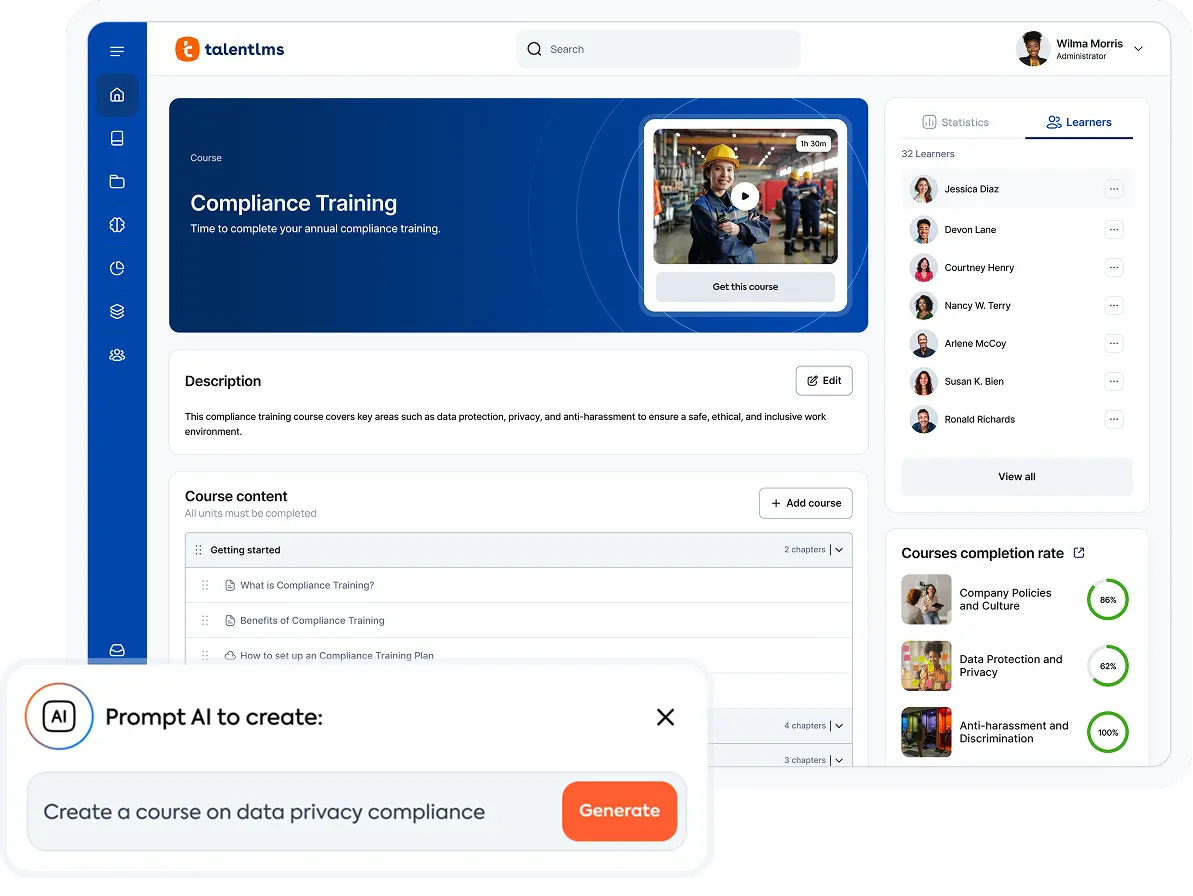
Conducting employee surveys often reveals what happened last quarter. Learning data shows you what’s happening right now. It exposes cultural gaps long before an annual questionnaire hits the inbox.
You just need to know how to read numbers:
- Low completion rates rarely indicate laziness: When employees skip training, it signals burnout or a workload that leaves no room for professional development. They physically can’t fit another task into their day.
- Manager participation tells an even bigger story: If leaders stall on their own training, they send a silent message to their teams that growth doesn’t matter. That apathy poisons the well and destroys trust from the top down.
- Uneven participation across departments reveals silos: It shows you exactly where engagement is dropping off and which teams feel disconnected from the broader mission.
These metrics act as an early warning system. They allow HR teams to spot disengagement and fix the root cause before top talent decides to walk away. With them, they can better design learning paths and courses.
Align learning with values
Values rarely survive the jump into daily operations unless you build a bridge for them. Structured learning paths serve as that connection. They translate high-level ideals into specific, role-based actions that employees can actually execute.
Here are a few ways to align learning with values:
- Onboarding can be used to set the tone: You use this time to teach “how we work” rather than just “what we do.” It becomes a cultural immersion where new hires learn the expected behaviors before they ever write a line of code or answer a client email.
- Compliance training offers a cultural opportunity: Instead of a dry review of rules, you can use these sessions to explain the ethical “why” behind the policy. It tangibly reinforces the value of integrity.
- Skills training can help teach value: You don’t just teach a sales technique—you teach how to sell honestly if that matches your values. This approach stops employees from guessing.

People & Culture Generalist
A People & Culture Generalist at Epignosis, supporting the employee experience across the full HR lifecycle. He focuses on fostering a positive company culture, enabling team growth, and strengthening internal processes that help people do their best work.
Expert tip: Make your culture visible in everyday moments
One of the fastest ways to create a positive company culture, especially across remote and hybrid teams, is to turn your values into “behavior cues” people can follow naturally.
A simple HR rule of thumb is to ask for every core value:
“What should this look like on a normal workday?”
For example:
- Transparency: Make it a standard to share key updates, meeting notes, and decisions in a public channel
- Team collaboration: Build in cross-team check-ins, not just last-minute handoffs
- Growth: Encourage managers to end 1:1s with a development prompt like: “What skill do you want to build next?”
When values show up as repeatable habits, employees stop guessing what “good culture” means and start practicing it consistently.
Equip managers to lead the organization’s culture
Managers determine if values survive the daily grind. You need training programs that give managers the tools to lead by example, especially when managing teams where people don’t always follow what they say.
Here is how you can equip them to lead effectively:
- Delivering constructive feedback: Teach leaders how to critique work without destroying confidence. This skill turns a difficult conversation into a growth moment rather than a morale killer.
- Building safety in remote teams: Remote employees can’t read body language. Managers need training on how to create psychological safety through a screen. This involves asking intentional questions and creating space for silence, so employees feel comfortable speaking up.
- Making inclusive decisions: You must train managers to pause and ask for input rather than rushing to a verdict. This prevents the loudest voice in the Zoom call from dominating the strategy and keeps the quieter, thoughtful experts involved.
Reinforce behaviors through recognition
Connecting recognition directly to development creates a loop where employees know exactly where they stand. It moves feedback away from vague compliments and anchors it in real performance.
Here is how to use recognition to lock in the right behaviors:
- Tie praise to specific values: Stop giving generic compliments. Instead of just celebrating a closed deal, highlight how they made it happen. If they collaborated with the support team to solve a complex client issue, call that out specifically. That detail proves that teamwork matters just as much as the final revenue number.
- Use learning to correct the path: When someone misses the mark, point them toward resources rather than just pointing out the failure. A missed deadline might require time management training rather than a reprimand. That approach frames the correction as an investment in their future success rather than a punishment.
- Make standards visible: Public recognition sets the bar for the rest of the group. When the team sees exactly which actions earn a spotlight, they stop guessing. They understand clearly which behaviors drive the business forward and which ones will simply not be tolerated.
Measure and adapt continuously
Most leaders treat positive culture like a one-time project. They set the values, put up a few posters, and assume the job is done. That approach fails because culture drifts over time.
You need a yardstick to measure the slide. Learning analytics provide that concrete data, turning abstract feelings into hard numbers you can actually track and improve.
Here is how you can use data to keep your company culture on course:
- Track application, not just completion: Don’t stop at checking who finished the course. Look for proof of the skill in the wild. If you train the team on “innovative thinking” but see zero new innovative ideas the following month, the company culture is blocking the behavior. That gap tells you exactly where to focus your next intervention.
- Watch for engagement drop-offs: Learning behavior often predicts turnover. Check the history of people who quit. You’ll often see that they have stopped engaging with development content months before they handed in their resignation. Spotting that trend early allows you to intervene with stay interviews before it’s too late.
- Listen to the feedback comments: Post-training feedback offers more than just a rating out of five. Look at the qualitative comments. If employees consistently rate “leadership communication” modules as irrelevant or disconnected from reality, they’re telling you that their actual managers don’t walk the walk.
You can also foster or create a culture of learning as one of your core values. That means your employees thrive as they keep learning, and you keep developing what you teach them. It’s a natural way to stay on top of changes and to monitor training.
A strong culture is adaptable
Business goals shift constantly. Skill necessity constantly keeps changing. Technology is always evolving.
But workplace culture?
The culture of the company is the one thing you can keep constant among all of this.
Build a strong culture that you can change, that has values that fit your business or future, and that’s important to your company.
FAQs
What does company culture mean?
Company culture defines the shared values, attitudes, and behaviors that characterize an entire organization. It establishes the unwritten rules that determine how employees interact, make decisions, and execute their work daily.
Why is company culture important?
Culture leads to improved employee engagement, retention, and overall business performance. A strong work environment aligns the team toward shared goals, improving productivity and differentiating your brand in a competitive market.
What are some examples of company culture?
Common examples include a company culture of innovation where people are encouraged to take risks, or a culture that values customer service above all else. Other organizations may foster a collaborative company culture that focuses on teamwork and shared success over individual competition.
How can learning help improve company culture?
Learning programs reinforce desired behaviors by teaching employees exactly how to apply core values in their daily roles. Continuous training clarifies expectations and assures everyone has the specific skills needed to support the organization’s standards.
How do you measure company culture?
You can measure culture through quantitative data like employee turnover rates, learning completion statistics, and engagement survey scores. Qualitative feedback from exit interviews and performance reviews also provides critical insight into the actual employee experience.
How do you explain company culture?
Company culture is simply ‘how we do things around here.’ It’s the unwritten rules that determine how people make decisions, how they treat each other, and what behaviors get rewarded.
