


What Is The Socratic Method?
The Socratic Method is a way of teaching and learning that relies on asking thoughtful questions rather than giving direct answers. This way, it encourages critical thinking, reflection, and independent reasoning. Developed from the teaching practices of the Greek philosopher Socrates, it shifts learning away from mere information reception. Instead, learners explore ideas, question assumptions, examine evidence, and arrive at conclusions through dialogue.
So, what is the Socratic Method, exactly? Simply put, it is a way of guiding learners with questions. It helps people look at their assumptions, think about evidence, and come to their own conclusions by talking things through, instead of just being told the answers.
Understanding the Socratic Method also sheds light on what it means to be ‘Socratic.’ This approach is all about disciplined questioning. Basically, it’s not just looking for an answer, but trying to understand why that answer makes sense. This idea was at the heart of Socrates’ teaching and is still important for learning today.
After all, today, AI makes information easy to find. Because answers are everywhere, critical thinking is more important than just memorizing facts. More and more, organizations want people who can question what they see, think through uncertainty, and work together to solve problems. This is why the Socratic Method is so useful for Learning and Development. Its focus on participation, reflection, and reasoning fits well with what we know about how people learn best.
How Does The Socratic Method Work?
The Socratic Method helps learners reach a deeper understanding by asking thoughtful questions instead of just providing answers. This approach makes learning active. Learners explain their thinking, test their reasons, and rethink their conclusions when they find new evidence.
Question
↓
Clarification
↓
Evidence
↓
Challenge Assumptions
↓
Reflection
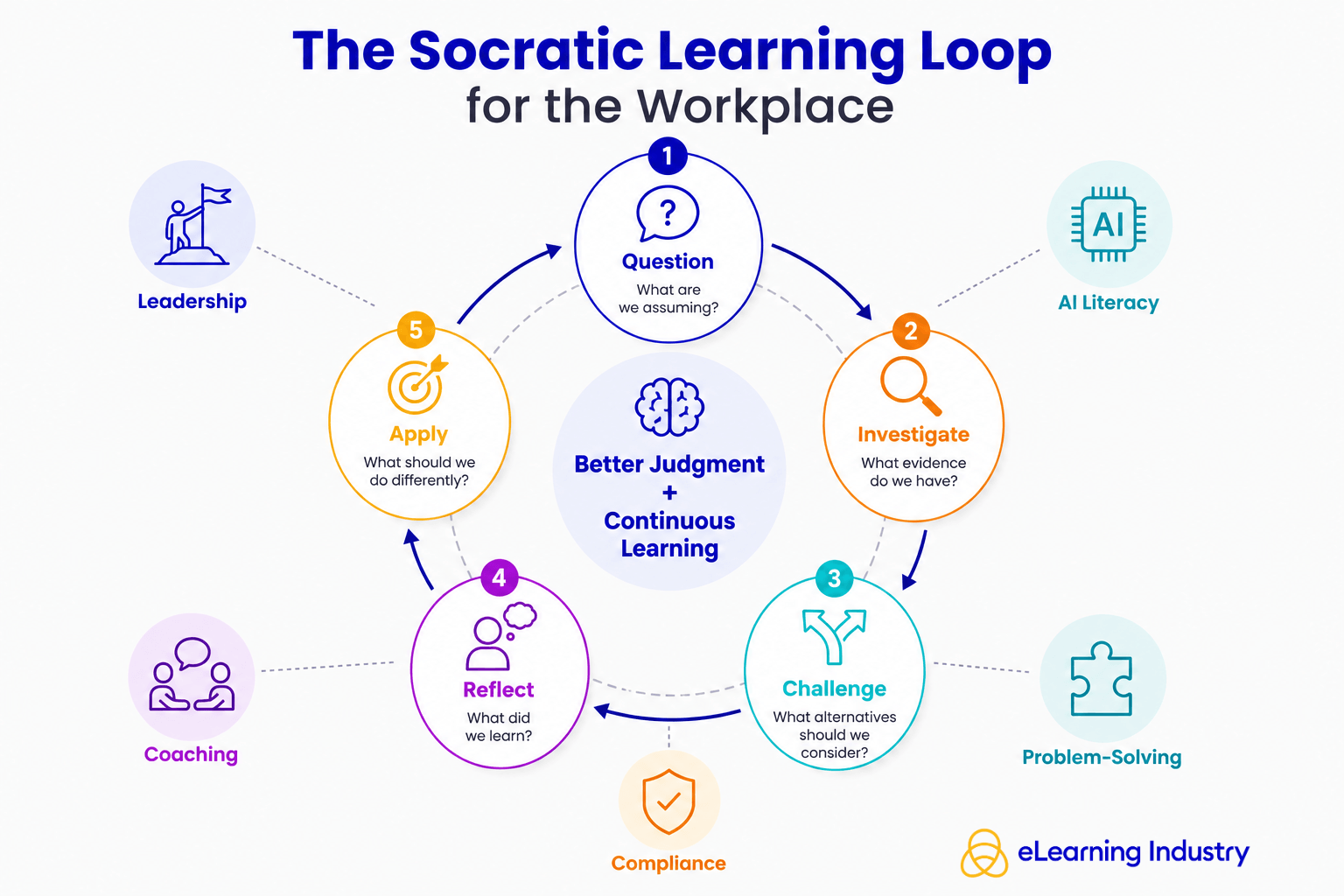
1. Start With An Open Question
Socratic questioning usually starts with a question that needs more than a simple yes or no answer. For example, in leadership training, a facilitator might ask, “What makes this the best course of action?” The aim is to get people to explain and explore their ideas, not just remember facts.
2. Probe Assumptions
Next, the facilitator looks at the assumptions behind the learner’s answer. Questions like “What are we assuming here?” or “Could that assumption be wrong?” help bring hidden beliefs to light. This step helps learners build stronger critical-thinking skills.
3. Examine Evidence
The conversation then moves from opinions to evidence. Learners might hear questions like, “What information supports that conclusion?” or “Is there evidence that contradicts it?” This part of the Socratic method helps people make decisions based on evidence and tells the difference between guesses and well-supported ideas.
4. Consider Alternatives
Effective Socratic reasoning also asks learners to look at different points of view. A facilitator might ask, “What other explanation is possible?” or “How might another stakeholder see this situation?” In the workplace, this is especially useful for leadership, solving problems, and training with real-life scenarios.
5. Reflect
Finally, learners think again about their first answer. What has changed? Which assumptions are still true? What would they do differently now? This reflection is what makes the process more than just a discussion. Rather than telling people what to think, the Socratic Method gives them a clear way to look at how they think. Learning and development teams can use this skill in many situations, not just one lesson.
What Is The Socratic Method Of Teaching?
The Socratic Method of teaching is a learner-centered approach in which educators use questions and discussion to guide learning, rather than simply presenting information. Rather than telling students what to think, the facilitator helps them look at their assumptions, explain their reasoning, consider evidence, and see different viewpoints.
The Socratic teaching method comes from Socrates, who used dialogue and questions to find gaps or contradictions in people’s thinking. Today, in schools and workplaces, this method is less about finding one right answer and more about helping learners think critically about complex topics.
This difference makes the Socratic style especially useful in learning and development. For example, a facilitator might share a workplace scenario and ask, “What would you do?” Then they might ask, “What evidence supports your choice?” and “How might someone else see this differently?” Each question helps the learner think more deeply about the issue.
Traditional Teaching |
Socratic Teaching |
| Lecturer-centered | Learner-centered |
| Gives answers | Asks questions |
| Emphasizes memorization | Emphasizes reasoning |
| Learners are relatively passive | Learners actively participate |
| Often seeks one correct answer | Explores multiple perspectives |
Socratic Method Examples In Learning And Development
The Socratic Method can shift workplace learning from just giving answers to helping employees question assumptions, look at evidence, and make better decisions. For L&D teams, this approach is especially helpful when the goal is to build judgment and problem-solving skills, not just pass on information. Here are four examples of the Socratic Method in action.
1. Leadership Development And Manager Coaching
Imagine a manager coaching an employee who is having trouble deciding which projects to prioritize. Rather than telling them, “Focus on the project with the closest deadline,” the manager could ask, “Which project creates the greatest business impact?” and then, “What could happen if you deprioritize the others?”
This kind of Socratic discussion helps employees think through trade-offs and build their own way of making decisions. Over time, it shifts coaching from giving answers to helping people become independent thinkers.
2. Sales Enablement And Objection Handling
Using the Socratic Method can make sales training more effective. For example, if a prospect says a solution costs too much, a trainer could ask the salesperson, “What might be behind that objection?” and “What information would help you know if price is really the issue?”
This type of Socratic reasoning trains salespeople to look into objections rather than respond right away.
3. Compliance Training And Ethical Decisions
Compliance scenarios in compliance training are another good example of using the Socratic Method. Instead of telling employees if a fictional situation breaks policy, trainers can ask: “Who could be affected by this decision?” “What assumptions are you making?”, and “Would your judgment change if the circumstances were different?”
This way, learners get to apply principles to unclear situations instead of just memorizing rules.
4. AI Literacy And Critical Thinking
Finally, the Socratic approach is also useful for teaching AI literacy. For example, instead of asking, “What is prompt engineering?”, an L&D professional might ask, “What assumptions are we making about AI accuracy?”
This kind of question helps people think about bias, mistakes, source quality, human oversight, and using AI responsibly. In this way, the Socratic Method teaches employees to think critically about AI-generated answers instead of just accepting them.
Why The Socratic Method Works: What Learning Science Says
The Socratic Method helps learners become active participants instead of just receiving information. Rather than being told what to know, they use Socratic reasoning to recall knowledge, explain their thoughts, question assumptions, and link new ideas to what they already know.
Learning science shows why the Socratic Method is valuable. Active learning gets people more involved, and retrieval practice means learners generate answers instead of just reviewing them. Elaboration helps them explain why answers make sense and connect ideas to real situations. A good Socratic discussion brings all these elements together.
The Socratic Method of questioning also supports metacognition and reflection. When learners explain their reasoning, they notice what they know, where they are unsure, and which assumptions they might need to rethink. This fits with constructivist learning, where people build knowledge through experience, questions, and what they already know.
There is another key link for L&D teams: adult learning. Andragogy focuses on relevance, experience, autonomy, and solving real problems. The Socratic approach supports these ideas by encouraging professionals to tackle meaningful challenges instead of just memorizing set answers.
Benefits Of The Socratic Method In Corporate Learning
The Socratic Method can make corporate learning more effective by moving employees from just taking in information to actively questioning, interpreting, and using it. For L&D teams, this shift often leads to better performance when employees face situations without clear answers.
Stronger Critical Thinking
By using Socratic questioning, learners check their assumptions, look for evidence, and consider other viewpoints. This helps organizations build employees who can diagnose problems instead of just accepting the first solution they see.
Better Decision-Making
The Socratic Method encourages people to ask questions like, “What evidence supports this?” or “What might we be missing?” before taking action. This way of thinking is especially helpful for managers, new leaders, and teams working in complex or uncertain situations.
Improved Teamwork
A good Socratic discussion lets employees hear different viewpoints and explain their thinking. As a result, teams can challenge ideas in a positive way, find blind spots, and make better decisions together.
Boosted Engagement
Rather than just taking in information, employees use Socratic learning to link new ideas with what they already know and real work situations. This hands-on approach helps them use what they learn when similar problems come up at work.
Ownership Of Learning
When learners figure things out by asking questions instead of just getting answers, they take an active part in building their understanding.
Flexible Learning Culture
Employees get used to asking questions, checking their ideas, thinking about results, and changing their views. For companies dealing with AI, new skill needs, and constant change, this mindset makes learning a regular part of how the organization works.
Best Practices For Using The Socratic Method In Digital Learning
The Socratic Method can make digital learning more engaging, thoughtful, and challenging if it is built around meaningful questions instead of just adding more discussion prompts. For L&D teams, the aim should be to help employees analyze situations, question assumptions, and reach well-reasoned conclusions.
Meaningful Questions
Begin by creating questions that go beyond simple recall. For example, rather than asking, “What are the steps in our decision-making framework?” try, “Which step matters most in this situation, and what evidence supports your answer?” Good Socratic questions help learners move from understanding to deeper analysis, evaluation, and synthesis.
Digital Learning
This method can be used throughout digital learning. In virtual Instructor-Led Training, facilitators can ask follow-up questions to explore participants’ thinking. Discussion forums, social learning groups, and peer circles can also support Socratic discussions, especially when learners are encouraged to challenge each other’s assumptions in a positive way. Scenario-based learning can introduce workplace problems that do not have a single correct answer.
AI
AI offers even more possibilities. AI learning assistants and coaching platforms can use the Socratic approach by asking learners adaptive questions instead of giving answers right away. In the same way, LMS courses can add reflective prompts after simulations, assessments, or real-world tasks.
Structured Questions
Still, effective Socratic teaching needs structure. Questions should gradually deepen the conversation, such as: What do you think? What evidence supports your conclusion? What assumptions are you making? Could there be another explanation? What might change your decision?
Conclusion
The Socratic Method is more than just a way to teach. For today’s organizations, it can be a powerful tool to build critical thinking, adaptability, and ongoing learning. Rather than only sharing more information, L&D leaders can design experiences that help employees question assumptions, look at evidence, consider different viewpoints, and explain their thinking. This approach is especially important now that AI makes information easy to find, but good judgment is more valuable than ever. When organizations focus on thoughtful inquiry instead of passive learning, they help employees become better at learning, adapting, and making smart decisions.
