

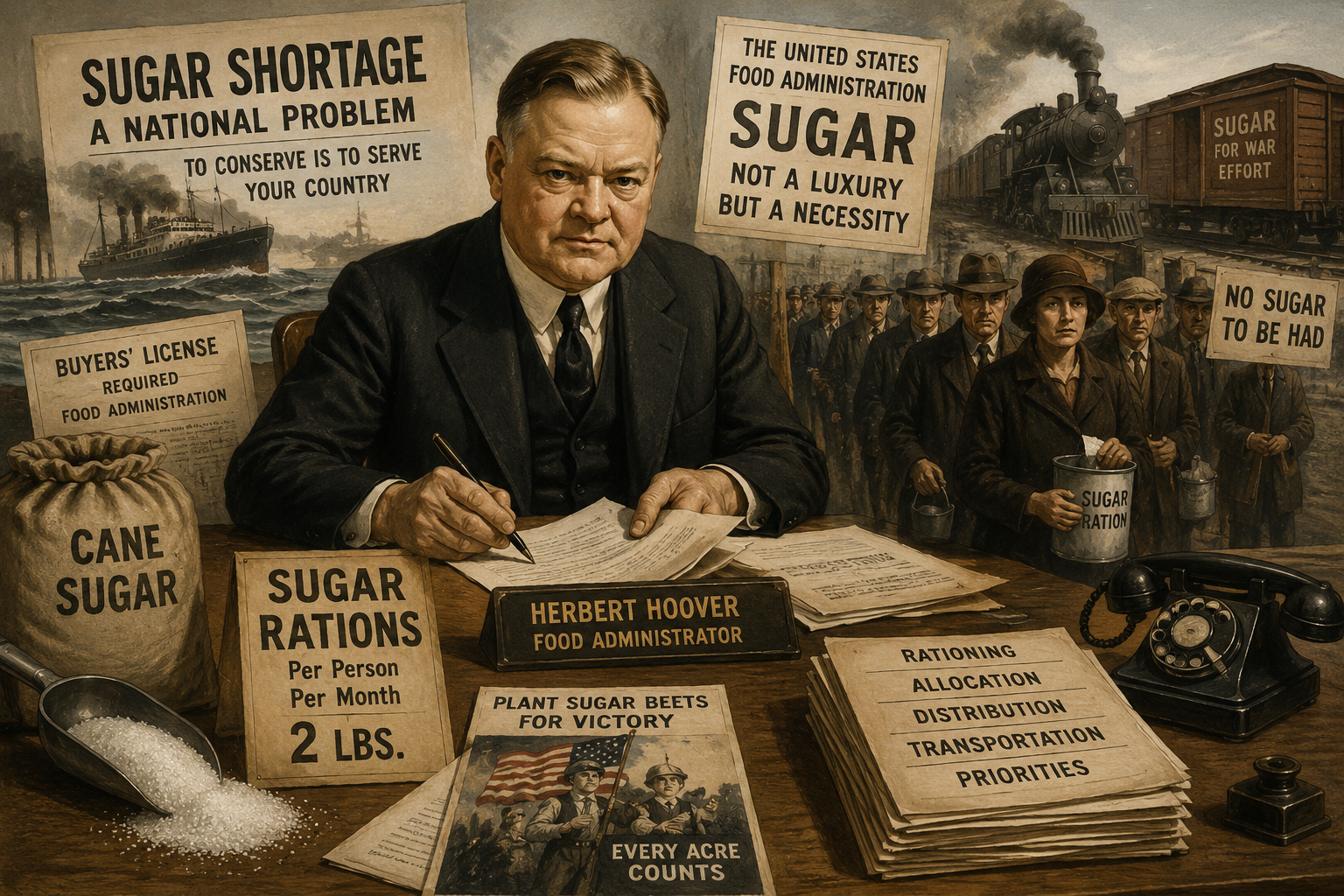
As German forces launched what would become their final major offensive on the Western Front in March 1918, President Woodrow Wilson’s Food Administrator, Herbert Hoover, identified what he called “one of the most vital problems confronting the nation”: a shortage of sugar. Demand had surged. Soldiers needed sugar in their rations, while producers and civilians relied on it to preserve and can food for the war effort. At the same time, supply had collapsed due to Europe’s engulfment in war, the disruption of Cuban cane fields during the 1917 Chambelona War, and German U-boats threatening Atlantic shipping.
What followed became one of the clearest examples in American history of price controls spiraling into creeping interventionism — and a textbook demonstration of why such schemes fail, even when administered by capable and patriotic officials pursuing a common wartime goal.
Hoover was commissioned as Food Administrator of the United States on August 10, 1917. A successful mining engineer and humanitarian, he seemed the ideal public servant for such an important task. He wasted little time, setting out to “assure to the American consumer a fair and just price” of sugar. Blaming rising prices on speculators rather than on underlying economic conditions, he ordered the suspension of trading in sugar futures on August 16 until “further notice.” And, by the end of the month, he had pressured American beet sugar producers “to limit the price of their product” with an expected savings of $30 million within the next year.
But replacing the flow of information and the structure of incentives supplied by the price system was far more difficult than Hoover, a graduate of Stanford University, imagined. Hoover’s attempts to adjust the system to unexpected changes in economic conditions were frustrated by the sugar industry’s attempt to divert the program to their own benefit. Hoover ultimately created a tripartite bureaucratic apparatus: the Sugar Division of the Food Administration, the International Sugar Committee, and the Sugar Distributing Committee. He set prices by signing agreements with producers and refiners under the threat of revocation of their license if they charged “excessive” prices.
But artificially low prices did exactly what economics textbooks predict: they encouraged consumption while discouraging production. Pre-war per-capita consumption stood at roughly 85 pounds annually, much of it in candy, soft drinks, condensed milk, canned goods, ice cream, and ketchup. Even at the beginning of the program, administrators acknowledged the predictable difficulties of holding prices low by urging consumers to limit consumption in the face of increased demand and decreased supply. By mid-October, a sugar famine was already causing sugar-using factories to shut down, and Hoover was forced to order cuts in candy production. The low price of sugar discouraged retailers from stocking it, especially given that it would not cover the increasing costs of transporting it from refineries.
Under Hoover’s informal price ceilings, demand stayed high while beet growers watched competing crops become more profitable. As economist Joshua Bernhardt (1919) noted, mounting production costs and unregulated prices for other foods made sugar beets progressively less attractive. In desperation, Hoover tried to enlist schoolchildren and boys’ and girls’ clubs in sugar production, offering families an allotment of sugar in exchange for planting an acre of sugar beets. Pledge cards, circulars, and monetary incentives were deployed with patriotic fervor.
Hoover also formed local commissions to investigate spiraling production costs, producing thousands of pages of testimony from planters, nearly all of whom recommended higher prices. Testimonies from over 100 planters in California alone filled nine thick volumes (Bernhardt 1919). Planters rejected a flat price because it gave an advantage to low-cost producers, especially foreigners. Cuba could deliver sugar for about 5.5 cents per pound, while domestic beet sugar planters required nine cents and Louisiana cane sugar planters needed ten. Hoover’s political solution to these competing special interest groups was to buy cheap foreign sugar, along with domestic output purchased at higher prices, and then resell it to American refiners at an average price.
Price controls on sugar gradually expanded the scope of intervention. Transportation priorities, refinery allocations, export quotas, and distribution zones were imposed. Louisiana sugar failed to reach New England refineries because regulated prices made it more profitable for Louisiana mills to sell lower-grade sugars directly to confectioners than to ship to Atlantic refiners. Centrally prioritizing sugar allocation without market prices led to accusations of misallocation. While households went without sugar for canning and baking, Hoover argued in Senate testimony that the candy industry employed 250,000 Americans and that further diversion of sugar would put them “entirely out of work.” Yet, as Blakey (1918) notes, the knowledge problem cuts the other way: candy might have deserved a higher priority “in view of the national campaign for prohibition,” given its potential as a substitute for alcohol.
The Food Administration proudly claimed it had saved consumers millions. Yet as Roy Blakey (1918) observed, gratitude evaporated when sugar simply sporadically disappeared from tables in regionalized shortages. Senator Henry Cabot Lodge’s mocking refrain captured the public mood: “What comfort is there in a low price when no sugar can be obtained?” Searches for “Sugar Famine” on Newspapers.com yield over 20,000 matches during the years 1917-1920, the years Hoover’s sugar programs were operative, yet only 284 in 1916 and 370 in 1920.
The dilemma Hoover faced was classic: he needed “capable and informed representatives” who inevitably had skin in the game, or “uninformed ones who were disinterested.” Neither produced efficiency. Instead, the plan spawned a clerical army, including state-level certificate systems classifying industrial sugar use into five categories (A through E), population-based allocations, and transportation zones, which required a system of prioritization as well, designed to match supply to “equitable” demand. As Frank Rutter (1902) earlier recognized about attempts to regulate the sugar industry, any regulation would pit the concentrated interest of producers against the dispersed costs faced by consumers, “Opposed to these demands [of the sugar industry] there is only the diffused interest of the consuming public, with no detailed knowledge concerning trade conditions or the inner workings of the tariff, and without organization….”
The sugar episode was not an isolated wartime curiosity. It was a microcosm of the broader logic of Ludwig von Mises’ interventionism. Regulate the price of one commodity and you must regulate its inputs, its substitutes, its transport, and its distribution. “From the few instances cited,” Blakey wrote, “as well as from one’s daily observation, it is easy to see that the regulation of the price of one thing involves the regulation of the prices of all constituent factors and competing commodities, which in the last analysis means the regulation of wages, as well as the regulation of the prices, the supply and the distribution of everything else.”
Today’s policymakers would do well to revisit this forgotten chapter before reaching for price controls, “equitable allocation” schemes, or industrial policy boards. Price ceilings create shortages, which in turn necessitate rationing. Rationing requires bureaucracy, which opens the door to lobbying and favoritism. The consumer — the very citizens Hoover was commissioned to serve — ultimately pays in empty shelves and higher overall costs.
Herbert Hoover was a brilliant engineer and a sincere public servant. He believed he could “stabilize” markets through expert administration. The sugar famine suggested otherwise. Markets are not problems to be solved by committees; they are discovery processes that coordinate millions of decisions without central direction. When governments try to override that process, even with the best of intentions and the full powers of wartime emergency, the result is not order but the very chaos they sought to prevent.
