

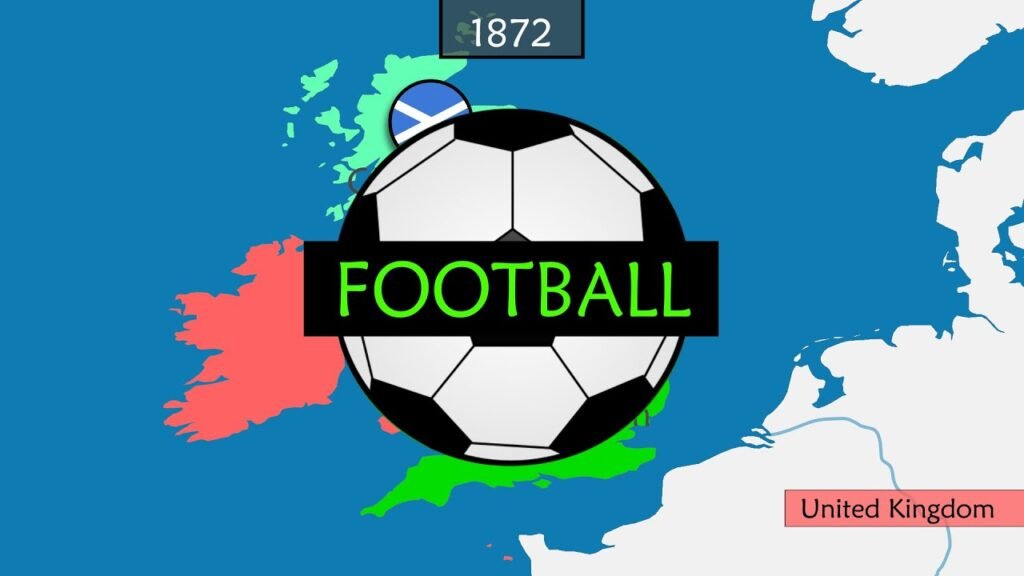
Every four years, humanity undergoes a great increase in its number of soccer fans — or rather, football fans, depending on what part of the world we’re talking about. That’s not to imply that the world otherwise suffers from a dearth of enthusiasts of that particular sport. Nor is football an obscure secondary term: the language of most every country obsessed with the thing itself has localized that name for it, resulting in a variety of words from fútbol to futbol to futebol to Fußball. There remains the matter of calcio, but then, Italians have always done things their own way. So do Americans, as this year’s World Cup has emphasized, but you’ll find that soccer actually turns out not to have originated as yet another awkward custom exclusive to the United States.
In fact, it derives from a few letters of the full British name of the game, “association football.” Commonly heard in the U.K. up until the nineteen-seventies, soccer eventually came in handy on the other side of the pond to differentiate it from what most of the world calls “American football.”
As explained in about 20 minutes in the Geo History video at the top of the post, the history of soccer, football, fútbol, or whatever you may call it is full of facts that will surely surprise those of who only pay it any attention when the World Cup comes around — and may occasionally surprise the die-hards who live and breathe the game even during the off years. For a much deeper (and more humorous) dive into a narrower slice of the past, we also have this two-hour history of the World Cup from football YouTuber Vizeh.
If you want to avoid a name specific to any one national language, you can always refer to “the beautiful game,” but even if that adjective applies to the action on the field, at least on a good day, it sits less easily with the politicking, backbiting, and not-always-above-board dealmaking characteristic of its business and administration at a global scale. The whole enterprise has come to represent all the glories and ugliness of modernity, reduced to a rigidly standardized battlefield on which increasingly many nations of the world aspire to achieve first presence, then domination. For example, South Korea, where I live, has made its seriousness on the pitch sufficiently known over four straight decades of World Cup participation that you might want to learn the Korean word chukgu — at least if the coming match with South Africa goes its way.
Related content:
Restored Footage from the First World Cup: Uruguay, 1930
Pelé’s Great World Cup Goals (RIP)
The Monty Python Philosophy Soccer Match: The Ancient Greeks Versus the Germans
Why Jorge Luis Borges Hated Soccer: “Soccer is Popular Because Stupidity is Popular”
Based in Seoul, Colin Marshall writes and broadcasts on cities, language, and culture. He’s the author of the newsletter Books on Cities as well as the books 한국 요약 금지 (No Summarizing Korea) and Korean Newtro. Follow him on the social network formerly known as Twitter at @colinmarshall.
