

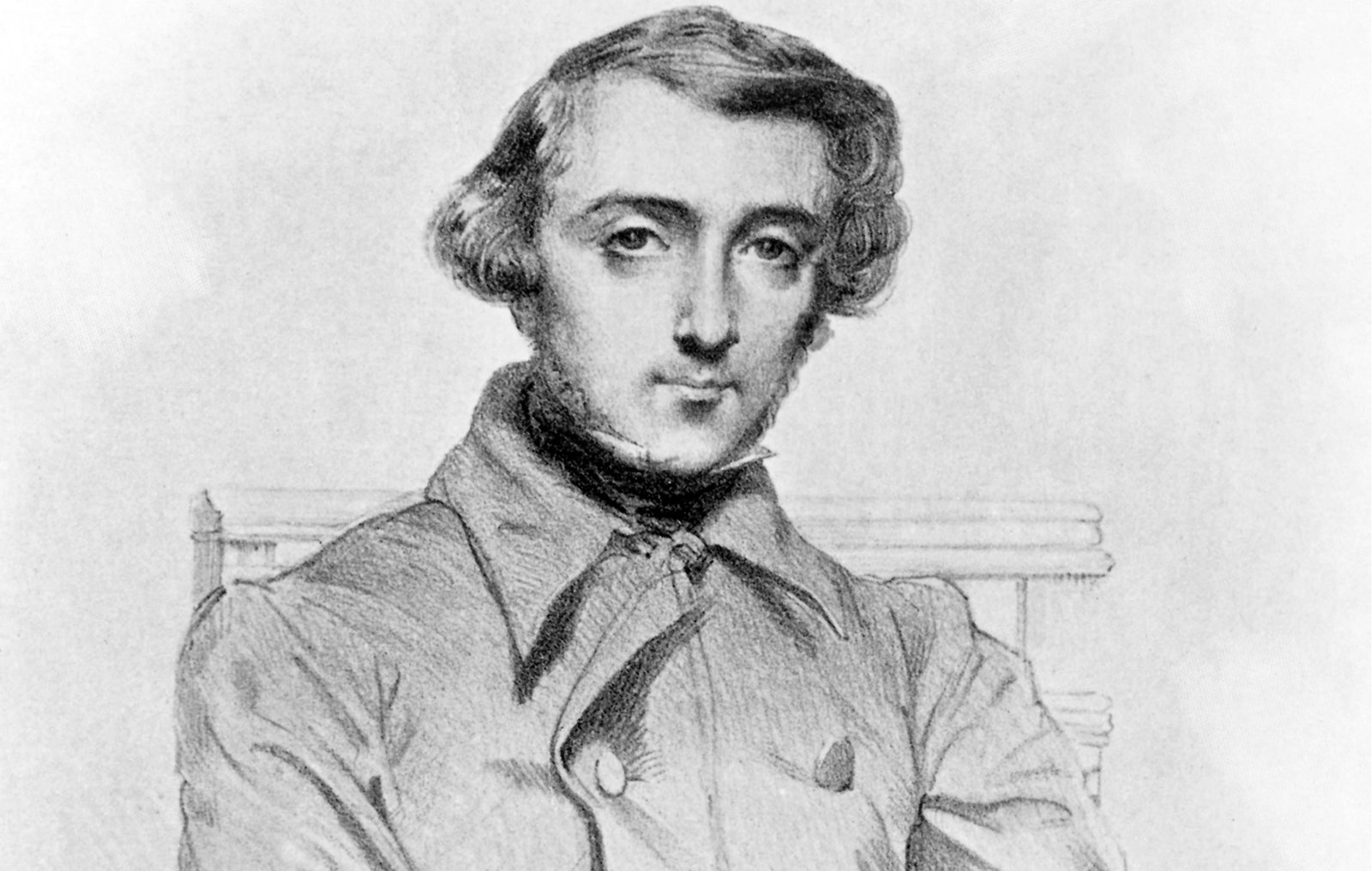
Alexis de Tocqueville was born on July 29, 1805. Two hundred and twenty-one years later, he has become a man whom every political tribe seeks to claim as its own. The most ardent suitors at the moment are the post-liberals. Patrick Deneen and the national conservatives have made Tocqueville something close to a patron saint, finding in his portrait of democratic America an early glimpse of liberalism’s fatal contradiction. Liberal societies, they argue, dissolve the moral and communal supports on which they depend, until nothing is left but isolated individuals standing alone before an enormous state. The remedy, they say, is to recover virtue, religion, and community, and to enlist a government willing to form its citizens toward the common good.
The first half of this story is hard to argue with. Tocqueville indeed believed that a free society draws on reserves of virtue it does not itself create. And he believed that a people interested in nothing beyond its own comfort would eventually lose the capacity to govern itself. He sometimes put the point more strongly still. “Despotism may govern without faith,” he wrote, “but liberty cannot.”
But the post-liberals have Tocqueville exactly backwards on the question that actually divides us, which is not whether free societies need virtue but where a free society is supposed to get it.
A careful reading of Tocqueville reveals that the cure he prescribed is very nearly the opposite of the one they are selling.
What Tocqueville Granted
Tocqueville thought that religion was indispensable to American freedom. One of its most important roles, he believed, was to serve as a public institution that gave democratic citizens fixed points in a world of flux. Tocqueville believed that the mores of a people — their habits, beliefs, and settled ways of living — mattered more to the survival of free government than its written laws.
“There is no country in the world,” he wrote, “in which political institutions can prove a substitute for common sense and public morality.”
Notice, though, that there are two different claims tangled together here. One is that a free people need virtue. This is the sound core of the post-liberal worry. A liberalism that pictures the free individual as requiring no formation, no restraint, and no inherited traditions is living on borrowed capital, and eventually the loan comes due.
The other claim is that freedom requires not merely virtue but religious faith. This claim is far more contestable, especially in our secular age. Nevertheless, we can grant it without handing the argument to the post-liberals. That’s because the real debate is not about ends but about means.
In a free society, what is it that actually cultivates virtue and sustains faith? It turns out that Tocqueville had an answer to this question. But it is far from anything on the post-liberal agenda.
Where Virtue Comes From
In America, Tocqueville found a wide variety of institutions aimed at improving the character of the people. Crucially, however, the vast majority of these institutions belonged to society rather than the state. The thing that struck Tocqueville most forcibly was the sheer density of voluntary association.
“Wherever at the head of some new undertaking you see the government in France, or a man of rank in England,” he wrote, “in the United States you will be sure to find an association.”
Americans banded together to build schools, churches, hospitals, and a thousand other things a Frenchman would have waited for the state to provide. These associations were a kind of practical school where people developed customs of cooperation, responsibility, and self-command. Virtue, for the American, grows out of habit, and habit out of free action repeated until it becomes second nature.
The same was true of self-government. Tocqueville called the New England township the place where Americans learned to be free.
“Town-meetings are to liberty what primary schools are to science,” he wrote; “they bring it within the people’s reach, they teach men how to use and how to enjoy it.”
The citizen who managed the affairs of his own town acquired the habits a free people cannot do without, and acquired them in the only way such habits can be acquired: by exercise.
And then there is religion, where his argument is sharpest and least convenient for the people now quoting him. American religion was powerful, Tocqueville thought, precisely because it kept its distance from political power.
“Religion in America takes no direct part in the government of society,” he wrote, “but it must nevertheless be regarded as the foremost of the political institutions of that country.”
He had seen what happened in Europe when churches climbed into bed with regimes, and he stated the lesson clearly: “The Church cannot share the temporal power of the State without being the object of a portion of that animosity which the latter excites.”
Tying a faith to the state only weakens it, binding its fortunes to a government that will someday fall and to all the resentments that government gathers on its way down.
The pattern here is clear. Every one of these institutions is local, participatory, and independent of central power. Each does its work from below, through free people acting for themselves. For Tocqueville, neither virtue nor faith is the kind of thing that can be handed down from above.
The Cure That Is the Disease
Tocqueville would have been alarmed, then, by the post-liberal agenda, or at least by its most ambitious version. A post-liberal who wanted only to defend the family, the church, and the school against the forces dissolving them would find Tocqueville a friend, not a critic. The alarm comes with the further step of enlisting the central state in the work of moral formation.
Using the power of the state to make citizens good would, on his account, only deepen the very isolation and passivity of democracy that it promises to heal.
His most famous prophecy was of a new kind of despotism, gentler than the old and thus much harder to resist. He imagined “an immense and tutelary power” rising over a nation of busy private individuals and taking the whole business of living off their hands. The power would be “absolute, minute, regular, provident, and mild.” It would labor willingly for their happiness, but would insist on being “the sole agent and the only arbiter of that happiness,” and would keep them, he said, in “perpetual childhood.”
Tocqueville’s target was a state that frees its people from the burden of an adult responsible life, one that takes the trouble of living off their hands and leaves them little to do but enjoy themselves. This comforting paternalism is, of course, not what the post-liberals are after. But in making the state the arbiter of virtue, they produce the same infantilizing effect in the domain that matters most. The post-liberal state relieves its citizens of the hardest and most personal labor there is: the labor of working out for themselves how to live.
That labor is precisely the mechanism through which character develops. Virtue is the fruit of habit, and the habits a free people most need ripen only where they are practiced. Law can restrain vice and shore up the institutions in which such practices happen. What it cannot do is practice for us. A government that commands its citizens into goodness gets the outward act, but the active virtue Tocqueville admired has to be grown, and it grows only where people govern themselves.
To be clear, this is not an argument against coercion as such. Tocqueville was no libertarian, and the townships he praised as schools of virtue were, after all, institutions of coercive government. But the authority of the townships was local, plural, and answerable. It was an authority that citizens could influence through voice and, if necessary, escape through exit.
What Tocqueville feared was not government but administrative centralization — the drawing of every local and private concern into the central state. Let a centralized power “penetrate into the privacy of individual interests,” he wrote, and “freedom would soon be banished.”
The post-liberal virtue-state is that penetration carried to the soul: the formation of souls lodged in the central state, the one task he thought had to stay dispersed, handed to the institution he trusted least to hold it.
In the end, Tocqueville cared less about who held power than about how much of it had pooled in one place.
“There is,” he wrote, “and I cannot repeat it too often, there is in this matter for profound reflection for those who look on freedom as a holy thing, and who hate not only the despot, but despotism.”
When he felt the hand of power lie heavy on him, he said, he cared little to know whose hand it was, and was no readier to bow because it was “held out to me by the arms of a million of men.” He might have added that it makes little difference whether such a power reaches for our property or for our souls.
Classical liberals have always feared concentrated power in the first of those domains, and met it with competition and dispersion rather than gentler masters. The post-liberal virtue-state asks us to make an exception in the second. But a government strong enough to make us virtuous is a government strong enough to make us anything it likes. That alone is reason to keep the making of virtue where Tocqueville found it: in the hands of free people, governing and improving themselves.
