

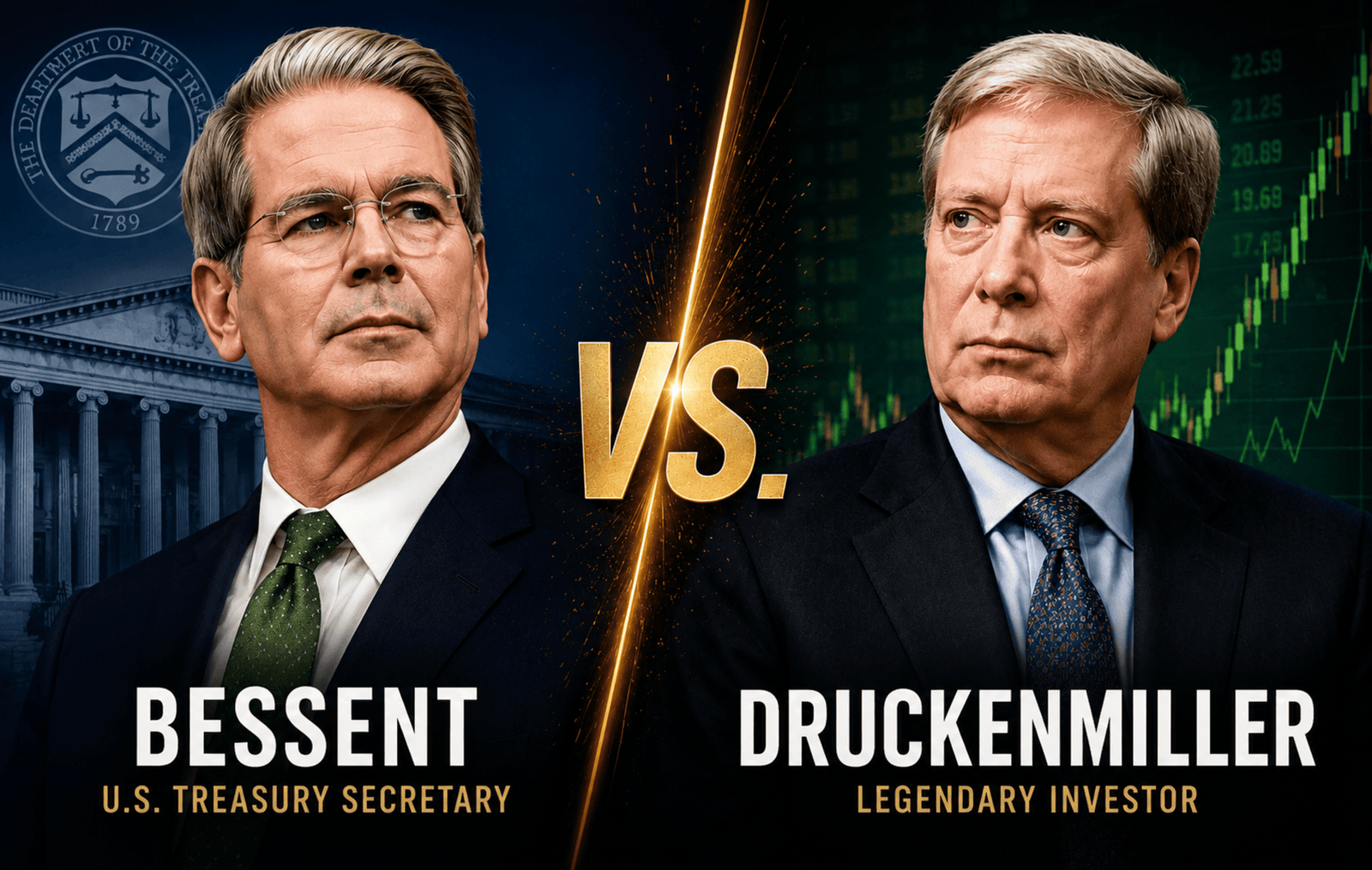
The dispute between Treasury Secretary Scott Bessent and Stanley Druckenmiller is more important than a technical disagreement over Treasury buybacks. It is a disagreement about what financial markets are for.
In one corner are the bond vigilantes: investors whose buying and selling impose a market price on fiscal profligacy, inflation risk, and deteriorating credibility. In the other are the bond bureaucrats: policymakers who increasingly regard adverse market prices as problems to be managed rather than information to be absorbed. Bessent increasingly appears to occupy the latter camp. Druckenmiller’s position is considerably more market-oriented: rising long-term yields are information. They reflect the collective assessment of millions of global investors confronting inflation, fiscal policy, debt issuance, growth expectations, and political risk. Suppressing that signal does not eliminate the underlying problem. It merely interferes with the price mechanism communicating it.
The philosophical divide is increasingly clear: Druckenmiller sees markets as institutions through which participants express views and discover prices, while Bessent appears to regard the Treasury market, perhaps because it trades the government’s own securities, as another avenue through which government policy may legitimately be conducted.
The immediate controversy concerns Treasury’s decision to double the maximum size of long-duration bond buybacks from $2 billion to $4 billion after the 30-year yield reached its highest level in nearly two decades. Bessent has portrayed the intervention partly as a response to yields that he believes are inconsistent with economic fundamentals and has emphasized that Treasury has additional tools available. Druckenmiller sees something much more troubling. There was no failed auction, seizure in dealer balance sheets, or disorderly liquidation comparable with March 2020. Markets were functioning. Investors simply demanded higher yields. In Druckenmiller’s formulation, this was not liquidity management but price management.
But even the distinction between “functioning” and “dysfunctional” markets should be treated cautiously. Governments and central banks have spent decades expanding the circumstances under which extraordinary volatility, widening spreads, falling asset prices, or rapidly rising yields are characterized as market failures requiring official action. Yet violent price movements are not necessarily evidence that markets have ceased functioning. They may instead be markets functioning particularly efficiently, rapidly incorporating information that policymakers, issuers, or leveraged investors would rather not confront. Once officials assume the authority to decide which prices constitute legitimate price discovery and which require correction, markets cease to be entirely markets. Prices become partly political decisions.
That is the deeper problem with Bessent’s approach. If Treasury regards some yields as unacceptable, investors inevitably begin trying to determine where the government’s pain threshold lies. The bond bureaucrats may therefore wind up summoning the very bond vigilantes they hope to suppress. Every implied ceiling becomes something the market can test, and every intervention provides additional information about how much political discomfort a particular price is causing.
Bessent, of all people, should appreciate the danger. In 1992, he worked alongside Druckenmiller and George Soros when their fund attacked an unsustainable British exchange rate policy. Britain attempted to defend sterling’s position in the European Exchange Rate Mechanism despite economic fundamentals increasingly inconsistent with that price. The government effectively drew a line in the sand. Markets attacked it. On Black Wednesday, September 16, 1992, Britain capitulated and withdrew from the ERM; Soros’s fund reportedly made roughly $1 billion. Bessent himself played a role in analyzing the vulnerability that made the trade possible.
There is an uncomfortable lesson here. Announcing, explicitly or implicitly, that Washington intends to hunt short sellers or defend particular Treasury yields can produce precisely the behavior it is supposed to discourage. Government efforts to establish preferred financial prices create targets. If underlying economic conditions ultimately support the speculators rather than the government, officials must devote ever-greater resources to defending an increasingly artificial price or eventually retreat. As Druckenmiller put it, governments fighting fundamentals eventually lose; the question is how much they expend before admitting it. The irony is difficult to miss: a man who once helped exploit a government’s attempt to impose an artificial price on a financial market now risks helping Washington establish one of its own.
More fundamentally, blaming short sellers is a pathetic substitute for confronting why investors might be selling Treasuries in the first place. The United States has accumulated record nominal federal debt, continues running enormous annual deficits, and must continually place extraordinary quantities of new securities into global markets. The fiscal 2026 deficit had already reached roughly $1.8 trillion through its first ten months. Against issuance on that scale, manipulating the maturity structure or adding several billion dollars of long-bond buybacks is not fiscal reform. It is an attempt to manipulate the market response to the absence of fiscal reform.
That risks transforming the dollar and Treasury market into instruments of a kind of financial industrial policy, a policy trend being actively pursued to some extent or other. Instead of asking what economic and institutional conditions would make the United States the world’s most attractive destination for capital, policymakers begin asking how Treasury can engineer the prices, yields, maturity structure, exchange rates, and investor behavior Washington prefers. The inversion is profound. Markets are no longer permitted to discipline policy; policy is increasingly deployed to discipline markets.
Historically, America’s financial advantages required far less engineering. Dollar dominance and deep Treasury demand ultimately rested on an enormously productive economy, constitutionally protected property rights, deep and liquid capital markets, comparatively predictable institutions, and a government that, however imperfectly, was once substantially more reluctant to intervene in private economic decisions. Those characteristics made investors want dollars and Treasuries. The strength of the system was precisely that Washington did not have to compel, cajole, subsidize, threaten, or manipulate investors into wanting them.
That distinction matters far beyond the present controversy. A Treasury security should be attractive because investors trust the fiscal capacity and institutions of the country issuing it, not because officials stand ready to punish people who sell it or manipulate its yield when markets deliver an unwelcome verdict. Likewise, the dollar should dominate because the economy behind it is productive, property rights are secure, capital can move freely, contracts are respected, and political interference with markets is limited. Once policymakers begin treating demand for dollars and Treasuries as something that must itself be manufactured, they are treating symptoms while progressively weakening the institutional foundations that created that demand.
Druckenmiller’s prescription is therefore both simpler and more radical: let the bond market speak. The bond vigilantes are not the disease. They are participants in a price-discovery process conveying information that political institutions have powerful incentives to ignore. Rising yields impose a visible price on borrowing, inflation risk, fiscal deterioration, and declining confidence. If long-term yields are flashing a warning about deficits, debt, inflation, or institutional credibility, policymakers should not send in the bond bureaucrats to silence the alarm. They should remove the policies that set it off and allow markets to determine the price.
