

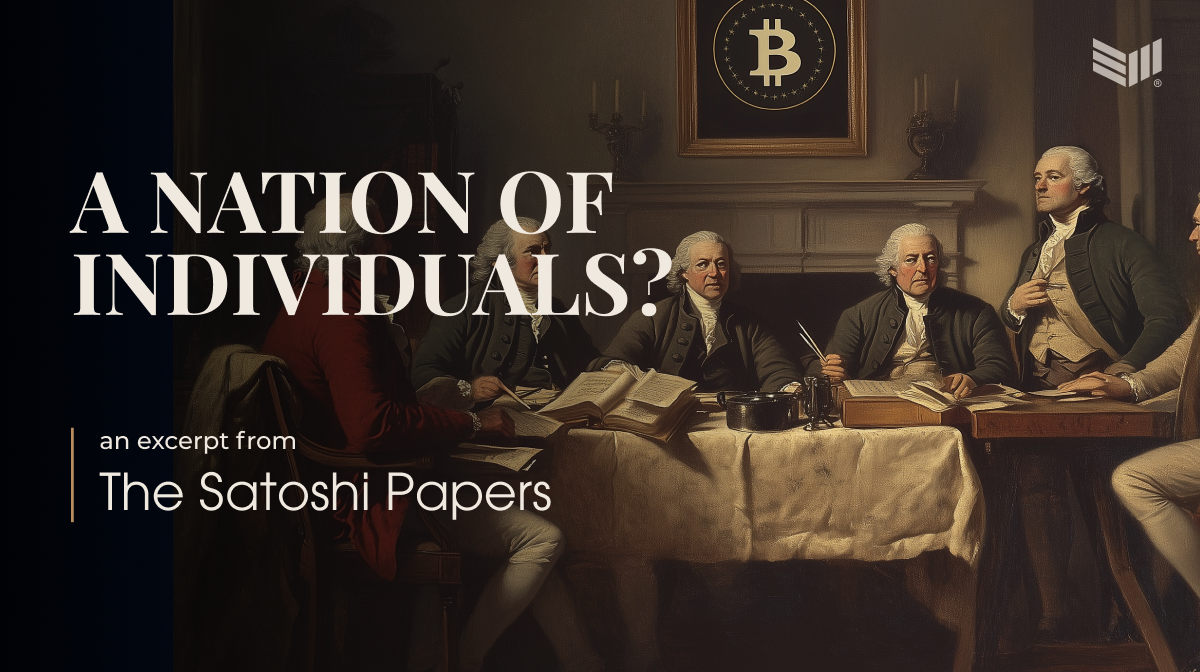
It is the prospect of the sovereign individual that seems to most trouble the nation-state today. This odd threat perception has been the outgrowth of a political genealogy that, in the generations since the American Revolution, has increasingly come to equate the state with society while constellating the individual as the enemy of both. This equation would have been profoundly disconcerting to the founders of the American republic, who called forth a new national project precisely to preclude the abuses of an entrenched and predatory overclass—an aristocracy—that deemed itself the rightful custodian, in perpetuity, of the fate and best interests of a people. The political question animating America’s founders was, therefore: How can a people self-govern without creating a hereditary class of governors? How can sufficient tension, if not conflict, remain between state and society that the rule of law is preserved without becoming a prison?
The founders devised an ingenious solution to this problem based on a revolutionary premise: That the rights of the individual, not those of the state, are fundamental for a free society.[1] In other words, people have rights; governments do not have rights. Governments have powers, but only those powers that are explicitly delegated to them by the people they represent. Put more precisely, the people have the totality of enumerated and unenumerated rights, while the state has only those powers explicitly enumerated. Any actions taken by agents of the state outside of their enumerated powers are a usurpation of the people’s rights. The people must safeguard these explicit limits and can take the enumerated powers of the state back at any time.
In other words, the American founders reversed the dominant political assumptions in their cultural world: It was not the people who had to prove that they were deserving of rights, that they were innocent before the law, or that they had cleared themselves of inherited obligations to the state. Rather, it was the state that bore the burden of proof: That it was worthy of trust; that it had the power to take a particular action; that any person or entity was guilty under the law; or that its war powers should be exercised with the people’s blood and treasure. Concretely, this meant that during the era of the US Constitutional Convention, when the debate between the Federalists and Anti-Federalists raged, a formative consensus emerged that the American state would have no power of its own, no money of its own, and no army of its own. The American Constitution stipulated that all of these things would be effectively on loan from the people, in whom true sovereignty resided.

But things have changed profoundly since the Constitution was ratified. Not only did America establish a standing army quickly thereafter; that army has been engaged in almost unceasing warfare—over a hundred conflicts both foreign and domestic, declared and undeclared—since that time. While most Americans today would likely be familiar with the large-scale conflicts in which their nation has participated—the Revolutionary War, the Civil War, and two world wars, for example—they probably would be surprised by the majority of the wars in which the United States has been involved. During the nineteenth century, those wars were fought mostly against American Indian tribes as part of the push to colonize the West, while during the twentieth century they were waged predominantly against socialist and communist movements around the world. Twenty-first-century conflicts, in turn, have been prosecuted under the banner of the war on terror and, more recently, the containment of adversary nations. Although the Constitution grants Congress the sole power to declare war, in practice, Congress has only declared war in a few major conflicts: The War of 1812, wars against Mexico and Spain, and wars against particular belligerents in the First and Second World Wars. The rest have been waged through some form of unilateral executive action, whether by presidential decree or by the determination of military officers.
Just as the US government now seems to have its own army, it seems to have its own money. In 1913, Congress passed the Sixteenth Amendment, giving it the right to levy permanent income taxes on the American people; estate taxes, gift taxes, capital gains taxes, and corporate taxes followed soon thereafter, while other permanent forms of taxation have been introduced in the decades since. This money has since come to be widely referred to as “government revenue” rather than “the people’s money.” But the federal government does not confine its spending to the people’s money; rather, it borrows extensively, supporting a ballooning administrative state whose agencies are so numerous and ill-defined that there is no authoritative reference for exactly how many there are. The Federal Register, the Online Federal Register, the US Government Manual, the Sourcebook of United States Executive Agencies, the Unified Agenda of Federal Regulatory and Deregulatory Actions, FOIA.gov, and USA.gov all list widely differing numbers and definitions of agencies.[2],[3] These agencies function as both rulemaking and rule-enforcing bodies, collapsing all three branches of government (legislative, executive, and judicial) into one in their own operations. This eliminates the checks and balances that the authors of the Constitution put in place to constrain the power of the state, subjecting the American people to a growing thicket of laws that they have had no part in making and have no electoral capacity to alter or repeal. As a result, an illusion is created that the government has its own power.
But while military conflict, taxation, and bureaucratic rule are all visible manifestations of the power of the state, they are underpinned by a platform that seems so normal and ubiquitous today that it largely goes unnoticed: A financial system in which central banks issue and manage the supply and price of unredeemable fiat currencies. These currencies serve as the base money that commercial banks, in turn, use as reserve assets to make loans. Commercial banks and central banks around the world form a network of financial intermediaries who share with each other information about every transaction that passes through their networks—which is also shared with the military, intelligence, and policing agencies of governments and intergovernmental organizations worldwide. Government’s gaze into the economic activity of every person and organization anywhere in the world is effectively unconstrained by any privacy laws or constitutional provisions regarding search and seizure of assets. This alliance between banking power and policing power took hold during the early twentieth century in what can be called the Banker Revolution—a revolution so successful that few are even aware it happened.
The Satoshi Papers is now available in the Bitcoin Magazine Store – order the paperback today or pre-order the limited Library edition, shipping mid-June 2025.
[1] Thomas Jefferson’s original draft of the Declaration of Independence read “We hold these truths to be sacred & undeniable; that all men are created equal & independent [emphasis added], that from that equal creation they derive rights inherent & inalienable, among which are the preservation of life, & liberty, & the pursuit of happiness.” See Thomas Jefferson, “Image 1 of Thomas Jefferson, June 1776, Rough Draft of the Declaration of Independence,” Library of Congress, https://www.loc.gov/resource/mtj1.001_0545_0548/?sp=1.
[2] Clyde Wayne Crews, “How Many Federal Agencies Exist?” Forbes, July 5, 2017, https://www.forbes.com/sites/waynecrews/2017/07/05/how-many-federal-agencies-exist-we-cant-drain-the-swamp-until
-we-know/?sh=535830391aa2.
[3] Molly Fischer, “What Is a Federal Agency?” Federal Agency Directory, Louisiana State University Libraries, March 28, 2011, https://web.archive.org/web/20130518150541/http://www.lib.lsu.edu/gov/fedagencydef.pdf.
