


What Is Backward Chaining?
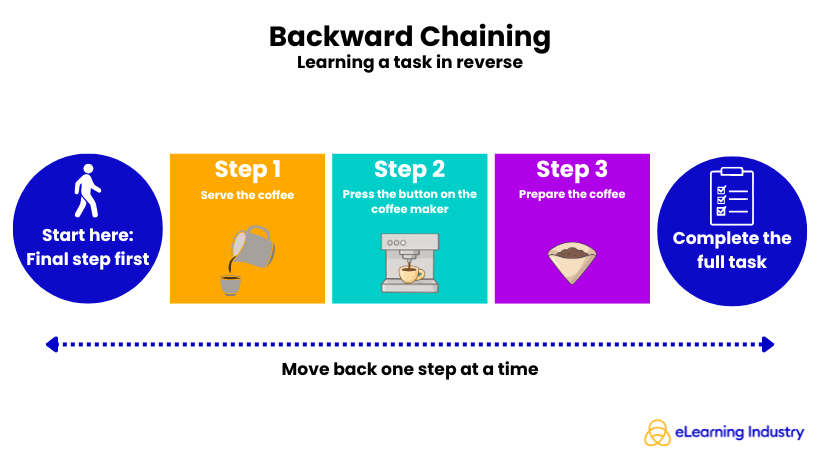
Backward chaining is a teaching method where learners are introduced to the last step of a task first, and earlier steps are added gradually until the full process is learned. Put simply, this method teaches complex skills by starting with the end goal. Instead of going through each step in order, the instructor does most of the task and lets the learner try the last step first. Gradually, earlier steps are added until the learner can do the whole task.
This method is different from the usual way of learning, where you go step by step from start to finish. In real life, the final result often matters most and helps people remember what they learned. That’s why backward chaining can work better for learning skills or procedures. The main idea is that people learn faster when they feel successful early on. When learners start with the end result, they quickly see how their actions matter, which boosts their motivation and helps them remember.
In Instructional Design, backward chaining is built on three key ideas:
- Task decomposition: Breaking a complex task into smaller, manageable steps.
- Reinforcement at completion stage: Rewarding success at the final step first.
- Building confidence: Mastering the last step first, then gradually increasing independence.
How Backward Chaining Works
Backward chaining involves using a step-by-step reinforcement. It starts with the last step of a task and then works backward to the earlier steps. Rather than teaching the whole process from start to finish, this method lets learners experience success at the end first, which helps build their confidence and memory. This approach makes complex skills easier to learn by breaking them into smaller, manageable steps. The process usually follows these steps:
- First, the task is broken down into clear, ordered steps. This is important in Instructional Design because it helps ensure that every action needed to complete the task is identified and arranged in a logical order.
- Next, the instructor completes all steps except the final one. This way, the learner can watch the whole process without feeling overwhelmed and can focus on just one step at a time.
- Then, the learner performs the last step first. This is the core of backward chaining. By finishing the task right away, the learner feels motivated and better understands the goal.
- Finally, the learner moves backward through the steps, taking on more responsibility each time. This continues until the learner can complete the entire task independently.
From a cognitive perspective, backward chaining is closely linked to behaviorism, which uses repetition and rewards to teach new skills. Each step the learner completes successfully serves as a reward, strengthening the connection between action and result. Backward chaining also aligns with cognitive reinforcement theory, which holds that memory and learning improve when people experience quick success that builds over time. Starting with the end result helps learners feel more certain and understand the steps better.
In summary, backward chaining helps people learn new skills by using clear steps, practice, and rewards. This structured approach makes it easier to remember what they learn and feel more confident.
Backward Chaining Examples
A backward chaining example helps make the concept much easier to understand because it shows how the method works in real situations. Let’s explore some examples of how the method is used in different settings.
Example 1: Instructional Design
Let’s see how backward chaining would be used in a corporate setting. In corporate Instructional Design, this often appears in onboarding or systems training. For example, a new employee learning to process customer refunds might start by completing the final confirmation step in a software system. Once they are comfortable with that, they learn how to review the request details just before confirming. Eventually, they work backward through the full process, including identifying eligibility and entering data. This approach builds confidence because the learner always reaches a successful outcome.
Example 2: Everyday Skill Learning
In everyday life, cooking is a clear backward chaining example. Someone learning to prepare a meal might begin by plating and serving a finished dish that someone else has mostly prepared. Next, they might learn how to cook the final component, like sautéing vegetables, before adding earlier steps such as chopping ingredients or organizing the recipe. Each time, they experience the satisfaction of completing the task, which helps motivation.
Another daily example is teaching a child to get ready for school. A parent might first have the child put on their shoes independently. Once that is consistent, the child learns to gather their backpack before putting on shoes, and eventually completes the entire routine from waking up to leaving the house.
Example 3: ABA Context (Backward Chaining ABA)
Backward chaining can also be seen in psychology, specifically in Applied Behavior Analysis (ABA). Backward chaining in ABA is commonly used for teaching self-care skills. For instance, when teaching handwashing, a learner might first perform the final step of drying hands. Then they add turning off the faucet, then rinsing, and so on, until they can complete the entire sequence independently. This structure supports success at every stage and reduces frustration as independence is built.
Backward Chaining Vs. Forward Chaining
When designing effective learning experiences, Instructional Designers often compare forward chaining and backward chaining because both methods teach complex skills step by step. The difference lies in the direction of learning and how learners build confidence in a task.
Forward chaining starts from the beginning of a process. Learners master the first step, then gradually move forward until they complete the entire task independently. This method works well when early steps are simple and foundational, and when understanding the full process from the start is important.
In contrast, backward chaining begins with the final step of the task. The instructor completes most of the process, and the learner performs the last action first. Over time, they learn earlier steps in reverse order until they can complete the full sequence. This is especially useful when immediate success and reinforcement are critical for motivation.
Feature |
Forward Chaining |
Backward Chaining |
Starting point |
First step | Final step |
Learning flow |
Step-by-step forward progression | Step-by-step backward progression |
Best for |
Structured, logical skill building | Confidence-building and complex procedures |
Reinforcement |
Delayed until the full process is learned | Immediate success at the end step |
Learner experience |
Gradual mastery | Quick sense of accomplishment |
When To Use Each Method
Use forward chaining when learners need to understand the full structure of a process early, such as in technical training or structured workflows. Use backward chaining when teaching hands-on or behavioral tasks where motivation and success reinforcement are essential, such as onboarding procedures or skill-based learning.
Backward Chaining In ABA Therapy
Backward chaining in ABA is an instructional method used in Applied Behavior Analysis where a complex skill is divided into smaller steps, and the learner starts by practicing the last step first. Instead of learning the whole sequence from start to finish, the therapist does most of the task and helps the learner complete just the final step. After the learner masters that, earlier steps are added one at a time.
This method is common in autism learning support because it helps people learn skills in a clear and manageable way. Many learners in ABA therapy do well with routines and predictable steps, and backward chaining offers both. By starting with the last step, learners quickly feel a sense of achievement, which boosts their motivation and involvement.
In backwards chaining in behavioral therapy, confidence plays a major role. When learners finish a task successfully, even if it is just the last step, they start to connect the activity with positive feedback. This helps lower anxiety and encourages independence over time. Rather than feeling stressed by the whole process, the learner can focus on one simple action at a time.
A main part of backward chaining in ABA is that the therapist guides the learning process. The therapist looks at the whole task, breaks it into simple steps, and chooses which step the learner will try on their own. As the learner gets better, the therapist gives less help, so the learner can eventually do the whole task by themselves.
This method is closely linked to reinforcement in psychology. Every time the learner completes the last step, they get immediate positive feedback, which helps them learn. Over time, this repeated encouragement builds confidence, makes learning less overwhelming, and helps skills stick for the long term.
Overall, backward chaining in ABA works well for teaching daily living skills, communication routines, and self-care tasks. It makes learning easier and more organized for people who need step-by-step support.
Application In Instructional Design
Backward chaining plays a critical role in modern Instructional Design because it focuses on how people actually build confidence in complex tasks.
Task-Based Learning Design
Instructional Designers use backward chaining to simplify procedural skills into clear, easy steps. In training modules, learners start by completing the last action in a process while the system or instructor handles the earlier steps. Gradually, more steps are added until the learner can perform the whole process on their own. This method works well for skill scaffolding, where support is slowly reduced as the learner’s skills improve.
LMS-Based Learning Paths
Backward chaining here uses microlearning or scenario-based tasks that focus on the final result first. Learners start by completing a simulated final product before learning the steps to achieve it. For example, in software training, learners might finish a simulated project before understanding how to create it. This approach strengthens learning, as each successful task builds understanding and confidence.
Complex Skill Training
Backward chaining is highly effective in areas such as software onboarding and compliance workflows. These environments often involve multi-step processes that can feel overwhelming if taught linearly. By reversing the sequence, learners immediately experience success, reducing cognitive load and improving engagement. In corporate training, this leads to faster time-to-competency and better performance consistency.
Corporate Training And L&D Use Cases
Backward chaining is widely used in corporate training because it fits naturally with how employees actually learn complex, task-based workflows. Instead of overwhelming learners with an entire process at once, backward chaining in corporate learning environments breaks training into manageable, goal-oriented steps that start from the end result and work backward.
Onboarding
New employees often need to learn multi-step systems such as CRM tools, HR platforms, or internal reporting systems. With backward chaining, learners first complete the final step of a task (for example, submitting a completed report), while the system or trainer handles the earlier steps. Over time, learners gradually take ownership of the full process. This builds confidence quickly because they immediately see successful task completion.
Compliance Training
Here, accuracy matters more than speed. Employees can focus first on the final compliance action, such as correctly logging a safety incident or completing a required form, before learning the supporting documentation steps. This reduces mistakes and strengthens procedural memory.
Operational Task Training
Backward chaining is used for roles that involve structured sequences, such as customer service workflows, IT troubleshooting, or manufacturing procedures. By starting with the outcome, learners better understand what “good performance” looks like before being asked to replicate the full process independently.
Implementation In eLearning
In eLearning design, backward chaining is most effective when it is applied as a clear plan in digital learning environments. Instructional Designers, L&D professionals, and EdTech teams aim to not just explain concepts but also to organize learning so that students can complete complex tasks step by step. This is why they start by focusing on the final outcome.
LMSs
In an LMS environment, the first step is to break down the task into clear, small steps. Backward chaining starts with the final step, so learners can see and complete the end goal right away. Then, the earlier steps are introduced in reverse order. This approach helps reinforce skills and build confidence. This step-by-step method works well for training that requires accuracy and practice.
Scenario-Based Learning
Scenario-based learning design plays a key role here. Instead of just reading or watching content, learners are put in realistic situations where they must take the final action first, such as submitting a report, closing a customer ticket, or completing a compliance task. As they progress, they unlock additional steps that guide them through the entire process. This method, called backward chaining, is especially effective for corporate onboarding and training.
Interactive Simulations
Learners can practice the last step in a controlled environment, receive feedback, and then gradually work backward through earlier actions. This improves retention and reduces cognitive overload, especially in complex workflows.
Adaptive Learning Through AI
Modern LMSs now use AI to create personalized learning paths. The AI analyzes each learner’s performance and adjusts the learning steps accordingly. It can provide extra help when needed or speed up progression for those who advance quickly. In backward chaining, this approach ensures that learners master each step before moving on to the next.
Conclusion
Backward chaining is widely used in Instructional Design because it simplifies complex tasks and improves skill retention. It’s also common in ABA, where it helps learners build confidence by achieving the final outcome early in the learning process. In corporate training, it supports onboarding, compliance, and procedural tasks by reducing cognitive overload and increasing completion rates. So, if you want to achieve better learner motivation and skill reinforcement, it’s a nice option to implement in your L&D strategy.
