

Author’s note: In my view BIP110 is both useless and harmful, and I do expect it to fail (see scenario 1). Despite this I tried to write this article as factually as I could, entertaining different possible scenarios, as I do hope it may provide some clarity on this soft fork attempt.
The OP_RETURN debate has escalated to the point where Bitcoin Knots implemented BIP110: a consensus protocol change that temporarily limits the size of OP_RETURNs and intends to reduce other types of data on Bitcoin’s blockchain as well.
However BIP110 does not have consensus: not everyone agrees there’s a problem that requires solving in the first place, nor that BIP110 solves it in any meaningful manner, while it restricts Bitcoin in potentially harmful ways. Most obviously, Bitcoin Core — still by far the most-used Bitcoin implementation — has not adopted BIP110, while only some 1-2% of hash power has been signaling support for it in recent weeks.
Nevertheless, BIP110-nodes like Bitcoin Knots will soon — starting from block 961,632, to be mined on or around August 8 — reject blocks that don’t signal support for the upgrade.
Here are the three main scenarios for how that could play out.
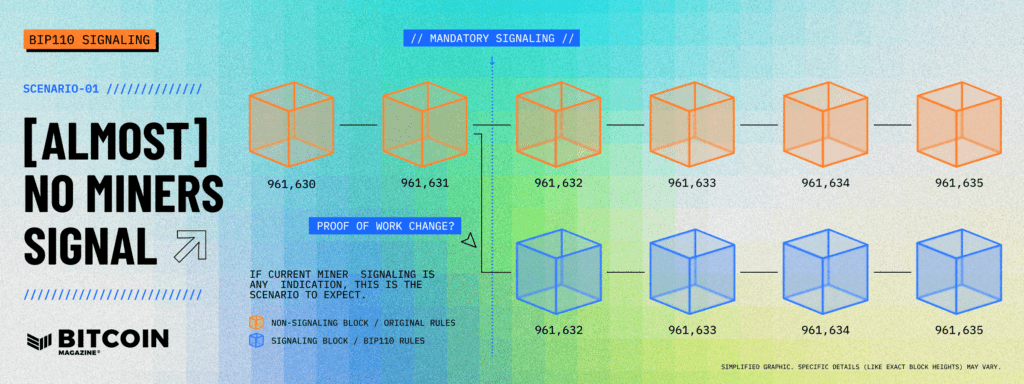
Scenario 1: (almost) no miners signal
If current miner signaling is any indication, this is the scenario to expect.
From the perspective of anyone running Bitcoin Core or other non-BIP110 enforcing nodes and wallets (the vast majority of the Bitcoin ecosystem) blocks will be mined as usual, and transactions will be processed like normal too. Anyone who’s not actively tracking these events on social media or elsewhere may not even be aware that anything unusual is going on, and in a practical sense for them there really won’t be; BIP110 does not affect them.
The same is not true for anyone running Bitcoin Knots or other BIP110-enforcing nodes, however. Since their software will reject non-signaling blocks, they basically wouldn’t see any new blocks at all (or perhaps a few per week), and incoming and outgoing transactions won’t confirm (or incredibly slow). In practical terms, these nodes would stall and become unusable.
If this happens, BIP110 proponents will have to decide between waiting to see if things improve for them (see scenario 3), giving up (switching back to non-BIP110 software), or deploying a next protocol change, like hard forking to a different proof-of-work mining algorithm.
Such a hard fork would possibly allow for mining with GPUs again, therefore letting more people mine new blocks to generate a blockchain with the BIP110 rules enforced. However this would also mean that BIP110/hard fork nodes permanently split off from the rest of the Bitcoin ecosystem to essentially create a new cryptocurrency. (More on this below)
Scenario 2: (almost) all miners signal
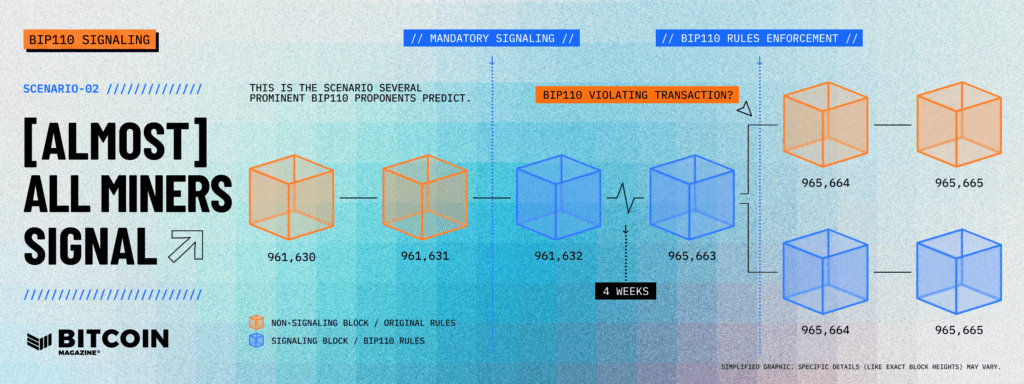
This is the scenario several prominent BIP110 proponents predict.
In this scenario, when the mandatory signaling window starts, all miners will suddenly signal for BIP110. Or at least, a majority of miners will signal AND reject any non-signaling blocks, so that all blocks that end up in the blockchain include a BIP110 signal.
If this happens, all Bitcoin nodes (Knots and Core alike) remain compatible, and the signals in the blocks indicate that miners plan to start enforcing the BIP110 rules another two weeks later. BIP110-violating transactions should by early September no longer end up in blocks.
In essence, this is the success scenario for BIP110; although only a small faction of developers, miners and users pushed for it, the upgrade goes into effect across the entire network.
…However even in this scenario there is an important caveat.
Blockchain signaling is a useful coordination mechanism for soft fork deployment, but it technically does not guarantee that the new rules will be enforced. Miners can signal support for the upgrade without actually using BIP110 software, which they for example could elect to do simply to ensure their blocks aren’t rejected by Bitcoin Knots nodes during the mandatory signaling window.
Bitcoin’s protocol rules are ultimately enforced by economic nodes however, and nothing currently indicates that most of these will enforce the BIP110 rules even if all blocks include a signal. So if BIP110-violating transactions are later accepted by most miners regardless, these economic nodes would accept blocks that include them, while BIP110 nodes would not. The blockchain would split between nodes that do and do not enforce BIP110 after all.
Scenario 3: a sizable minority of miners signal
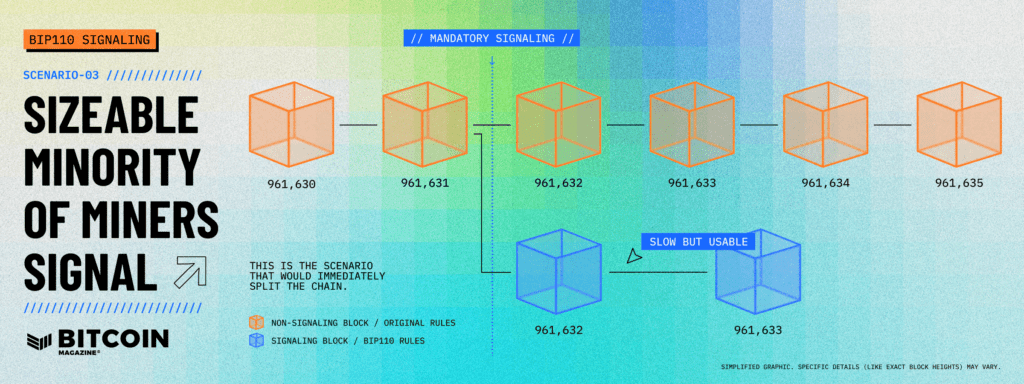
This is the scenario that would immediately split the chain.
Currently some two percent of miners signal support for BIP110, which is probably too little to be meaningful (see scenario 1). But let’s imagine this quickly increases tenfold or so. We also have to imagine that this sizable minority itself rejects any non-signaling blocks— else it would still be indistinguishable from scenario 1 where BIP110 nodes stall (since they require ALL blocks to include a signal).
If the sizable minority is both signaling and rejecting non-signaling blocks, they’d start to build their own minority blockchain with only signaling blocks in it. Blocks on this minority chain would confirm significantly slower than usual — maybe just one or two per hour — but BIP110 nodes remain reasonably usable. And after a few months the mining difficulty would adjust, so blocks are found (closer to) six times per hour again. Another couple of weeks later the BIP110 rules would go into effect.
Meanwhile, Bitcoin Core and other non-BIP110 enforcing nodes would still operate fairly normally as well. Their blocks will confirm a little bit slower for a while — maybe about four or five per hour — but after a couple weeks mining difficulty adjusts here too, to also bring this back to six per hour on average. The BIP110 rules would never go into effect on this blockchain.
As a result, a BIP110 blockchain and a blockchain with the original rules would then exist side by side as two different cryptocurrencies, indefinitely.
There is one notable caveat to this scenario as well, however. If the BIP110 chain were to overtake the original chain in length later on (due to miners moving to the BIP110 chain), all nodes — Core and Knots alike — would accept the BIP110 chain as the only chain. The original chain would in this case be discarded, or wiped out.
This one-sided wipe out risk is in fact why BIP110 proponents expect all miners to signal preemptively, preventing a split. Miners won’t want to mine on a blockchain that can later be discarded, they argue, as that would also mean losing all block rewards they earned on it.
In actuality, users and miners that want to prevent that the original chain can get wiped out could do so however: they can manually invalidate any block on the minority BIP110 chain while it still is the minority chain. This way their nodes would reject switching to it even if it becomes longer at any point in the future, making the split permanent also.
So what exactly happens if the chain permanently splits?
If and when the Bitcoin blockchain permanently splits, it essentially marks the creation of a new cryptocurrency, or forkcoin. Everyone who owns BTC at the time of the split automatically receives the equivalent amount of coins on the new blockchain, not unlike what happened with Bitcoin and Bitcoin Cash in 2017.
However in reality these things aren’t necessarily as straightforward, and if BIP110 does cause a chain split under any of the scenarios above there will likely be some complications.
For one, there’ll almost certainly be disagreement over which side of the chain represents “Bitcoin” (“BTC”), and which side is the new forkcoin. It seems likely however that the blockchain with the original rules will by most people be considered “Bitcoin”, whereas the blockchain with the BIP110 rules will be called something else; we’ll call it “BIP110 coin” for now.
Accessing the BIP110 coins then, will require BIP110-specific software like, indeed, Bitcoin Knots. The new coins won’t show up on Bitcoin Core nodes or most wallets.
However, BIP110 does not currently include replay protection. This means that transactions on one chain can be copied (“replayed”) on the other chain. Instead of just sending BTC, users could unknowingly also send the equivalent BIP110 coin to an identical address on the BIP110 chain— or vice versa.
It’s difficult to estimate at this point how much the forkcoins will be worth, or even if they will be worth anything at all. The lack of interest in buying BIP110 coins via fork future contracts does suggest there may not be much interest to buy them after a split either. But if you nevertheless want to be sure you’ll receive BIP110 coins if there are any, it’s probably best to self-custody your BTC (have access to your private keys), and don’t send any transactions until the dust settles and there is more clarity on how to proceed.
Aaron van Wirdum is the former Editor-in-Chief of Bitcoin Magazine and author of The Genesis Book: The Story of the People and Projects That Inspired Bitcoin. Follow him on Nostr.
