

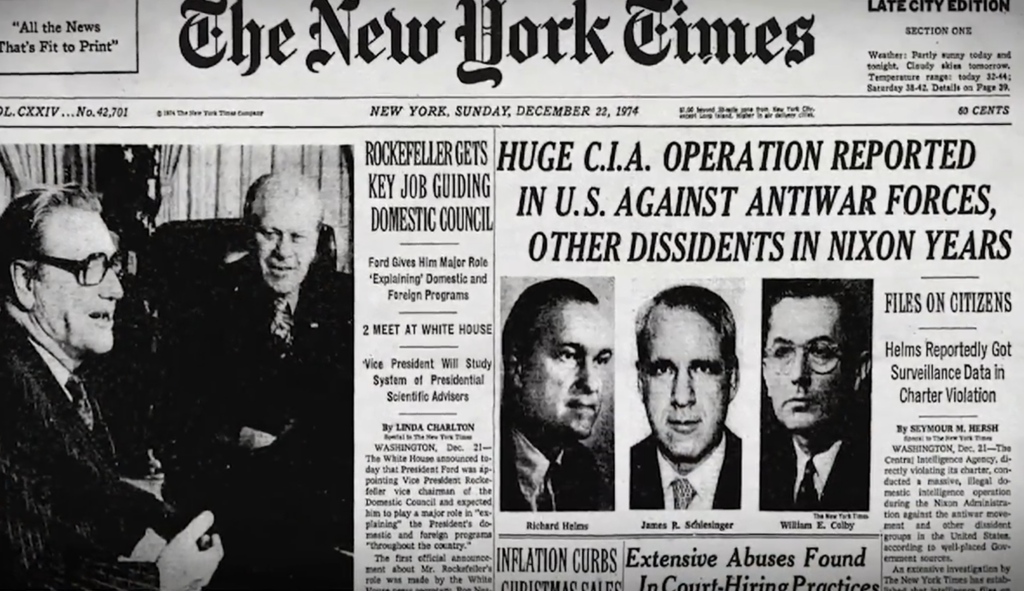
The public shock upon the release of the Final Report of the Select Committee to Study Governmental Operations and Intelligence Activities (The Church Committee Report) in April 1976 is now a quaint memory. Its damning findings on the violation of American citizens’ constitutional and natural rights dismayed historian Henry Steele Commager, who bemoaned, “It is this indifference to constitutional restraints that is perhaps the most threatening of all the evidence that emerges from the findings of the Church Committee.”
The specifics of the report revealed that the CIA, FBI, NSA, and even the IRS engaged in intelligence collection against US citizens from the 1940s through the early 1970s. These agencies engaged in now-infamous projects such as multiple assassination plans and attempts on the lives of Fidel Castro (Cuba), Rafael Trujillo (Dominican Republic), and Patrice Lumumba of the Democratic Republic of the Congo. These are aside from COINTELPRO, which targeted perceived leftist domestic threats, and Mockingbird, which entailed active CIA recruitment of journalists to propagandize the American public.

The report could have served to expose and roll back such activities. Instead, the surveillance state has grown both exponentially and inexorably advanced. How has our citizenry responded? Public reaction has been comparatively muted and sheepish. In contrast, DC has behaved ravenously.
Indeed, contemporary Americans are now languid, perhaps even expecting federal agencies to surveil, snoop, and in some cases terminate those they deem to be threats to so-called US interests. One of the committee’s key findings was that there was a need for a permanent congressional intelligence committee to keep an eye on the executive branch and its abuses of natural rights. It would be up to them to watch the watchers.
This sentiment justified the creation of the Foreign Intelligence Surveillance Act (FISA) in 1978. Americans were told to rest assured, this legislation would prevent such abuses in the future. Nothing could have been further from the truth.
Seven years after the 9/11 attacks, Section 702 was enacted as part of the FISA Amendments Act. According to Rachel Miller, this move “broadened the scope of FISA, allowing the government to conduct foreign intelligence surveillance outside the United States without an individualized application for each target. The FAA garnered bipartisan support, notably from then-Senator Obama in 2008 and more recently former FBI director Christopher Wray.”
That bipartisan support may have been a harbinger of the findings of the Privacy and Civil Liberties Oversight Board (itself a bipartisan committee executive agency). It would surprise no one to learn that it has concluded that “incidental” collection of US citizens’ data in pursuit of foreign targets shows “no signs of intentional abuse.”
Critics point out that in 2023 alone, over 57,000 of these so-called “backdoor searches” were conducted. As a result, the US District Court for the Eastern District of New York found that it is indeed a violation of the Fourth Amendment’s warrant requirement as a protection of US citizens’ rights.
Despite the fact that many of these abuses are well known to the American public, on April 29th, the House of Representatives voted 235 to 191 with 4 abstentions to renew the section along with the warrantless surveillance it permits. Unable to pass it before its expiration on April 30, the Senate inexplicably passed a 45-day extension, which was swiftly approved by the House by an even wider margin than the initial vote.* For the opposing minority of congressional members, some have called for a requirement that intelligence agents obtain probable cause warrants prior to querying the Section 702 data. Naturally, the intelligence community has pushed back, and the majority of Congress has fallen in line.
This complacency on the part of both the public and the political class and the brazen Constitutional gymnastics from various administrations leads Senator Mike Lee to lament, “the arguments go something like this: ‘Yes, there have been problems in the past. Yes, there have been abuses of FISA 702. But you need not worry because we now have procedures in place, administrative procedures that will fix the problem once and for all.’”
By ignoring past abuses and ongoing privacy concerns, surveillance by association is set to stand for the foreseeable future. The sum of the findings from the Church Committee, however, demonstrated a need to shackle the intelligence agencies that violated Americans’ rights, all in the name of national security in the three decades after the Second World War. The current Congress, and all those since the implementation of the FISA legislation have failed to uphold the spirit and the letter of the Fourth Amendment’s acknowledgement of the people’s right to be secure in their “persons, houses, papers, and effects” (which in this author’s view includes all digital effects) against unreasonable search and seizure. This isn’t a mere suggestion. It’s the law of the land.
Proponents of Section 702 are quick to deploy cost-benefit analysis. Seemingly without exception, the conclusion is reached that the alleged safety benefits always outweigh the costs of infringing on constitutionally-recognized human rights. However, a utilitarian worldview withers when scrutinized by the Constitution (not to mention the Declaration of Independence) itself, and its underlying assumptions about the sanctity of property and persons.
The way out of this congressional quagmire is to uphold personal and property rights as our nation’s highest values. Until that happens, we can count on the warrantless surveillance (voyeurism?) to continue. Even if it is “incidental.”
* In an intriguing twist, Senate Majority Leader John Thune said the bill was dead on arrival because there was a provision that would outlaw the Federal Reserve from establishing a CBDC (Central Bank Digital Currency). Apparently, Thune can tolerate warrantless surveillance, but protecting Americans from digital, programmable, currency is beyond the pale.
