


What Is Divergent Thinking?
Divergent thinking is becoming more important in workplaces where employees need to solve new problems, question assumptions, adapt quickly, and find new ways of doing things. However, many traditional learning experiences still do the opposite. This means that learners are often given a question and expected to find just one correct answer.
This approach is fine when there really is only one correct answer. But workplace challenges are often more complicated. For example, improving employee engagement, redesigning onboarding, solving a customer problem, or handling organizational change can all have many possible solutions.
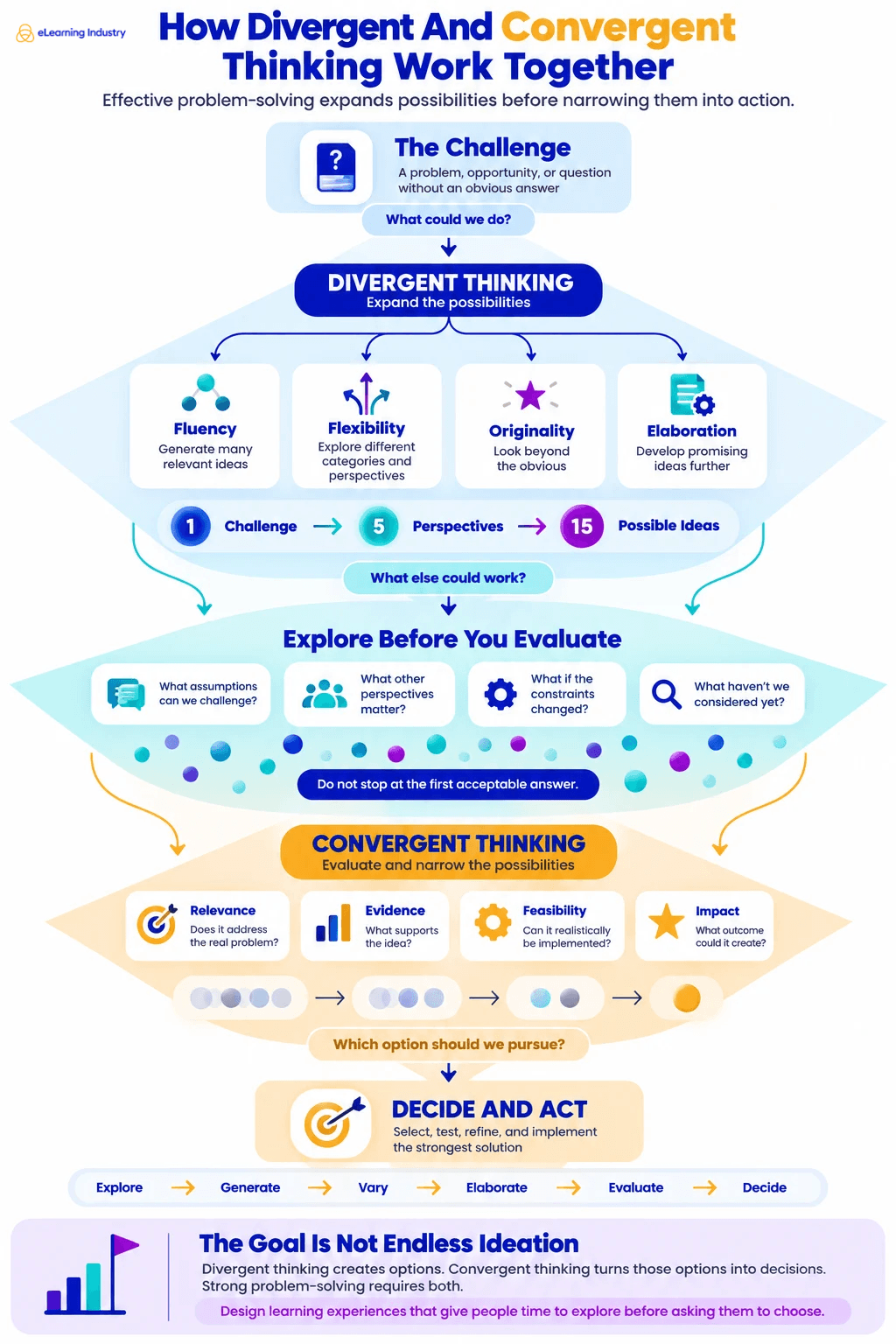
This is where divergent thinking helps. Divergent thinking is a way of thinking in which someone comes up with several possible ideas, answers, or solutions rather than looking for just one right answer. In short, it’s about exploring the problem fully before narrowing things down.
The American Psychological Association (APA) describes divergent thinking as a creative problem-solving strategy that goes beyond the usual or previously taught methods. Psychologist J. P. Guilford is known for this idea, which is often compared to convergent thinking.
But what does divergent thinking look like in real situations? Suppose an organization wants to boost participation in a leadership development program. A convergent approach might start by picking the most obvious solution. In contrast, a divergent approach would ask questions like: What could be causing low participation? What could be changed? What different formats, incentives, communication methods, manager actions, or learning experiences might help?
Thinking divergently isn’t just about being unconventional. It means making a conscious effort to generate different options before choosing which one to focus on.
What Are The 4 Dimensions Of Divergent Thinking?
Divergent thinking is often described using four main dimensions: fluency, flexibility, originality, and elaboration. While some people refer to these as the “four types of divergent thinking,” it is more accurate to call them dimensions or characteristics. Research usually highlights fluency, flexibility, and originality, with elaboration mentioned frequently as well.
1. Fluency
Fluency in divergent thinking is about how many relevant ideas someone can generate. For instance, an L&D team might come up with 15 ways to improve new-hire onboarding before deciding which ideas are realistic.
The goal is not to assume that having more ideas always means better ideas. Instead, fluency helps teams avoid settling for the first solution that seems to work.
2. Flexibility
Flexibility in divergent thinking is about variety, such as whether ideas cover different categories, perspectives, or approaches. For example, instead of developing 10 versions of another eLearning module, a team could consider coaching, performance support, workflow changes, manager involvement, peer learning, simulations, or changes to the work environment.
This difference matters. 10 similar ideas show fluency, but several truly different approaches show more flexibility.
3. Originality
Originality in divergent thinking is about how new or uncommon an idea is. In workplace learning, originality can mean finding a solution the team has not considered before or combining existing ideas in a new way.
However, originality by itself is not enough. An unusual idea that does not solve the problem is still not very useful for the organization.
4. Elaboration
Elaboration in divergent thinking means taking an initial idea and adding more depth and detail. So, instead of just saying, “Let’s use simulations,” a learner could explain which behaviors the simulation should focus on, what decisions participants would make, how feedback would be given, and how performance would be measured.
In other words, elaboration turns an interesting idea into something concrete that can be reviewed and discussed.
Divergent Vs. Convergent Thinking: What’s The Difference?
Divergent thinking helps generate many possible answers. In contrast, convergent thinking looks at the options and focuses on finding the best or most accurate solution. According to the APA, convergent thinking uses logical analysis to review solutions and choose the one most likely to work.
So, the difference between convergent and divergent thinking is not about which style is better. Instead, each serves a different purpose.
Divergent Thinking |
Convergent Thinking |
|
Goal |
Expand possibilities | Narrow possibilities |
Core question |
What could work? | Which option works best? |
Direction |
One problem → many possibilities | Many possibilities → fewer choices |
Primary emphasis |
Ideation and exploration | Analysis and selection |
Typical activity |
Generating alternatives | Evaluating alternatives |
Learning example |
Develop five possible responses | Select a response using defined criteria |
Divergent and convergent thinking usually work best when used one after the other. A team might start by generating many possible solutions. Then, they can use facts, limits, costs, risks, and company goals to narrow down their choices. If the team decides too soon, they might miss out on better options. But if they keep brainstorming without choosing, they may never make a decision.
In short, if you only brainstorm and never decide, you end up with ideas but no action. If you decide too soon without enough ideas, you might choose from too few options. That’s why the best approach is to let both types of thinking play their own roles in the process.
What Are Some Divergent Thinking Examples?
Divergent thinking often involves open-ended problems with many possible answers rather than a single correct solution.
Example of Divergent Thinking in Psychology
One way to demonstrate divergent thinking is through an Alternate Uses task, in which a person thinks of as many uses as possible for a common object. These tasks help researchers look at how fluent, flexible, and original someone’s ideas are.
A basic example of divergent thinking in psychology could be:
“How many different uses can you imagine for a brick?”
There isn’t just one right answer. The goal is to come up with as many ideas as possible.
Divergent Thinking Examples in the Workplace
Divergent thinking is especially useful for solving challenges within organizations.
Challenge |
Divergent Thinking Example |
| Low training engagement | Generate ten possible causes before choosing one. |
| Employee onboarding | Design several different onboarding experiences. |
| Leadership development | Explore multiple responses to an ambiguous scenario. |
| Skills gap | Consider learning and non-learning interventions. |
| Customer complaint | Generate several possible root causes. |
| Learning technology | Explore different workflows before selecting an approach. |
How Are Divergent Thinking And Creativity Connected?
Divergent thinking helps boost creativity by adding more ideas, as well as a wider range and greater originality. Still, it is important not to confuse divergent thinking with creativity itself.
Someone might come up with 30 ideas, but none of them may be very useful. On the other hand, a truly creative solution often needs more than just ideas. It can also take skill, good judgment, careful improvement, testing, and putting the idea into practice. So, divergent creativity is just one step in the larger creative process.
For L&D, it helps to make this distinction: Divergent thinking grows the pool of ideas, while creative judgment helps decide which ones are valuable.
This is important when building divergent thinking skills. The goal is not just to come up with as many unusual ideas as possible. Learners should have chances to create, improve, judge, and finally use their ideas.
Why Does Divergent Thinking Matter At Work?
Divergent thinking is important at work because many problems do not have just one solution. As roles, technology, customer needs, and business goals change, employees need to think beyond standard routines.
This skill can help in several ways.
- Problem-solving: Employees can look at different possible causes before deciding on a solution.
- Innovation: Teams can consider new products, services, processes, or ways of learning.
- Adaptability: Employees can let go of the idea that things must always be done the same way when situations change.
- Learning transfer: Learners can apply what they know to new situations rather than just repeating memorized answers.
- Decision-making: Teams can consider more options before deciding where to allocate their resources.
It is important to remember that divergent thinking does not mean ignoring structure. Its value at work comes from exploring more useful options before making a decision.
How Can L&D Develop Divergent Thinking Skills?
You can help learners build divergent thinking by using activities that reward exploration, encourage multiple answers, support perspective shifts, and focus on developing ideas instead of just rewarding a single correct answer right away.
1. Separate Idea Generation From Evaluation
It is harder for learners to think creatively when they have to come up with ideas and judge them simultaneously.
Instead, try breaking the process into steps:
Generate → Develop → Evaluate
In the first stage, focus only on what is possible. Wait until later to consider factors like feasibility, cost, evidence, and other criteria when choosing ideas.
2. Use Open-Ended Problems
Learners develop divergent thinking when they work with questions that have more than one reasonable answer.
Instead of:
“Which action should the manager take?”
try:
“What are four ways the manager could respond, and what might happen in each case?”
The second question gives learners more space to explore different ideas.
3. Require Multiple Solutions
Divergent thinking often ends when people settle for their first reasonable idea.
Instead, ask for more ideas on purpose:
- Generate five approaches.
- Identify three explanations.
- Suggest four interventions.
- Find two alternatives that do not involve training.
This approach encourages people to go beyond the most obvious answers.
4. Shift Perspectives
Divergent thinking becomes easier when learners consider the same problem from different perspectives.
Ask:
- How would the employee see this?
- What would the manager notice?
- What matters to the customer?
- How might HR approach it?
- What assumption would another department challenge?
Looking at a problem from different perspectives can reveal solutions you might miss if you only use one viewpoint.
5. Change The Constraints
You can also spark divergent thinking by deliberately changing the problem.
Ask learners:
- What if the budget were cut in half?
- What if this had to launch tomorrow?
- What if no new technology could be purchased?
- What if participation doubled?
Adding new limits can break old habits and help people think in more flexible ways.
6. Develop Ideas Before Rejecting Them
Divergent thinking also means building on ideas.
Before rejecting an idea, ask:
- How could it work?
- What would it require?
- Who would need to participate?
- How could we test it?
- What could make it stronger?
The main idea is simple: let learners explore different ideas before asking them to choose one.
How Can Instructional Designers Encourage Divergent Thinking?
Instructional design can intentionally support divergent thinking rather than leaving it to chance.
For example, scenario-based learning can introduce situations with more than one reasonable response. Branching scenarios let learners see how different choices lead to different outcomes. In the same way, problem-based learning gives learners the challenge first, so they explore possible solutions instead of just repeating information.
Open-ended assessments are important too. Besides multiple-choice questions, instructional designers can ask learners to:
- Diagnose
- Design
- Propose
- Generate
- Compare
- Justify
Generative AI offers another useful opportunity, but it should not take over learners’ divergent thinking.
A better learning sequence might look like this:
1. The learner independently generates three solutions.
2. AI generates additional alternatives.
3. The learner identifies perspectives AI overlooked.
4. The learner combines or improves promising ideas.
5. Convergent thinking is then used to evaluate the options.
In this approach, AI enhances the learning experience but does not replace the learner’s own thinking.
Conclusion
Divergent thinking helps organizations tackle problems that do not have a single clear answer. When employees expand possibilities, look at things from new angles, question assumptions, and come up with different options before judging them, they can handle new challenges more thoughtfully. For L&D teams, this means turning divergent thinking from a theory in psychology into a useful skill people can actually use at work.
The goal is not to make every task open-ended. Some situations really do need one right answer. After all, organizations do not need an endless stream of ideas. They need employees who know when to open up possibilities and when to focus them into action.
