


The Trump administration’s announcements of a 10 percent tariff on Chinese imports and 25 percent tariffs on goods from Mexico and Canada (all currently in some holding pattern) have led to considerable volatility in stock and foreign exchange markets.
Investors, unsurprisingly, are expressing concerns over potential disruptions in global supply chains and the macroeconomic implications of obstructions to trade. But interestingly, various financial markets have shown a relatively muted response to proposals regarding the implementation of reciprocal tariffs. The subdued character of the reaction may simply show exhaustion, with market participants becoming desensitized to new announcements. Or, the quiescence could indicate that investors are nonplussed, perceiving reciprocal tariffs as less impactful, likely to be negotiated away before implementation, or even positive.
By way of explanation, reciprocal tariffs are trade duties that a country imposes to mirror the tariffs placed on its exports by another nation. The primary objective is to either establish a level playing field or retaliate, ensuring that if one country levies tariffs on certain goods, the affected nation can respond with equivalent tariffs. For instance, if Country A imposes a 20 percent tariff on steel imports from Country B, Country B might retaliate by enacting a similar tariff on steel or comparable goods from Country A. The strategy behind reciprocal tariffs is to incentivize countries to reduce or even eliminate trade barriers, fostering a more open and balanced international trading system.
Several nations currently impose tariffs on US goods without facing equivalent tariffs, or impose tariffs of a much higher magnitude on goods imported from the United States. India, for example, has been identified as maintaining high tariffs on many American products, with average rates around 17 percent: significantly higher than the US rate of 3.3 percent on some Indian products. Similarly, the European Union applies a 10 percent tariff on US automobiles; the US has its own tariffs on European cars, but at a much lower rate (2.5 percent).
A foundational distinction in economics is that which separates positive analysis (describing the world as it is) from normative analysis (prescribing how it should be). Reciprocal tariffs provide a particularly useful lens through which to examine this dichotomy. While economic theory generally favors free trade as the optimal state of global commerce, real-world policy decisions tend to reflect a more interventionist approach. Specifically, the question of whether a nation should respond to foreign tariffs with its own protectionist measures exemplifies this ongoing debate.
Reciprocal tariffs illustrate the divide between positive and normative economics: a positive analysis explains that while unilateral free trade generates benefits for consumers and economic efficiency, imposing reciprocal tariffs can pressure protectionist nations to lower their trade barriers, potentially leading to freer trade overall. The normative question, however, is whether a nation ought to take the principled high ground by avoiding retaliatory tariffs or instead strategically impose them to achieve long-term trade liberalization.
On one hand, a nation may determine that the most economically sound response to tariffs on its goods is not to impose retaliatory tariffs of its own. Free trade tends to maximize efficiency by allowing nations to specialize in the production of goods and services in which they have a comparative advantage. Retaliatory tariffs, by contrast, restrict trade, increase costs for consumers, and distort resource allocation.
US Trade Policy Uncertainty Index (1990 – present)
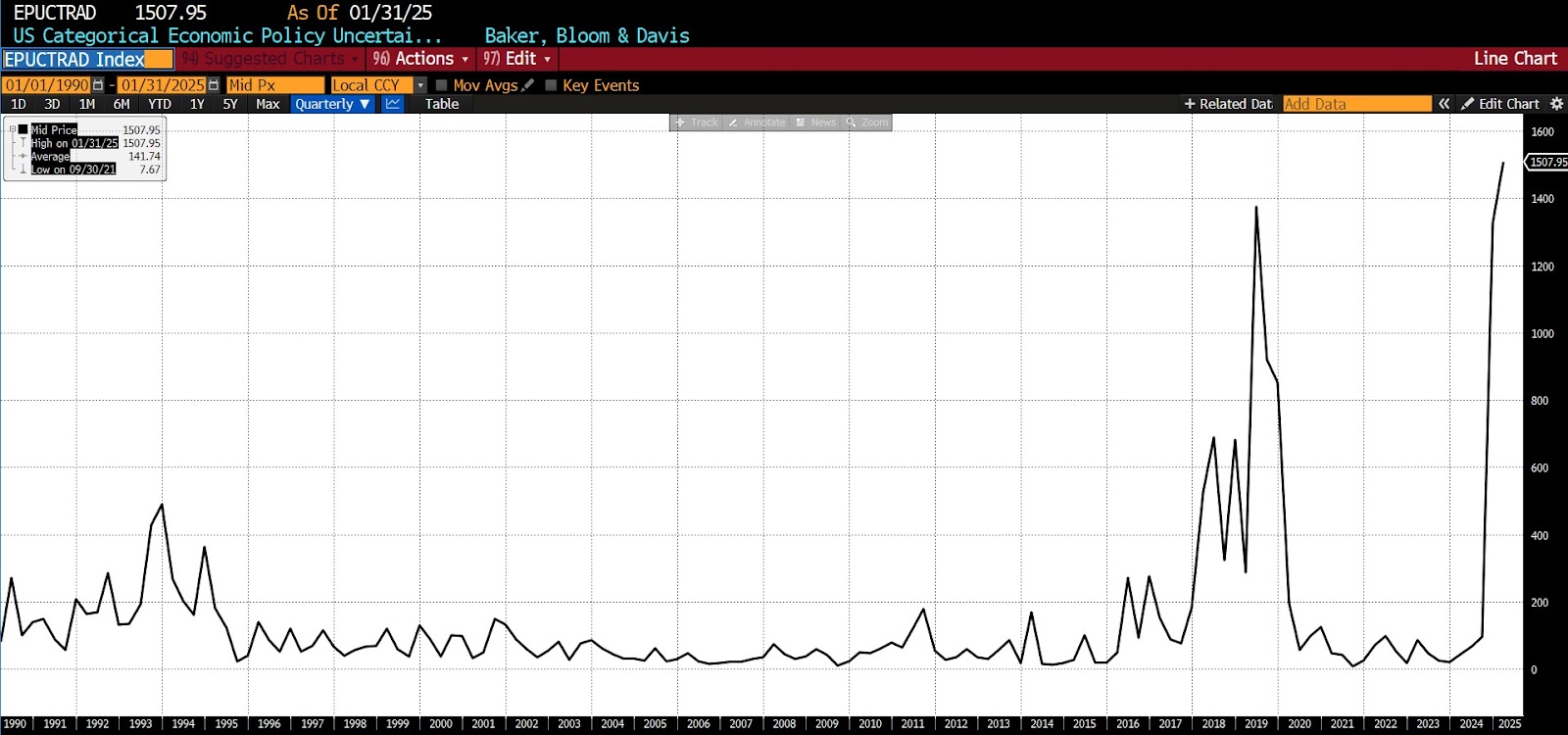
Even when one country implements tariffs, unilateral free trade remains beneficial. Avoiding counter-tariffs keeps domestic prices lower, benefiting consumers and businesses reliant on imported goods. Not retaliating also prevents damaging trade wars, which have historically had negative economic consequences (consider the Smoot-Hawley Tariff Act, which exacerbated the Great Depression). In addition, there is the not-inconsiderable moral high ground: a nation committed to unilateral free trade can position itself as a stable, open-market economy, attracting investment and diplomatic goodwill. From this perspective, free trade is the ideal arrangement regardless of how other nations act.
There is an alternative argument, which holds that reciprocally tariffing nations that impose or maintain tariffs may serve the broader cause of freer and more productive trade in the long run. While imposing tariffs is contrary to free-market principles, strategic reciprocation may pressure protectionist nations to lower or eliminate their trade barriers, leading to a more open global system. The practice of imposing reciprocal tariffs is not without risk, but may force protectionist governments to reassess the costs of obstruction, possibly resulting in broader trade liberalization. In that sense, reciprocal tariffs may be viewed as a corrective measure as opposed to an end goal. Proponents of doing so are likely to characterize reciprocal tariff campaigns (such as that which is being discussed) as pragmatic, free-market oriented interventions as opposed to dogmatic non-interventionism.
But imposing retaliatory tariffs, even if undertaken in the spirit of fostering unfettered trade, is a perilous proposition. History shows that such measures may escalate trade disputes, disrupt supply chains, and inflict disproportionate harm on domestic consumers and producers. While foreign tariffs hinder US exports, raising domestic barriers in response may encounter intransigence, compounding inefficiencies and weakening economic stability. Additionally, their targeting is inherently political in nature. The prosperity of the United States ultimately depends not on mirroring the protectionism of others but on maintaining open markets and competitive pricing. Imposing reciprocal tariffs, would represent a further deviation from the general historical principle of the US applying unconditional Most-Favored-Nation (MFN) trading policies outside of bilateral and regional agreements.
(Two such deviations have occurred recently: Biden’s 2022 revoking of Russia’s and Belarus’s MFN status to impose higher tariffs in the wake of the invasion of Ukraine, and the tariffs imposed by the Trump administration on Chinese imports during beginning in 2018.)
The debate over reciprocal tariffs underscores the is/ought dichotomy that is central to economic policy analysis. Free trade is the optimal outcome, and unilateral free trade remains beneficial even in the face of foreign tariffs. In the government/official sphere, though, trade dynamics may be deemed as necessitating strategic responses to protectionist policies abroad. But dismissing, let alone praising, tariff threats of any kind (retaliatory or other) as “negotiating tactics” ignores the creation of market distortions through preemptive stockpiling, increased costs due to administrative and compliance changes, and growth-impeding uncertainty, which delays investment and expansion decisions.
Navigating between the science of economics and the practical realities of real-world decision-making is a perpetual challenge. The debate over the application of reciprocal tariffs illustrates a broader truth pertaining to all of the social sciences: sound economic theory provides guiding principles, while real-world application, especially when political dynamics enter the fray, frequently requires balancing normative ideals with unsentimental practicality.
As a scientist, I would prefer the theoretically sound, apolitical (and principled) approach, but the debate presents a valuable opportunity to highlight the contrast between idealism and expedience: in trade policy, and beyond.
