

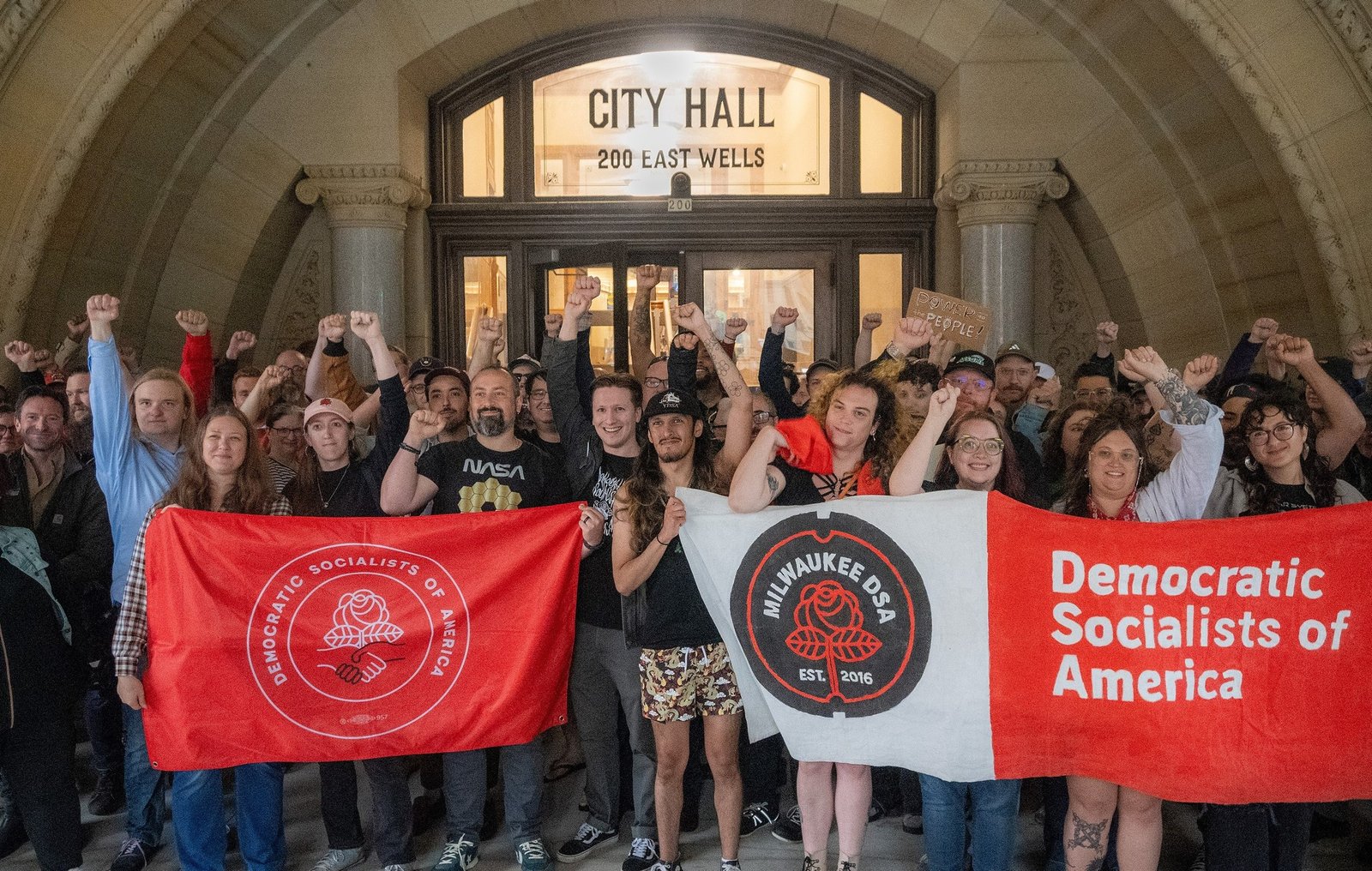
Everyone is talking about the blue wave that swept across America in the midterms. But underneath lies something much bigger unfolding: a socialist sweep.
The Democratic Socialists of America (DSA) provides an election tracker listing more than 160 victories across the country, including DSA-backed candidates and ballot measures, stretching from local government and state legislatures all the way to Congress.
These victories are more than a successful election night for DSA. They are another indication that socialism is gaining political legitimacy in America. A recent study found 38 percent of Democrats and Democratic-leaning respondents would prefer a candidate identifying as a democratic socialist over one identifying simply as a Democrat. And to understand why this movement is winning, we have to understand the message behind it.
Economic Power to the Working People?
At the center of DSA’s economic program is criticism of ownership and control.
The DSA defines capitalism as “a system designed by the owning class to exploit the rest of us for their own profit. Its platform calls for “public ownership of the largest corporations and essential industries,” with a broader goal of replacing capitalism and “private ownership.” The DSA says it is composed of workers “building a new society from the ground up.”
This message resonates. Everyday Americans are under financial strain: 72 percent of Gen Z received financial support from their parents and 85 percent are delaying major milestones they can’t afford. With so many struggling to get ahead and corruption increasingly clear in government, democratic socialism’s message to stand up for the working people makes it increasingly appealing. But Americans should be wary. We’ve heard this promise before, and history tells a very different story about who ultimately ends up with the power.
Venezuela’s Working Class Was Promised Power, Too
Hugo Chávez did not come to power promising Venezuelans that the government would control their lives and destroy their economy.
Chávez’s twenty-first-century vision of socialism promised to fight the poverty, inequality, and exploitation he blamed on capitalism, a system he once described as “the way of the devil and exploitation.” That vision increasingly translated into policy through the nationalization and expropriation of private industries, price controls, and an ever-greater state grip on the economy. Venezuela’s number of private companies fell from roughly 14,000 in 1998 to 9,000 by 2011.
The consequences were devastating. Venezuela’s poverty rate skyrocketed from 33 percent to 96 percent in less than seven years as the country suffered severe shortages and economic collapse. Venezuela’s crisis had multiple causes, but socialist efforts to expropriate private property and nationalize industries undeniably discouraged the private investment and production needed to support its people.
And that’s the part of Venezuela’s story Americans should pay attention to: the campaign promise was to take economic power from the capitalist few and give it to working people. But taking ownership out of private hands didn’t transfer that power to the working class. Instead, it increasingly concentrated power and wealth in state actors and powerful cronies.
The Ideological Link Between Democratic Socialism and Communism
To understand what could come next politically, Americans should examine the ideological relationship between democratic socialism and communism — and particularly what both say about ownership.
Communists Karl Marx and Friedrich Engels argued that capitalism and private capitalist ownership should be overthrown, with capital taken from the bourgeoisie by degrees and the major means of production increasingly centralized in the hands of the state during the “transition.”
Democratic socialism takes a more gradual approach toward that same goal. Rather than pursuing a rapid, revolutionary overthrow, democratic socialists seek change through “public ownership,” “economic democracy,” and “working-class control.” The DSA, for example, calls for public ownership of America’s largest corporations and essential industries.
The connection is clear. Both challenge private ownership and seek to replace it, to varying degrees, with collective or public ownership. Their differences largely come down to how far they want to go, how quickly, and what political methods they use to get there.
DSA national co-chair Megan Romer made that vision clearer in an August interview with The New Yorker. Asked whether companies such as Google and Apple would remain privately owned under democratic socialism, Romer first pointed to industries she considers necessities — including electricity, internet, and water services — and said DSA wants those to be publicly owned everywhere. Asked whether she believed in the public “owning the means of production” as the Marxists used to say, Romer answered, “I do, yeah, yeah.” She described working-class control of the means of production as a long-term “demand,” while emphasizing that DSA does not intend to change everything overnight.
That distinction matters. The DSA isn’t calling for seizing the means of production overnight. Instead, it advocates a gradual expansion of public ownership beginning with America’s largest corporations and essential industries, while keeping its broader goal of working-class ownership and control.
In other words, this isn’t simply about regulating or reforming capitalism. Those reforms are steps toward its long-term vision of a “future without capitalism” — a vision that would fundamentally change who ultimately owns and controls the economy.
From Ideas to Political Power
Some argue that the 2026 midterms were a victory for moderate Democrats, not socialism. But that overlooks the historic gains made by the Democratic Socialists of America. 88 DSA-backed candidates won their elections on November 3, including six new members heading to Congress, marking a significant expansion of the movement’s political representation.
And while those congressional victories came in Democratic-held districts, that is precisely why they matter. Democratic socialists are gaining influence within the Democratic Party itself, putting more elected officials in positions to challenge party leadership and advance their economic agenda. And the DSA’s ambitions extend beyond the Democratic Party. Its own electoral strategy calls for eventually building an independent socialist party, with some going as far as concluding the Democrats cannot be reasoned with: “They must be destroyed.”
The socialist sweep doesn’t mean socialism won America overnight. It means a growing movement advocating fundamental changes to private ownership now has more elected representatives in positions to influence legislation, challenge party leadership, and advance its economic vision. And Americans should be paying close attention.
