

Escalating fighting between the United States and Iran pushed crude oil sharply higher on Thursday, driving Treasury yields to fresh highs for the year and weighing on both stocks and gold. Renewed doubts about whether heavy artificial-intelligence spending will pay off deepened the equity selloff, while the U.S. dollar firmed as traders sought shelter.
Check out the forex news and economic updates you may have missed in the latest trading session!
Forex News Headlines & Data:
-
Australia Employment Change for June 2026: 76.3k (15.6k forecast; 40.3k previous)
- Australia Unemployment Rate for June 2026: 4.4% (4.4% forecast; 4.4% previous)
- U.K. CBI Business Optimism Index for Q3 2026: -36.0 (-40.0 forecast; -65.0 previous)
- U.K. CBI Industrial Trends Orders for July 2026: -45.0 (-43.0 forecast; -45.0 previous)
- Canada CFIB Business Barometer for July 2026: 58.3 (49.9 forecast; 49.6 previous)
-
European Central Bank Deposit Facility Rate was held at 2.25% as expected
- ECB Press Conference: Christine Lagarde’s message was essentially that the ECB is not pre-committing to any rate path and will keep a meeting-by-meeting approach as it assesses incoming data, inflation risks, and policy transmission.
- U.S. Chicago Fed National Activity Index for June 2026: -0.02 (0.14 forecast; -0.1 previous)
- Canada Retail Sales Prel for June 2026: 0.4% m/m (0.4% m/m forecast; 1.0% m/m previous)
- U.S. Initial Jobless Claims for July 18, 2026: 187.0k (210.0k forecast; 208.0k previous)
- U.S. Chicago Fed National Activity Index for June 2026: -0.02 (0.14 forecast; -0.1 previous)
- Euro area Consumer Confidence Flash for July 2026: -15.9 (-17.6 forecast; -17.7 previous)
Broad Market Price Action:
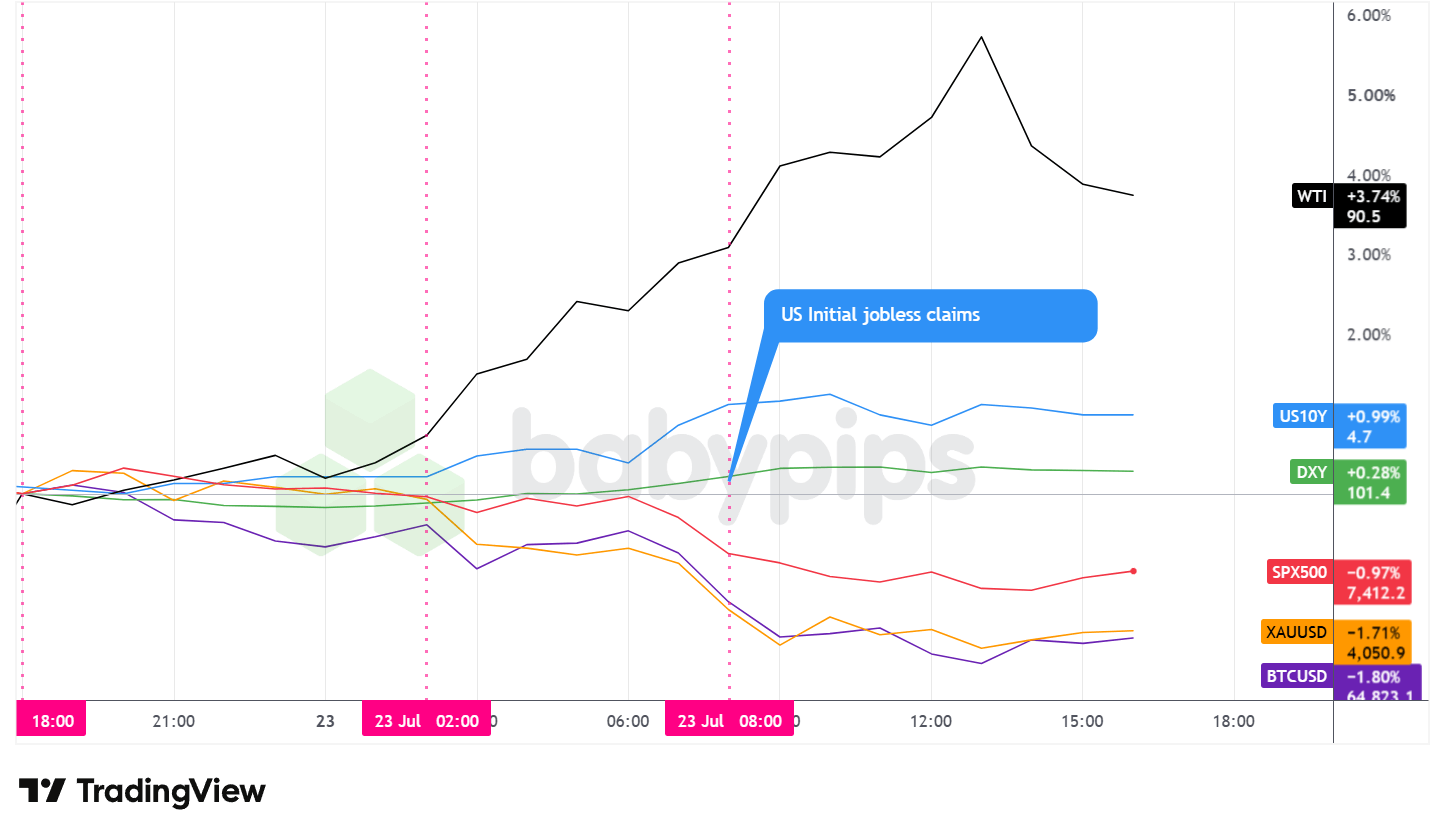
Dollar Index, Gold, Oil, S&P 500, U.S. 10-yr Yield, Bitcoin Overlay – Chart Faster With TradingView
WTI crude oil ran the show on Thursday, climbing about 3.7% to settle near $90.50 per barrel. Prices pushed higher through the European and U.S. hours and tagged an intraday peak above $92 in the early afternoon before easing into the close. The advance tracked a further escalation in the U.S.-Iran conflict, with Brent topping $100 a barrel as the fighting entered a twelfth straight night and threats to shipping through the Strait of Hormuz and the Red Sea mounted.
Treasury yields climbed alongside the oil move. The 10-year yield rose to roughly 4.70%, its highest of the year, as higher energy costs revived inflation worries. Rate expectations shifted with the tone. According to Bloomberg, traders now price around a 35% chance of a Fed hike at next week’s meeting, up from about 10% a week ago, with an increase fully priced by September.
Equities fell. The S&P 500 dropped about 1% to close near 7,412, sliding to an intraday low around 7,375 by midday before clawing back part of the loss late. The pressure centered on megacap technology, where renewed skepticism about the payoff from large AI investments weighed on sentiment. Alphabet dropped after lifting its capital-spending forecast, and Tesla fell despite solid deliveries, per Bloomberg. Higher yields and the oil shock added to the drag.
Gold slid about 1.7% to trade near $4,051, giving back ground from around $4,140 as it fell through the European morning. The pullback looked like a more conventional risk reaction, with a firmer dollar and rising real yields possibly outweighing the safe-haven pull of the conflict.
Bitcoin fell about 1.8% to trade near $64,823, dropping from above $66,000 to a low near $64,570 before it stabilized. With no crypto-specific catalyst apparent, the move likely reflected the broader risk-off tone across speculative assets tied to the day’s geopolitical and rate concerns.
FX Market Behavior: U.S. Dollar vs. Majors
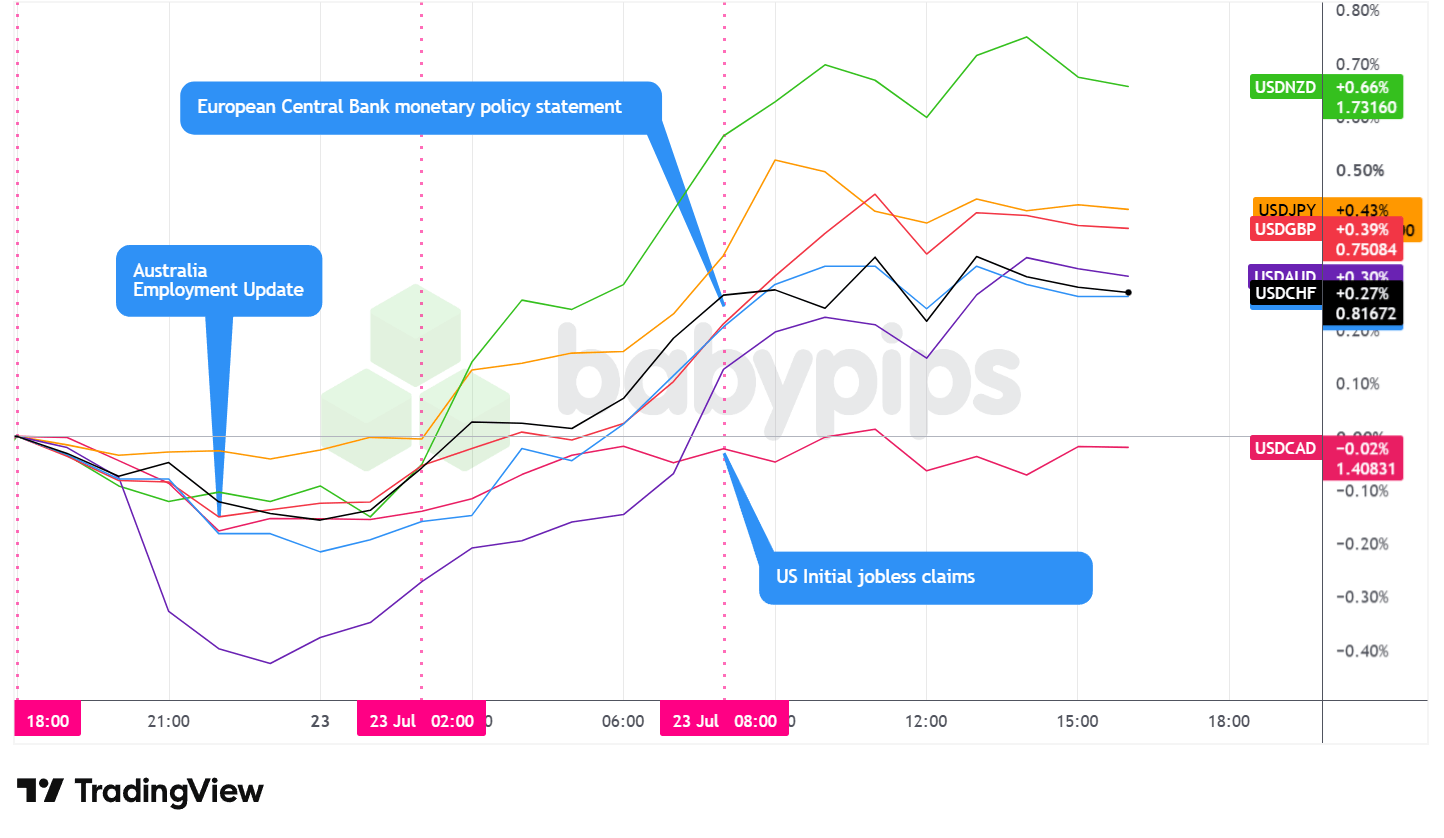
Overlay of USD vs. Majors – Chart Faster With TradingView
The U.S. dollar finished Thursday as one of the strongest major currencies, gaining against most peers as higher yields and risk aversion pulled flows toward the greenback.
During the Asian session, the dollar drifted lower against the majors before it steadied by the middle of the Asian morning. The Australian dollar found early support from a strong jobs report, with employment jumping 76.3k in June against a 15k forecast, the unemployment rate holding at 4.4%, and the participation rate rising to 67.0%. That upside surprise lifted the Aussie for a time and nudged Australian yields higher.
The dollar began to rebound just ahead of the London open and extended that recovery on net through the European session. The European Central Bank left its key rates unchanged, an outcome markets had fully priced, so the reaction stayed muted. In her press conference, President Lagarde held to a meeting-by-meeting approach and declined to commit to a rate path, leaving a September move on the table after last month’s hike. The dollar’s climb through London owed more to firmer Treasury yields and the risk-off backdrop than to anything out of the euro area.
The rebound ran until shortly after the London close. U.S. initial jobless claims came in at 187k, well under the 210k forecast and consistent with a still-firm labor market, which fit the higher-yield, firmer-dollar theme. From there the greenback traded choppy and mostly sideways into the close.
At the Thursday settle, the dollar held gains against most majors, with the New Zealand dollar, yen, and pound among the weakest of the group. The Canadian dollar was the lone holdout, finishing slightly higher against the greenback. That outcome likely reflected support from the sharp rise in crude oil, given Canada’s status as a major energy exporter.
Promoted: Navigating Geopolitical Shocks Isn’t Reserved for Institutional Traders.
When oil, gold, and Treasury yields are all spiking on conflict headlines, it’s easy to get chopped up in the crosscurrents. Most traders quietly wonder if consistent profitability is actually achievable in such complex intermarket environments. Jack Schwager’s newest book, “Market Wizards: The Next Generation,” answers that question directly.
The legendary author behind the original Market Wizards series interviews a new generation of successful traders—many self-taught—who built real wealth by navigating unpredictable global events. Their common thread isn’t genius or insider access to central bank data. It’s a deliberate process, disciplined risk management during volatile sessions, and the conviction to take trading seriously as a pursuit worth mastering.
Get Market Wizards: The Next Generation on Amazon!
Disclosure: We may earn a commission from our partners if you sign up through our links, at no extra cost to you.
Upcoming Potential Catalysts on the Economic Calendar
- Australia S&P Global Manufacturing & Services PMI Flash for July 2026 at 11:00 pm GMT
- U.K. GfK Consumer Confidence for July 2026 at 11:01 pm GMT
- Japan CPI Growth Rate for June 2026 at 11:30 pm GMT
- Japan S&P Global Manufacturing & Services PMI Flash for July 2026 at 12:30 am GMT
- Germany GfK Consumer Confidence for August 2026 at 6:00 am GMT
- U.K. Retail Sales for June 2026 at 6:00 am GMT
- Germany S&P Global Manufacturing & Services PMI Flash for July 2026 at 7:30 am GMT
- ECB Consumer Inflation Expectations for June 2026 at 8:00 am GMT
- Euro area S&P Global Services PMI Flash for July 2026 at 8:00 am GMT
- U.K. S&P Global Manufacturing & Services PMI Flash for July 2026 at 8:30 am GMT
- U.S. Building Permits Final for June 2026 at 12:00 pm GMT
- Canada Manufacturing & Wholesale Sales Prel for June 2026 at 12:30 pm GMT
- Canada PPI for June 2026 at 12:30 pm GMT
- Canada New Housing Price Index for June 2026 at 12:30 pm GMT
- U.S. S&P Global Manufacturing & Services PMI Flash for July 2026 at 1:45 pm GMT
- U.S. New Home Sales for June 2026 at 2:00 pm GMT
- ECB Lane Speech at 3:30 pm GMT
The next stretch hinges on whether the oil-driven risk-off tone holds or fades. With crude near six-week highs and the U.S.-Iran conflict showing little sign of easing, energy prices and any fresh headlines on shipping through the Strait of Hormuz look like the swing factor for yields, the dollar, and risk sentiment.
A dense run of July flash PMIs across Australia, Japan, Germany, the euro area, the U.K., and the U.S. will test how much the geopolitical backdrop is bleeding into activity, while Japan’s inflation print and U.K. retail sales offer read-throughs for the BOJ and BOE. With the ECB now leaning on incoming data, euro-area PMIs and inflation expectations carry added weight for the September call.
Stay frosty out there, forex friends!
When geopolitical tensions escalate and oil spikes, the dollar and yen typically strengthen while risk assets pull back, but most traders don’t understand the mechanism driving those moves. Premium members can read our lesson:
📖 Geopolitical Risk, Trade Policy, and Safe Haven Flows
Reading this helps you understand how geopolitical shocks move currencies through safe-haven demand, which assets investors flee to under conflict, and how to position when headlines drive the market instead of data.
And if you’re not a Premium subscriber yet, this is a perfect time to join.
With Babypips Premium, you get full access to School of Pipsology lessons that help you understand not just which currencies react to geopolitical shocks, but why they react, what’s happening at the central bank and hedge fund level, and how to spot the next major safe-haven flow before it happens
