

Everything You Wanted To Know About Immersive, Gamified Learning
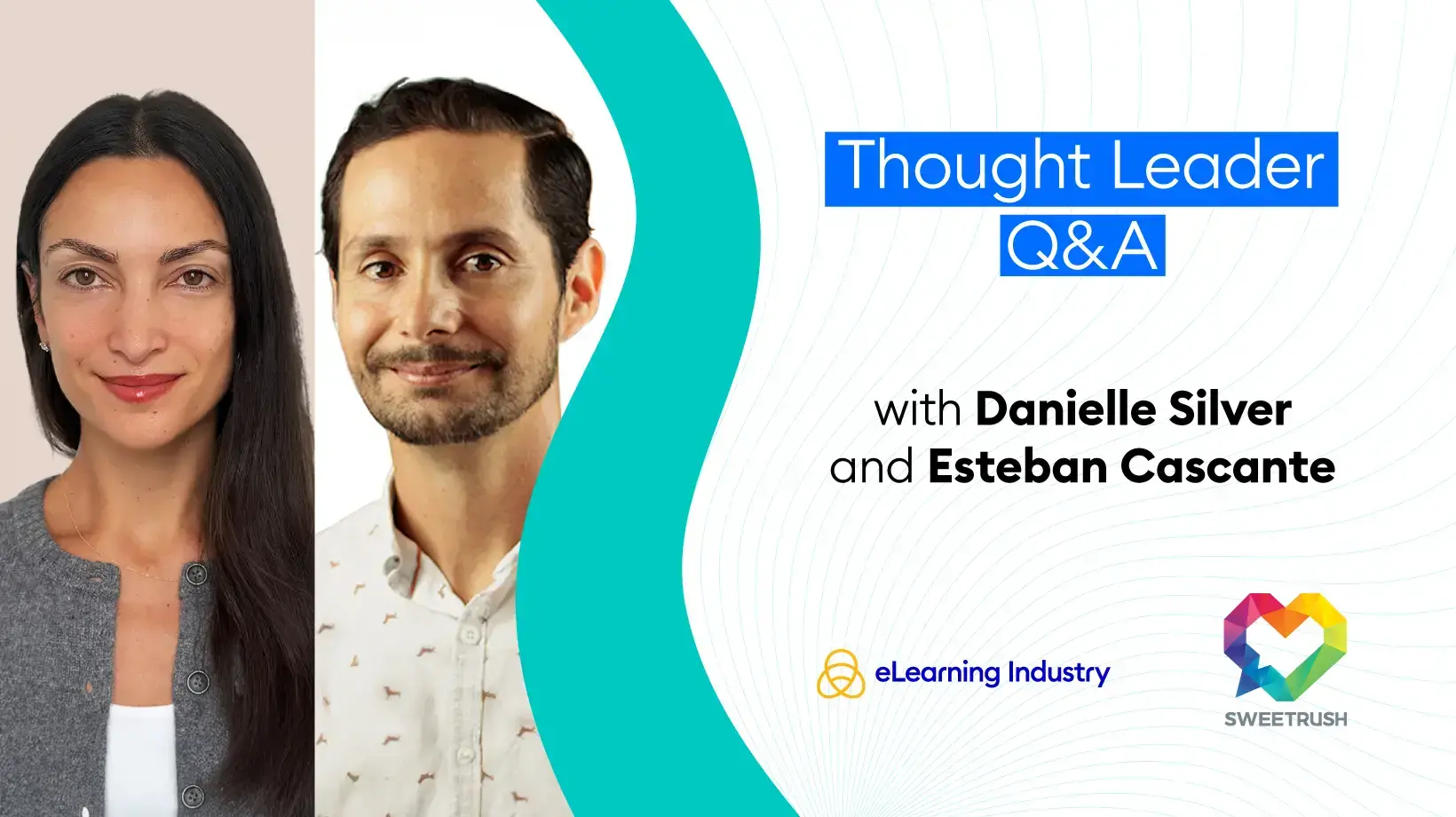
Danielle Silver is a Solution Architect on the SweetRush XR team. She spends her time helping clients dream up ways to use immersive technology to elevate learning and engage their learners in new and exciting ways. Dani is particularly interested in the use of virtual and mixed realities and their ability to affect knowledge retention and true behavior change. Dani is not only knowledgeable but a delight to work with and cares deeply about ensuring the success of the project and her clients. From the moment you connect with Dani, you’ll know you are in good hands.
Esteban Cascante is the Director of XR and Project Management at SweetRush and has more than 20 years of expertise in educational product design. He harmonizes complex workflows across eLearning, XR, and AI to produce award-winning learning experiences, and is passionate about the intersection of people and process. Known for his calm leadership and “people-first” approach to process, he is a dedicated champion for innovation and client success.
Today, we’ll discuss gamified, immersive learning enabled by technologies such as XR and AI.
What are the best use cases for technologies like Extended Reality (XR), AI, and gamified learning? Specifically, how can we tell when it’s a true business need versus a shiny object?
Esteban: XR is a great tool for high-stakes learning needs—for example, medical and industrial training—but it is also good for empathy training because it allows users to experience situations from someone else’s perspective.
Gamification works best with content that allows for autonomy and curiosity. Finally, AI can be added to any of these to increase flexibility and customization to the experiences.
Danielle: This is such a crucial question. The fact that we are even asking it shows a healthy shift away from the initial tech hype and toward genuine, strategy-driven implementation.
At the end of the day, we don’t design for the technology; we design for the person. Every experience we create starts with two North Stars: the learner and the learning objective. Only after defining those do we look at the toolkit to decide which modality, technology, or solution makes sense.
We are seeing these technologies used across the board, for example:
- Active skills application: Once a learner has grasped the foundational knowledge, these tools let them put their skills to the test. Whether it’s a high-stakes Virtual Reality (VR) scenario or an AI-powered conversation simulation, learners can practice, fail, and iterate in a safe environment.
- Empathy and perspective-taking: As Esteban mentioned, empathy-building is incredibly powerful here. Immersive tech allows learners to literally step into someone else’s shoes, experiencing scenarios from different perspectives to build better leadership, DEI, and communication skills.
- Scalable onboarding: Bringing new hires into immersive, gamified ecosystems helps them explore company spaces, understand cross-functional teams, and absorb company culture much faster than traditional slide decks ever could.
- From power skills to technical skills: We see these technologies applied to the entire spectrum of training—from refining leadership skills to mastering highly technical, dangerous, or complex engineering procedures.
Whenever you need to bridge the gap between abstract theory and real-world execution, these technologies provide the perfect playground for high-impact learning.
We know that XR experiences and simulations are engaging, but how effective are they in boosting learners’ on-the-job performance and skill retention?
Esteban: We need to first ensure we understand the problem we are trying to solve with the learning product and then design for it.
This foundation allows us to not only create the right interactions but also to implement the right statistics to track against in the future. Without that initial clarity, we would be just shooting in the dark.
Danielle: Simulations—whether they are immersive VR, AI-powered conversations, or traditional branching scenarios—do something static content can’t: They give learners a safe space to fail.
Whether it is a high-stakes conversation with a difficult customer, a sensitive situation with a colleague, or a dangerous procedure on a factory floor, you don’t want a worker’s first “real” try to be in front of a live audience or a piece of heavy machinery. By allowing learners to practice, make mistakes, and try again without real-world consequences, we build their confidence. When they finally encounter that exact moment on the job, they are fully prepared to execute.
This approach dramatically boosts on-the-job performance because it taps into how our brains actually learn and retain skills:
- From knowing to doing: Traditional training focuses on conceptual knowledge (the what), but simulations build procedural knowledge (the how). By physically or mentally going through the motions, the brain builds neural pathways similar to real-world experience, thus turning the skill into muscle memory.
- Beating the forgetting curve: It’s a well-known training challenge that passive learners can forget up to 70% of what they learn within 24 hours. Because experiential learning requires active decision-making, it vastly improves long-term skill retention. In fact, research [1] shows immersive training can improve retention rates by up to four times compared to traditional classroom learning.
- Immediate feedback loops: In the real world, a mistake can be costly or dangerous. In a simulation, a learner receives instant, data-driven feedback. They see the immediate consequences of their choices, which is exactly where the deepest learning and behavioral shift happens.
Do you find that immersive and/or gamified simulations contribute to content burnout, screen fatigue, and the growing isolation many learners are feeling?
Esteban: They could contribute to all three if they are not correctly designed. For example, the simulations should not exceed 15 minutes each. That should be enough for tactical muscle-memory or specific empathy training, for example. After that, we can take the learners out of the experiences.
One example is an empathy training for medical impairments that we created for healthcare professionals. The learners took one of the three scenarios, then joined a live discussion to process how they felt and what they learned before returning to the experiences, then repeating the process for each scenario.
Consider that in most cases, simulations are a great way to practice, but that does not mean all the lessons should take place inside them. We should also use some other modalities in combination with simulations to make the learning journey more sound and engaging.
Danielle: Actually, we are seeing the exact opposite of burnout, fatigue, and isolation. In an era where static eLearning courses are everywhere, what we’re hearing from the market is that learners are struggling with massive information overload. People aren’t burned out by tech itself; they are burned out by passive scrolling. They are craving genuine engagement and human connection.
When designed intentionally, immersive and gamified technologies do not isolate learners; they can actually create deeply memorable, shared moments.
The key is how you blend them. For example, we’ve seen VR used brilliantly during live experiential learning (LEL) sessions. As Esteban mentioned, learners put on the headsets individually to experience a specific, high-stakes scenario. When they come out of the headset, they immediately debrief, share insights, and collaborate with their peers. It turns a standard lecture into a powerful session of discovery and connection.
Another example of shared moments is the resurgence of virtual escape room experiences. By transforming a standard training topic into a puzzle that needs to be solved, you immediately pique a learner’s natural curiosity and competitive drive. Instead of just reading text on a screen, they have to actively search for clues, connect disparate pieces of information, and solve problems. This shift from passive consuming to active exploring hooks the brain, making the core concepts incredibly “sticky” and far easier to recall later, on the job.
Of course, we have to be highly strategic about where we infuse these experiences along the learner journey. Traditional modalities, like microlearning modules, videos, or job aids, still have immense value for baseline knowledge transfer. But when it comes to re-engaging disconnected learners and making content stick, experiential learning is one of the best tools we have to spark real engagement.
As technology evolves, what opportunities are you seeing to integrate AI into XR learning experiences?
Esteban: The possibilities are vast. Right now, we are building AI-driven coaching simulations where learners can practice high-stakes conversations in a psychologically safe environment. Beyond that, the real opportunity lies in hyper-personalization—such as intelligent virtual tour guides that navigate learners through complex physical spaces (such as warehouses) while answering open-ended, contextual questions in real time. Finally, AI can act as a passive spatial observer, tracking user mechanics silently and intervening with adaptive guidance only when the learner actively struggles or requests help.
Danielle: We are constantly prototyping how we can merge these emerging technologies to create deeper, more impactful experiences for learners. As you can imagine, the landscape is shifting by the day, opening up incredible new possibilities.
Recently, we experimented with integrating an AI coach directly into a shared, multiplayer VR space.
In this setup, teams can enter a virtual environment together from anywhere in the world to explore different interactive stations. Instead of a pre-recorded voiceover, an intelligent AI coach guides them through the experience. Learners can naturally ask the coach questions, get real-time answers, and steer their own discovery.
This blend of technologies offers massive potential for remote collaboration and corporate onboarding. Imagine a virtual workspace where each station represents a different chapter of a company’s history, culture, or cross-functional team. As a cohort of new hires walks through the space together, the AI coach acts as a dynamic tour guide, sharing context and answering questions on the fly. Instead of being just a training module, it’s an immersive event that drives immediate team building, connection, and a shared sense of culture from day one.
Looking ahead, this integration will only get smarter. We are moving toward a future where AI won’t just guide learners, but will actually adapt the virtual environment in real time based on a team’s performance or skill gaps. By combining the presence of XR with the intelligence of AI, we are creating learning environments that are truly immersive and adaptive.
What are the technical and licensing considerations we should keep in mind when designing immersive simulations with AI avatars?
Esteban: This type of learning experience comes with additional operational costs that regular eLearning modules do not. The most common is token expense. Tokens are small, bite-sized fragments of text, such as individual words, characters, or parts of syllables. The larger the volume of content we send to and receive from the AI model, the more expensive it gets. Depending on your total number of active users, this volume can scale quickly.
Also, if we deploy hyper-realistic avatars, we require third-party licensing for the live-streaming functionality. The cost of these market licenses depends heavily on your number of concurrent users, which can quickly add up.
Finally, there are hosting and processing infrastructure costs. While hosting the AI model on a server is relatively inexpensive initially, a global deployment requires server replication across multiple geographic regions to eliminate latency and ensure a seamless, timely response for every learner.
Danielle: As Esteban noted, licensing in the AI space requires careful planning. From a big-picture perspective, AI-powered experiences do come with a different cost structure than traditional eLearning. License fees and API token costs (the cost of processing data through AI models) are typically calculated based on usage. The more learners interact with the AI, the more those costs can add up.
Because of these costs, it is incredibly important to integrate AI-powered components exactly where they make the most strategic sense.
Before building, you have to ask yourself: What is the specific benefit of AI in this exact learning moment? Furthermore, you have to look closely at the learning objective to decide what level of technology is actually required.
A high-fidelity AI avatar isn’t always necessary. If a learner needs to practice text-based communication—like drafting client emails, handling a live chat cue, or mastering a written sales pitch—a text-based AI simulation is just as powerful, often at a fraction of the cost. If the technology you choose unlocks that “aha!” moment and drives the concept home, the ROI will absolutely justify the cost.
You don’t need to power an entire three-hour curriculum with live AI to make an impact. Instead, the smartest approach is to inject small, targeted AI components across a blended learning journey. Use traditional, cost-effective modalities (like short videos, readings, or interactive modules) to build baseline knowledge, and then deploy your high-value AI components exactly when it’s time for dynamic, real-time conversation practice or personalized coaching. This mix gives you the absolute best results for your learners while keeping your budget highly optimized.
How can immersive simulations and gamified learning experiences fit within an organization’s existing LMS and content ecosystem?
Danielle: At SweetRush, we are completely tech-agnostic. Before we ever kick off a project or design a single piece of content, we work to deeply understand our partner’s existing ecosystem. We believe that technology should always elevate the learning experience, never get in its way. Our goal is to make these advanced solutions as accessible as possible for the learner, and as seamless as possible for the organization.
When it comes to putting these experiences into practice, we design with global scale in mind. Here is how we ensure immersive and gamified content fits cleanly into your everyday ecosystem:
- SCORM wrapping for seamless LMS fit: For the most part, we can SCORM-wrap our simulations and gamified learning experiences. SCORM wrapping allows them to launch, track, and integrate directly within your standard Learning Management System (LMS), which is absolutely vital for scaling an initiative to a widespread, global audience.
- Custom VR-to-LMS integration: Historically, VR existed in a silo, making tracking a headache. To solve this issue, we developed a proprietary LMS integration tool. This tool bridges the gap, allowing data from the VR experience to connect directly and securely back to your central LMS.
Ultimately, your current infrastructure shouldn’t limit your innovation. By handling the heavy technical lifting behind the scenes, we ensure that deploying a cutting-edge simulation feels just as smooth as launching a traditional eLearning module.
How can L&D leaders and teams prove that immersive, gamified simulations are meeting their organizations’ business needs?
Danielle: To prove true business value, we have to look past simple completion rates and focus on behavioral change and operational impact. Because immersive simulations and gamified learning are active experiences, they generate an incredible amount of rich, behavioral data that traditional eLearning simply cannot capture. Every decision, mistake, and correction a learner makes is tracked. This tracking allows L&D leaders to directly connect training milestones to performance data across three distinct buckets:
1. Operational Efficiency And Cost Savings
Immersive tech drastically reduces “time-to-competency”—the time it takes a new hire to reach full productivity. Instead of shadowing someone on the job for weeks, a learner can master a process in a virtual environment.
Look at metrics like reduced onboarding time, lower training seat-time, and minimized operational risk. Training an employee in a simulation means they aren’t slowing down real-world operations or using expensive raw materials while they learn.
2. Direct Performance Metrics
Because simulations mimic real-world complexity, you can directly map simulation data to on-the-job Key Performance Indicators (KPIs).
If a customer service team goes through an AI-powered conversation simulation, you can measure their post-training customer satisfaction (CSAT) scores, call resolution times, or error rates. When you see compliance errors drop or sales conversions tick upward after a gamified launch, you have direct proof that the simulation met the business need.
3. Confidence Αnd Risk Mitigation
In high-stakes environments, a lack of confidence costs money and causes accidents. Simulations allow us to measure a learner’s certainty alongside their accuracy.
Data [1] shows that immersive learning can significantly increase a learner’s confidence in applying new skills compared to classroom environments. When people are confident, they make fewer critical mistakes, safety incidents drop, and employee retention improves because workers feel genuinely supported and equipped to do their jobs.
Ultimately, the best way to prove impact is to partner with business stakeholders before building the experience. Identify the exact business metric they are trying to move—whether it’s reducing safety incidents, increasing sales, or speeding up onboarding—and use the simulation as the specific engine to move it.
What advice do you have for an L&D leader who is ready to start adding immersive, AI-powered, and gamified experiences to their learning portfolio?
Esteban: I believe it is crucial to pinpoint the exact touchpoints where immersive experiences and gamification add value. Not every part of a curriculum needs to be transformed into a simulation or a game; by being selective, you can manage your budget strategically and allocate resources exclusively to the most impactful sections.
An effective way to achieve impact is to identify the specific operational areas where employees frequently make errors—or where those mistakes carry the highest financial and reputational risk—and focus your advanced learning technology entirely on mitigating those gaps.
Danielle: Taking the leap into immersive, AI-powered, or gamified learning can feel overwhelming, but it doesn’t have to be a massive risk. For L&D leaders ready to evolve their portfolios, here are three pieces of advice to ensure a successful launch:
1. Think Big, Start Small, Scale Fast
You do not need to overhaul your entire training curriculum overnight. Look for a small, high-impact pilot project—a specific “friction point” in your current training where retention is low, or mistakes are frequent. Build a single AI-powered conversation simulation or a short, focused gamified module. Use this pilot to test the waters, iron out any technical or infrastructure quirks within your ecosystem, and gather initial feedback from your learners.
2. Prioritize The Learner Experience
It can be incredibly easy to get caught up in the bells and whistles of new hardware or complex software. However, the most successful initiatives prioritize accessibility and the user journey. Make sure the entry barrier for the learner is as low as possible. If you are introducing VR, consider starting with web-based 360-degree simulations that can be accessed on a desktop computer before rolling out physical headsets. If you are using AI, ensure the interface is intuitive and requires zero tech-savviness to navigate.
3. Build An Internal Network Of Champions
Advanced learning solutions require buy-in across multiple departments. Early on, partner with your IT, cybersecurity, and data privacy teams to make sure the tech meets organizational standards. Equally important, find business leaders who are passionate about innovation and willing to champion the pilot within their own business units. Use your pilot’s data to build a strong internal business case. When you can show other department heads exactly how a gamified simulation cut onboarding time or boosted confidence in the pilot group, securing the budget and buy-in for your next, larger initiative becomes much easier.
Wrapping Up
Thanks so much to Danielle Silver and Esteban Cascante for sharing their expert insights on how to maximize the effectiveness and value of L&D programs through immersive, gamified, and AI-powered learning experiences.
Feeling inspired by the possibilities? Reach out to SweetRush about their immersive and gamified learning solutions today.
Reference:
[1] What does virtual reality and the metaverse mean for training?
