


New York City is celebrating the win of its most defining election in years. On November 4, voters selected their new mayor.
Zohran Mamdani, a self-described democratic socialist, surged in popularity — especially among Gen Z — on promises to freeze rent, open government-run grocery stores, eliminate bus fares, and raise the minimum wage to $30 an hour. His victory on Tuesday marks a major political shift in one of the world’s most influential cities — and it could be an ominous sign of where America is headed.
Media coverage right now is focused on whether Mamdani’s policies will actually make life in New York more affordable — and while that’s an important question, it’s not the only one we should be asking. Some — including President Trump — have labeled Mamdani a communist. Mamdani rejects the charge, insisting he’s a democratic socialist and that the two couldn’t be more different. But that raises an even more important question that few people are asking: how different is Mamdani’s “democratic socialism” from the Marxist socialism it claims to distance itself from?
Marx’s Vs Mamdani’s Framework
In The Communist Manifesto, Karl Marx built his entire system around class conflict. He saw history as a constant struggle between the bourgeoisie — the wealthy owners of factories, land, and capital — and the proletariat, the working class who labored for them. To Marx, the capitalist was the villain: the exploiter of workers and the thief of their labor. His solution was total upheaval: abolish private property, erase class divisions, and replace capitalism with collective ownership managed by the state.
The proletariat will use its political supremacy to wrest, by degrees, all capital from the bourgeoisie, to centralize all instruments of production in the hands of the State, i.e., of the proletariat organized as the ruling class; and to increase the total of productive forces as rapidly as possible.
In other words, Marx believed the working class should use the power of the state to seize control of all production, centralizing it “in the hands of the state” — which he described as the proletariat organized as the ruling class. In theory, this meant the economy would be run “for the people.” In reality, it means the state would run everything — because the state was the people, at least in name.
Cultures that have adopted Marxist principles promise fairness, but in practice, concentrate nearly all power in the hands of government. What begins as a call to liberate workers from oppression ends with individuals stripped of both property and choice.
Mamdani’s version of socialism sounds less radical, but it flows from the same logic. He’s not calling for a violent revolution, nor the complete abolition of private ownership. Instead, he frames the “villain” differently — the greedy billionaire, the corporate landlord, the capitalist system that supposedly makes New York unaffordable. His plan is to make life “fairer” for working-class New Yorkers through rent freezes, government-run grocery stores, and higher minimum wages. But each solution leans on the same idea Marx started with: using government power to fix inequality. None of his proposals limit government power or expand individual liberty — they expand the state’s power in the name of helping the people. It may sound democratic, but the foundation is the same: more control from the top, less freedom for the individual.
What’s the Difference Between Democratic Socialism and Marx’s Socialism?
In his NBC interview, Mamdani was asked point-blank if he’s a communist. His response: “No, I am not…I call myself a democratic socialist.” Today, democratic socialists claim their version is different. The word “democratic” makes it sound safer — like it’s no longer about force, just about fairness. The idea is that instead of taking power through revolution, socialism can be voted in peacefully. But voting for socialism doesn’t make it any less socialist, nor does it promise government power will be used for good. Calling it “democratic” doesn’t change the system — it just changes how it’s introduced. The end goal is still the same: to let government, not individuals, decide what’s “fair,” and force everyone else to conform.
That same mindset carries into how Marxists and their colleagues view wealth. Democratic socialists begin with the belief that inequality itself is injustice — that the success of some must come at the expense of others. It starts with envy and entitlement disguised as fairness: the idea that those who have more should be forced to “give back” to those who have less. Beneath it lies a quiet moral assumption rooted in Marxist thought — the notion that some know better than others how much people should earn, how their money should be spent, and that government should step in to correct that “injustice.” It echoes Marx’s famous line, “From each according to his ability, to each according to his needs.” In theory, it sounds compassionate. In practice, it hands the power of deciding both ability and need to the state.
None of it is voluntary; it relies on the power of government to enforce a vision of equality that punishes success instead of encouraging opportunity. So they push for higher taxes, arguing that the state should decide who has “too much” and redistribute it. But once that line is drawn, it never stops moving. Today it’s billionaires. Tomorrow it’s millionaires. Eventually, it’s the middle class. Because government doesn’t create wealth — it can only take, until there’s nothing left to take.
Then there’s the question of government control over the means of production. Democratic socialists insist they’re different from communists because they’re not asking for the government to run everything — just the “important stuff.” Housing, healthcare, public transit… and whatever else they decide to add to that list next. But it’s fine, they argue, because these necessities shouldn’t be managed by greedy corporations in search of profit.
That’s exactly how socialism starts — small, targeted, and “reasonable.” Every socialist system begins with the promise of managing only a few “key” industries that are “too important” for the free market. That’s how it started in Venezuela. The government first nationalized the oil and steel industries, claiming state control was necessary to stabilize prices and protect workers. But over time, that “limited” control spread — first into agriculture, then banking, electricity, tourism, and transportation — until nearly every sector of the economy was under state management. What began as “helping” key industries became total control of production, and with it, the collapse of an entire nation.
Once government controls one industry, there’s nothing stopping it from reaching for another.
So while Mamdani’s version of socialism may sound softer than Marx’s, it grows from the same root. Both rest on the belief that government — not individuals or markets — should manage economic life in the name of fairness. One makes demands by force; the other asks for it by vote, but both seek unchecked control.
Mamdani is right about the problem — New York has become unaffordable. But it’s not the “unfair capitalist system” that made the city expensive to live in; it’s decades of government interference that have limited supply, inflated costs, and buried productivity under layers of bureaucracy. The same policies fueled New York’s housing crisis and soaring cost of living. And now, Mamdani’s solution is to expand the very system that created the problem — inviting even deeper government control into the very systems that caused this crisis in the first place.
So what really separates democratic socialism from Marx’s communism? In short, it’s the same plant — just at different stages of growth. I created this diagram to help envision it: democratic socialism is the seed, socialism is the growing plant, and communism is the full-grown tree, where the state controls every part of economic life and, eventually, people’s choices.
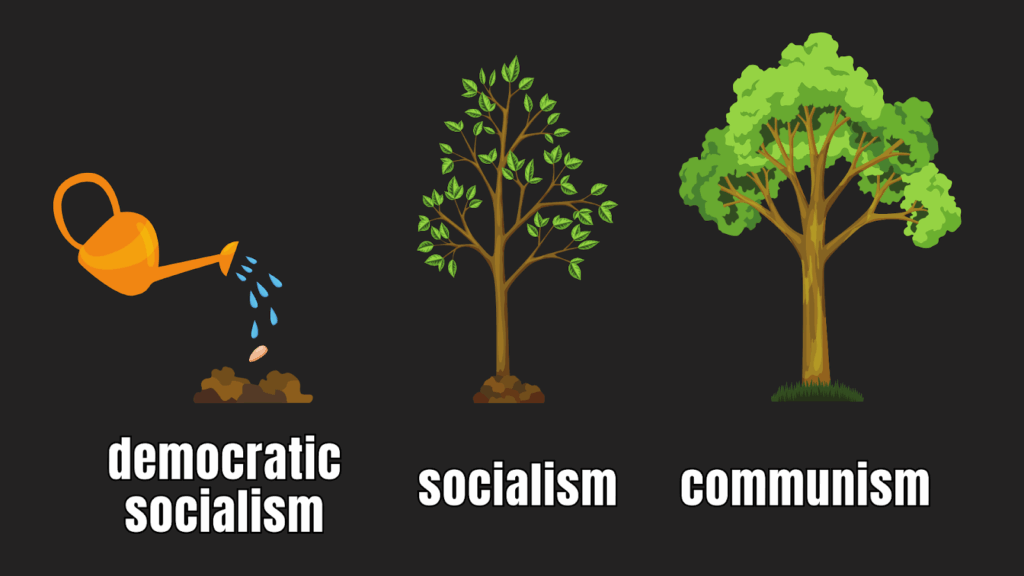
When Mamdani says he’s not a communist, he may genuinely believe that. But the ideology he’s promoting comes from the same soil Marx planted in 175 years ago — the belief that government control can ‘fix’ what free people built. What Mamdani calls “democratic socialism” isn’t a rejection of what Marx built; it’s this generation’s version of it. It’s communism with training wheels — rebranded for today’s youth.
Politicians like Mamdani get away with selling socialism because they’re not trying to overthrow capitalism overnight — they say they’re trying to reform it. They replace free exchange with state intervention one policy at a time, until the line between “helping” and “owning” disappears. Mamdani might not be Marx reborn, but his ideas come from the same place — and if history has taught us anything, it’s that the outcome doesn’t change just because the packaging looks friendlier. And the outcome always has a body count.
So as New Yorkers celebrate Mamdani’s win, I hope they — and the rest of America — pay attention. Because what happens here won’t just shape one city’s future. It will reveal how much longer we’re willing to flirt with the same ideology that has destroyed freedom everywhere it’s been tried.
