


What Are Multiple-Choice Questions (MCQs)?
Multiple-choice questions are assessments that evaluate knowledge by asking learners to select the correct answer from a list of options. Also known as MCQs, they are widely used in corporate learning because they are scalable, consistent, and easy to analyze. In a multiple-choice format, each question includes a prompt and a predefined set of answers, making evaluation fast and objective.
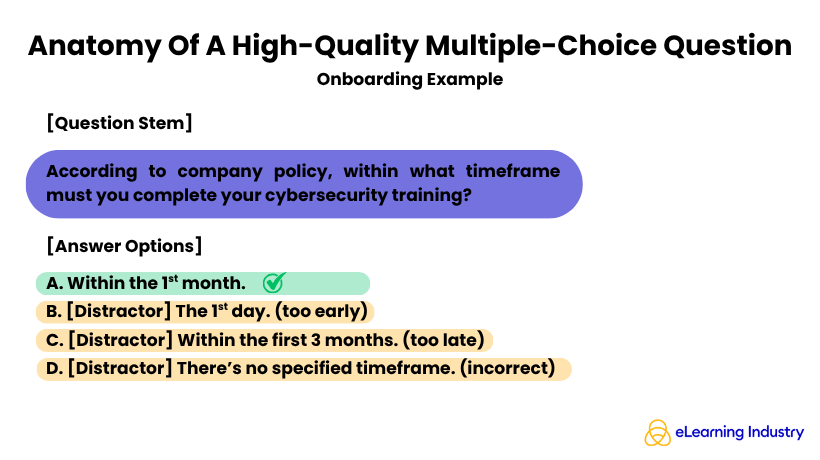
Multiple-choice questions have a simple structure. The stem is the question or problem. The options are the possible answers given to the learner. One of these options is correct, while the others are distractors. Distractors are plausible but incorrect answers designed to test understanding rather than guesswork.
These questions are also objective because they remove bias from the scoring process. Every learner is assessed using the same standards, which is important for training compliance, certification, and large assessments.
In today’s corporate learning, MCQs help drive data-driven decisions, identify knowledge gaps, and enable L&D teams to measure learning outcomes at scale. When created properly, they combine efficiency with valuable insights.
Table Of Contents
Why Multiple-Choice Questions Still Matter In Corporate Learning
There is a common misconception that multiple-choice questions are too basic for modern learning. In reality, when well-designed, they are among the most efficient and scalable tools in corporate training.
Quick Knowledge Assessment
A well-structured multiple-choice test enables L&D teams to quickly assess knowledge across large audiences without sacrificing consistency. This is especially valuable in global organizations where standardization matters. Plus, they generate clean, measurable data that teams can use to identify knowledge gaps, track performance trends, and make informed decisions about future training investments.
Fairness
In compliance and certification contexts, objective questions such as MCQs ensure fairness and reliability. They provide clear evidence of understanding, which is critical for audits and regulatory requirements.
Effectiveness
In some cases, MCQs are more effective than open-ended questions. For example, when testing foundational knowledge, reinforcing key concepts, or evaluating decision-making under time constraints.
Types Of Multiple-Choice Questions (With Use Cases)
Not all multiple-choice questions are the same. While the format seems simple, different types of questions can test different levels of thinking. For L&D professionals, the choice of question type should focus on what you want to measure.
Single-Answer Questions
The most common form of multiple-choice format, single-answer questions ask learners to select one correct option from a list.
These are ideal for:
- Knowledge checks
- Compliance training
- Reinforcing key concepts
Because they are straightforward, they work well when the goal is to confirm understanding of facts, definitions, or processes. However, they mainly test recall rather than deeper thinking.
Use case: After a cybersecurity module, ask learners to identify the correct definition of phishing.
Multiple-Answer Questions
In this multiple-choice question variation, learners must select more than one correct answer.
These questions:
- Increase cognitive effort.
- Require deeper processing.
- Reduce the chance of guessing correctly by accident.
However, they also introduce complexity. Without clear instructions for multiple-choice questions, learners may feel unsure about how many answers to select. There is also a higher risk of partial knowledge leading to incorrect responses.
Use case: Ask learners to identify all the behaviors that violate a company’s code of conduct.
Scenario-Based MCQs
Scenario-based multiple-choice questions move beyond recall and into application. Learners are given a realistic situation and asked to choose the best course of action.
This type aligns with higher levels of Bloom’s taxonomy:
- Application
- Analysis
- Decision-making
These are especially valuable in corporate learning, where performance matters more than memorization.
Use case: Present a difficult customer interaction and ask the employee what they should do next.
True/False Questions
While often overlooked, true/false questions are a simplified version of objective questions within the multiple-choice family.
They are useful when:
- You need quick checks.
- The content is binary (correct/incorrect).
- Time is limited.
However, they come with a 50% guessing probability, which limits their reliability. Use them strategically, not as a primary assessment method.
Use case: Reinforcing key policies in short refresher modules.
Best Answer Questions
This is where multiple-choice questions become more nuanced. Instead of a single correct option, learners must choose the best answer from several plausible options. In real-world learning, there is rarely a perfect answer. This type reflects that ambiguity by:
- Testing judgment.
- Encouraging critical thinking.
- Mirroring real decision-making conditions.
The challenge lies in designing strong multiple-choice distractors, which are incorrect options that are still believable.
Use case: Leadership training, where multiple responses could work, but one is more effective given the context.
How To Write Multiple-Choice Questions That Actually Measure Learning
Well-designed multiple-choice questions reveal whether learners can apply knowledge in real situations. For L&D leaders, the goal is not to create more questions but to design better ones. That starts with aligning each question to a clear purpose and building it with precision.
Start With Learning Objectives
Writing effective multiple-choice questions starts before you even create the question. Each question should connect directly to a learning goal that leads to a business outcome. For example, if a training program aims to improve how employees handle customers, your test should focus on decision-making in realistic situations, rather than just asking about isolated facts.
Many assessments struggle because they use trivia-style questions that don’t reflect real work performance. Instead, focus on what learners need to do in their jobs. When you clearly define this, it becomes easier to create good multiple-choice questions. Each question then serves as a way to measure skills, not just knowledge.
Crafting Strong Question Stems
The question stem sets the foundation. In writing multiple-choice questions, clarity always matters more than cleverness. A strong stem is direct, specific, and easy to understand on first read.
Keep your questions simple and clear. If learners struggle with the wording, you’re testing their ability to understand, not their knowledge. For instance, questions that ask, “Which of the following is NOT…” can confuse learners without helping them.
Instead, try to present questions as real-life situations or decisions. This approach makes your multiple-choice questions more relevant and better measures how well learners can apply what they know.
Designing Effective Multiple-Choice Distractors
Strong multiple-choice distractors are what separate a good question from a weak one. Distractors should be plausible but clearly incorrect for someone who understands the topic. The best distractors come from real misunderstandings or common workplace mistakes. L&D professionals can use their experience and data here. If many learners get a process wrong, that mistake should be included as a distractor.
Avoid using shortcuts like “All of the above” or “None of the above,” as these options can make the question less helpful. Also, steer clear of patterns where the correct answer is always longer, more detailed, or in the same spot. These patterns let savvy test-takers guess correctly without really understanding the material. When creating multiple-choice questions, ensure the distractors encourage critical thinking rather than create confusion.
Writing Clear Answer Options
Answer options should be consistent in length, tone, and structure. In how to write a multiple-choice question, this ensures that the correct answer does not stand out unintentionally.
For example, if one option is significantly longer or more detailed, learners may assume it is correct. Likewise, differences in grammar or wording can act as clues. The goal is to make all options equally credible at first glance.
Clarity is also important. Avoid vague or overlapping choices, as they make it unclear which answer is “best.” A good multiple-choice question has one clear correct answer, supported by precise wording.
Examples Of Good Multiple-Choice Questions
Strong multiple-choice questions are not about tricking learners but about revealing how well someone understands a concept. Below are practical multiple-choice question examples, comparing weak vs. effective design.
1. Testing Recall Vs. Understanding
Bad MCQ
What is cybersecurity?
A. A type of software.
B. Protection of systems.
C. A programming language.
D. None of the above.
Improved MCQ
Which scenario best illustrates cybersecurity in practice?
A. Installing updates to fix vulnerabilities.
B. Writing code in Python.
C. Designing a website layout.
D. Managing payroll systems.
Why it works: The improved version tests knowledge application, not just recall.
Why it fails: The bad version is vague and invites guessing rather than real understanding.
2. Weak Vs. Strong Distractors
Bad MCQ
What is onboarding?
A. Hiring
B. Training
C. Banana
D. Leaving
Improved MCQ
What is the primary goal of employee onboarding?
A. Integrate new hires into company culture and processes.
B. Replace underperforming employees.
C. Conduct annual performance reviews.
D. Manage payroll.
Why it works: Strong multiple-choice distractors are plausible and related.
Why it fails: The bad example includes irrelevant options, reducing assessment value.
3. Ambiguity Vs. Clarity
Bad MCQ
What should managers do often?
A. Communicate
B. Lead
C. Help
D. All of the above
Improved MCQ
Which action most improves team alignment in remote teams?
A. Setting clear weekly goals.
B. Avoiding meetings.
C. Reducing feedback.
D. Limiting communication.
Why it works: Clear context supports better decision-making.
Why it fails: The bad version is too broad and uses “all of the above,” a weak pattern.
4. Poor Vs. Effective Multiple-Choice Format
Bad MCQ
What is L&D?
A. Learning
B. Development
C. Learning and Development
D. IDK
Improved MCQ
In a corporate context, what does L&D (Learning and Development) primarily focus on?
A. Building employee skills aligned with business goals.
B. Managing office supplies.
C. Overseeing legal compliance only.
D. Handling IT infrastructure.
Why it works: This follows a clear multiple-choice format and aligns with business outcomes.
Why it fails: The bad version is overly simplistic and not meaningful for professionals.
Creating A Multiple-Choice Question Test: A Practical Framework
For L&D professionals, a well-structured approach to multiple-choice tests ensures that questions deliver meaningful insights, not just scores.
1. Define The Purpose
Start by clarifying why you are building the multiple-choice test. Is it for assessment or reinforcement? Assessment-focused tests validate knowledge and support decisions (e.g., certification), while reinforcement tests help learners retain information. Your purpose will shape how you create multiple-choice questions and how strict your evaluation should be.
2. Map Questions To Skills
Every question should connect to a specific skill or learning objective. When creating a multiple-choice test, avoid isolated or trivia-style items. Instead, ensure your multiple-choice questions reflect real competencies that matter to the business.
3. Balance Difficulty Levels
An effective multiple-choice test includes a mix of easy, moderate, and challenging questions. This balance helps differentiate between surface-level understanding and deeper knowledge. It also improves the reliability of your multiple-choice format.
4. Apply A Randomization Strategy
Randomizing question order and answer options reduces bias and limits guessing patterns. If you are working within an LMS, this is a simple but powerful way to strengthen your multiple-choice questionnaire.
5. Define Scoring Logic
Decide how answers will be scored. Will all questions carry equal weight? Will partial credit apply in multiple-choice question formats? Clear scoring rules ensure fairness and consistency.
Mini Checklist: How To Make A Multiple-Choice Question Test
- Define the purpose of the multiple-choice test.
- Align all multiple-choice questions with competencies.
- Include varied difficulty levels.
- Randomize questions and answer options.
- Set clear scoring logic.
Beyond Assessment: Creative Uses Of Multiple-Choice Questions
While multiple-choice questions are often associated with testing knowledge, they can also serve as powerful tools for engagement and interaction in corporate learning. When designed thoughtfully, fun multiple-choice questions and multiple-choice trivia questions can energize sessions, encourage participation, and reinforce learning in a memorable way.
Icebreakers
One way to use them is as icebreakers in workshops. For example, an onboarding session might start with a few light-hearted questions, such as, “Which fictional character would make the best team leader?” with multiple options. This approach immediately invites participants to think, share, and connect with one another, without the pressure of right or wrong answers. These fun multiple-choice questions make introductions interactive while subtly highlighting organizational values or culture.
Gamification
Multiple-choice questions can also support gamification and reinforcement. In training modules, quick trivia-style questions between sections can keep learners engaged and help consolidate key points. For instance, after a compliance lesson, a multiple-choice trivia question such as “Which of these actions aligns with company cybersecurity policy?” allows learners to apply knowledge in a safe, low-stakes environment.
Team Challenges
Finally, MCQs can be used creatively in team challenges or live polls. During a leadership workshop, facilitators might ask, “Which strategy would you prioritize to improve team performance?” and offer several choices. This encourages discussion and collaborative problem-solving while keeping the structure simple and familiar.
When NOT To Use Multiple-Choice Questions
While multiple-choice questions are a versatile assessment tool, they are not suitable for every learning scenario.
Complex Skill Demonstration
If your goal is complex skill demonstration, a multiple-choice test may fail to capture learners’ true abilities. Skills like problem-solving, hands-on technical work, or creative tasks often require open-ended exercises rather than selecting an answer from a list.
Behavioral Assessments
Understanding interpersonal skills, leadership style, or decision-making processes needs scenario-based evaluation, observation, or reflective exercises. Trying to simplify these into a multiple-choice questionnaire can produce misleading data and reduce credibility.
Open-Ended Reasoning Tasks
Critical thinking, analysis, or essay-based problem-solving cannot be effectively measured with a multiple-choice test. While multiple-choice questions are excellent for knowledge checks, they are less useful for assessing depth of reasoning or nuanced understanding.
Conclusion
Multiple-choice questions can be very effective when designed thoughtfully. The most important aspect is that each question should align with a clear learning goal to ensure the test measures what’s important. However, while multiple-choice questions are a great choice, it’s best to use them alongside other types of assessments rather than relying on them alone.
Frequently Asked Questions (FAQ) About Multiple-Choice Questions
To write effective multiple-choice questions, start with a clear learning objective. Craft a concise question stem, provide one correct answer, and include plausible multiple-choice distractors. Avoid trick questions, ensure consistent formatting, and test for comprehension rather than recall.
Read each question carefully, eliminate obviously incorrect options, and focus on what the stem is asking. Watch for qualifiers like “all of the above” or “none of the above,” and choose the answer that best aligns with the learning objective.
Examples include:
- Knowledge check: “Which of the following is a primary color?”
- Scenario-based: “A learner struggles with X, which solution works best?”
- Trivia or engagement: “Which CEO founded Company Y?”
A multiple-choice question typically includes:
- Stem: The question or scenario.
- Options: The list of possible answers.
- Correct answer: The single or best choice.
- Distractors: Plausible but incorrect answers.
Statistically, there’s no guaranteed “most common answer.” However, in well-designed multiple-choice tests, answers are usually randomized to avoid pattern bias, ensuring fair assessment.
