

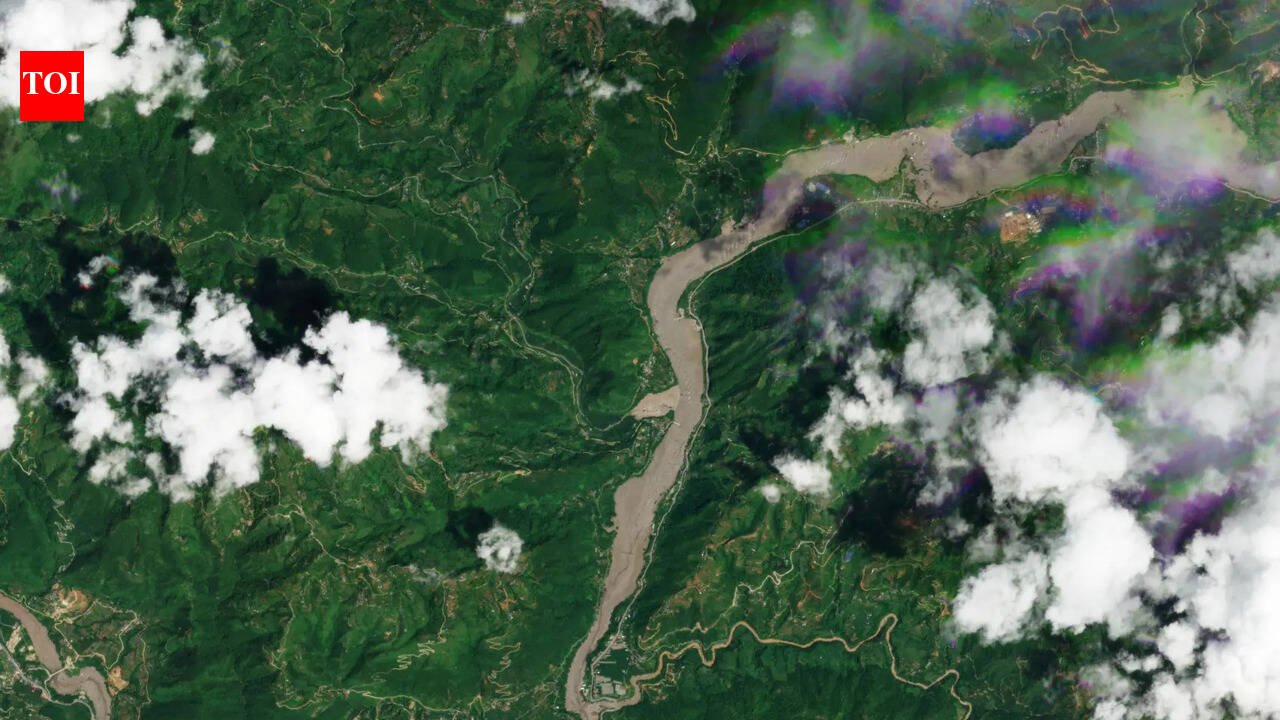
On August 26, 2026, a catastrophic flash flood struck the Nepal-Tibet border, tearing through the Lhende Khola and Bhote Koshi river system. As rescue operations continue, the death toll has climbed past 270, with over 1,000 people still missing, including a large number of foreign tourists and pilgrims. Of those unaccounted for, 178 are Indian nationals, many of whom were on pilgrimage to Mount Kailash. The flood destroyed roads, bridges, hydropower plants and communication infrastructure, and triggered a mudslide that crippled Gyirong Port, a key crossing point between Tibet and Nepal.The event was initially blamed on an earthquake-triggered avalanche. The US Geological Survey (USGS) first reported a magnitude 4.4 earthquake in the region. However, after further analysis of seismic waves and satellite imagery, USGS revised its findings, stating that the seismic event was a glacial collapse and debris flow that caused the subsequent catastrophic impacts downstream, and upgraded the magnitude-equivalent of the event to 5.2. In other words, no earthquake occurred at all; the shaking was generated by the collapse itself.This is not an isolated event. In July 2025, a glacial lake outburst flood (GLOF) struck the same river system, damaging four major hydropower plants and knocking out 8% of Nepal’s electricity supply. It also washed away the “Friendship Bridge” linking Nepal and China, disrupting trade for months. This recurrence has renewed focus on Nepal’s extreme vulnerability to high-altitude disasters.
The trigger
A flash flood is a sudden, high-velocity surge of water that inundates an area within a very short time, often minutes to hours. In mountainous terrain, flash floods carry far greater destructive energy than plains floods because steep gradients accelerate the water and the debris it carries, leaving communities downstream almost no warning time.A related and increasingly important concept is the Glacial Lake Outburst Flood (GLOF). As glaciers melt, meltwater often collects behind a natural dam made of loose rock and ice debris (called a moraine). If this unstable dam breaches, whether from heavy rain, an avalanche, or an ice/rock collapse into the lake, it releases a huge volume of water and debris almost instantly.A third mechanism, seen more clearly in this event, is a glacier collapse and debris flow, where a mass of ice and rock breaks off a glacier at high altitude and crashes into a river valley below, without any lake being involved at all. The sheer force of this impact displaces river water and loose sediment, sending a wall of mud, boulders and water downstream.
Anatomy of the disaster
- The trigger: According to satellite and seismic analysis, a large chunk of glacier on the Tibetan side sheared off the mountainside at roughly 5,200 metres and plunged about a kilometre into the valley, into the Lhende River (called the
Bhote Koshi downstream in Nepal). Daniel Shugar, a geomorphologist at the University of Calgary, compared pre- and post-event satellite imagery to confirm the collapse. - Seismic confusion: The impact of this mass of ice and rock generated shockwaves picked up by seismic sensors, initially misread as a 4.4 magnitude earthquake. USGS later clarified that no earthquake had actually occurred, and that the seismic signal was generated by the landslide itself. The revised equivalent magnitude was 5.2.
- The debris dam and rupture: The colliding ice, rock and mud displaced river water and likely formed a temporary, unstable debris dam. Water backed up rapidly behind it. When the pressure became too great, the dam gave way, releasing a mixture of water, mud, boulders and debris downstream at extreme velocity.
- Downstream devastation: The flood swallowed roads, bridges, houses and hydropower infrastructure in Nepal’s Rasuwa and Dhading districts. Nepali authorities reported water levels on the Trishuli river rising by as much as 9 metres in just half an hour, according to the Kathmandu-based International Centre for Integrated Mountain Development (ICIMOD).
- Cross-border cascade: The Lhende Khola feeds into the Bhote Koshi, which in turn joins the Trishuli, and eventually the Narayani, before crossing into India as the Gandak river. This interconnected hydrology is why flood alerts were issued downstream in Bihar and Uttar Pradesh almost immediately.
Nepal’s geographical vulnerability
- Extreme gradient: Nepal has some of the highest peaks on Earth alongside narrow, deep river gorges. This combination acts like a funnel, accelerating water speed and destructive force.
- Concentrated settlements: Habitable land in narrow Himalayan valleys is limited, so populations, and now also hydropower and tourism infrastructure, cluster along riverbanks, right in the flood’s path.
- Poor accessibility for rescue: Rescue helicopters could not land in the worst-hit areas of Rasuwa district until floodwaters receded, delaying relief operations.
- Sediment load: As water rushes down steep slopes, it dislodges huge quantities of earth and boulders, adding to the destructive mass and complicating rescue efforts, including for the hundreds of Chinese rescue personnel deployed near Gyirong.
- Climate change link: Warmer temperatures are destabilising Himalayan glaciers and expanding glacial lakes, a trend climate scientists say is increasing the frequency of such sudden-onset disasters.
Relevant bodies and frameworks
- US Geological Survey (USGS): The US federal agency that monitors global seismic activity; its revised analysis was central to correctly identifying the cause of this disaster.
- ICIMOD (International Centre for Integrated Mountain Development): A Kathmandu-based intergovernmental body monitoring climate and glacial risks across the Hindu Kush Himalayan region.
- National Disaster Risk Reduction and Management Authority (NDRRMA), Nepal: Nepal’s apex disaster management body, coordinating relief and rescue.
- National Disaster Management Authority (NDMA), India: Has held workshops specifically on GLOF risk reduction, given India’s own exposure (e.g., the 2023 South Lhonak Lake GLOF in Sikkim).
- Hindu Kush Himalaya (HKH) region: A transboundary mountain system spanning eight countries, increasingly the focus of coordinated glacial-hazard monitoring.
How this concerns India
- Human toll: 178 of the missing are Indian nationals, many pilgrims travelling the Mount Kailash-Mansarovar route through the Gyirong crossing.
- Downstream flood alerts: Because the Bhote Koshi-Trishuli-Narayani system drains into India as the Gandak river, flood warnings were issued in Bihar and Uttar Pradesh soon after the disaster.
- Policy relevance: India faces its own GLOF risk in the Himalayan states (Sikkim, Uttarakhand, Himachal Pradesh, Ladakh). The 2023 South Lhonak Lake GLOF in Sikkim and the 2025 Kishtwar (J&K) flash flood are recent domestic parallels, reinforcing the case for coordinated, transboundary early-warning systems in the Himalayas.
- Diplomatic timing: The disaster comes soon after India and Nepal, and separately India and China, have been engaging on connectivity and strategic cooperation in the Himalayan region, adding urgency to cross-border disaster coordination.
Prelims Fact Box
| Fact | Detail |
|---|---|
| Event | Flash flood, Lhende Khola-Bhote Koshi river system, Nepal-Tibet border, August 26, 2026 |
| Cause (revised) | Glacial collapse and debris flow (not an earthquake), magnitude-equivalent 5.2, per USGS |
| Initial cause reported | 4.4 magnitude earthquake (later retracted by USGS) |
| Key rivers involved | Lhende Khola → Bhote Koshi → Trishuli → Narayani → Gandak (India) |
| Key crossing damaged | Gyirong Port (Tibet-Nepal land border crossing) |
| Worst-hit Nepal districts | Rasuwa and Dhading |
| 2025 precedent | GLOF on the same river system damaged 4 hydropower plants, cut 8% of Nepal’s electricity supply, washed away the Friendship Bridge |
| Related term | GLOF = Glacial Lake Outburst Flood |
| Nepal’s terrain feature | Combination of extreme altitude and narrow gorges that accelerates flood velocity |
Practice question (Mains)
“Discuss the geomorphological factors that make the Himalayan region, particularly Nepal, highly vulnerable to flash floods and glacial lake outburst floods. Examine the need for transboundary disaster management cooperation in the Hindu Kush Himalayan region.” (250 words)
Quick Q&A
Q1: Was the Nepal-Tibet flood caused by an earthquake?No. While early reports pointed to a 4.4 magnitude earthquake, USGS later clarified this was a misreading. The seismic signal was actually generated by a glacial collapse and debris flow, not tectonic activity.Q2: What is the difference between a GLOF and this event?A classic GLOF involves the sudden failure of a dam holding back a glacial lake. In this case, scientists believe a chunk of glacier collapsed directly into the river valley, without a lake outburst necessarily being the primary trigger, though investigations are ongoing.Q3: Why does the Himalayan region see so many such disasters?A combination of extreme altitude, steep gradients, glacial retreat due to climate change, and unstable moraine-dammed lakes makes the Hindu Kush Himalayan region one of the most flood-prone mountain systems in the world.Q4: Why did India issue flood alerts so quickly?Because the affected river system drains into India as the Gandak river, via the Trishuli and Narayani, any major flood upstream in Nepal poses a direct downstream risk to Bihar and Uttar Pradesh.
