


What Is Overlearning?
Overlearning means practicing a skill even after you have already mastered it. This extra practice helps strengthen your memory, makes the skill more automatic, and improves how well you remember it over time. Overlearning is especially helpful when you need to recall information under pressure or after not using it for a while.
So, what is overlearning, and why does it matter? Many workplace training programs stop once employees show they can do the job. Mastery is important, but it does not always guarantee long-term success. If people do not keep practicing, their new skills can fade, leaving them less confident and more likely to make mistakes when it really counts.
The difference between learning and overlearning is straightforward. Learning helps you become competent, but overlearning takes it further by making the skill faster, more accurate, and easier to remember. When you overlearn something, you can do it with less effort, even when you are stressed or in a new situation. At this point, the skill is deeply ingrained because of repeated, focused practice.
For Instructional Designers, knowing when to use overlearning and when extra practice is not needed is important for creating training that leads to lasting results, not just short-term gains.
What Is Overlearning In Psychology?
Overlearning is a well-known idea in psychology. It explains why practicing a skill even after you have mastered it helps you remember it better and perform well over time.
Origins
The concept of overlearning in psychology started with behaviorism, which focused on using repetition and rewards to shape how people act. Later, cognitive psychology looked at how memory works and how it can be made stronger over time. Studies have shown that practicing more after you have already learned something helps you remember it better and makes it easier to recall, even after a long time. This matches the AP Psychology definition of overlearning, which is about practicing more after you have mastered a skill to help you remember it.
Why The Brain Benefits From Continued Practice
Research shows that overlearning works because repeated practice strengthens the brain’s connections and helps memories last longer. When people keep practicing, they can remember things more easily and automatically, which makes real-life tasks feel easier. Overlearning also helps with skills that need to be done the same way every time, making them faster and more reliable. This means people can do familiar tasks well, even when they are stressed or have not practiced for a while.
How Overlearning Improves Long-Term Knowledge Retention
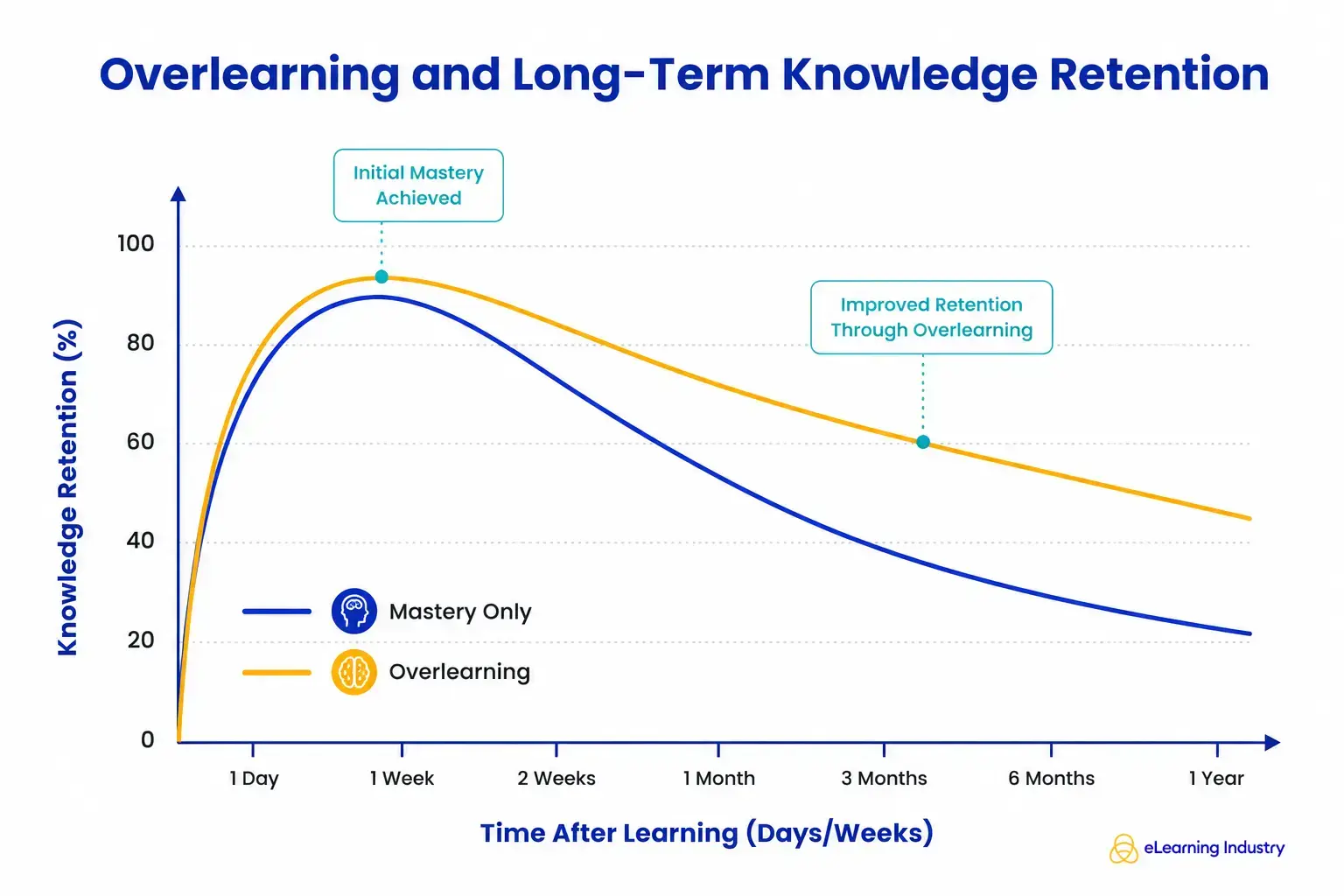
Overlearning helps people remember what they learn for much longer by making their memory stronger and recall easier. Rather than stopping practice as soon as someone gets something right, overlearning means practicing until the skill feels automatic. This is especially useful at work, where employees need to use what they know correctly in real situations.
Helps Strengthen Memory
Overlearning works well because it helps people store memories more securely. The forgetting curve shows that people forget new information over time unless they practice it. Actively recalling information, instead of just reviewing it, helps people remember it for longer. For instructional designers, this means creating learning experiences that offer more than one chance to succeed and give learners time to practice and recall important ideas.
Makes Skills More Automatic
When people keep practicing after they already know how to do something, their skills start to feel automatic. This means they use less mental energy on the basics and can pay more attention to bigger decisions. For example, pilots practice emergency steps until they react without thinking. Surgeons, emergency workers, customer support, and sales teams also benefit from overlearning because acting quickly and correctly often matters more than just knowing the right answer.
Improves Performance Under Pressure
Stress, multitasking, and too much information can make it harder to remember things and make good decisions. Overlearning helps people do better in these situations because important skills become second nature. When routine tasks are automatic, employees can focus more on solving problems, talking with others, and making good choices even when things get busy.
Reduces Skill Decay Between Training Sessions
Even strong skills can fade if they are not practiced. Combining overlearning with spaced practice, refresher sessions, and regular reminders helps people keep their skills sharp between trainings. Instead of just one-time lessons, Instructional Designers can build learning programs that help people remember and use what they learn over the long term.
When Should Instructional Designers Use Overlearning?
Overlearning works best when people need to perform tasks accurately, consistently, and without hesitation. Not all training needs extra practice after mastery, but some skills are much more costly to forget. Instructional Designers should focus on tasks where mistakes could impact safety, compliance, productivity, or a learner’s confidence. Understanding overlearning helps you decide where extra practice will have the greatest impact.
Compliance Training
Compliance training is a great example of when overlearning is useful. Employees often need to remember legal rules, company policies, or industry regulations long after finishing a course. Just passing a final test usually isn’t enough. Using realistic scenarios, quizzes, and regular refreshers helps people remember what to do when it really counts.
Safety-Critical Roles
In high-risk jobs, mistakes can have serious consequences. Healthcare workers, manufacturing workers, aviation crews, and construction teams often need to act quickly under pressure. In these cases, overlearning means practicing key tasks until they feel automatic. This helps reduce hesitation and leads to better decisions when things get stressful.
Customer-Facing Employees
People who work directly with customers also gain from overlearning. Sales reps can practice handling objections, support teams can work on conflict resolution, and retail staff can build up their product knowledge. Ongoing practice helps employees respond naturally rather than search for answers, leading to more confident, consistent customer service.
Digital Skills That Must Become Habitual
Some digital skills should become second nature, not something employees have to think about each time. Good examples include cybersecurity habits, software workflows, and proper data handling. While overlearning in psychology is about building memory after you’ve mastered a skill, the same idea works at work. Put extra practice into skills that are risky, done often, or hard to fix if done wrong. These are the tasks where overlearning pays off most in the long run.
When Overlearning Can Become Counterproductive
Overlearning can be effective, but it does not suit every learning goal. Practicing beyond mastery can help people remember information longer, but too much repetition may cause fatigue, boredom, and less benefit over time. Extra practice might not add much value and could take time away from learning other important skills. This is especially important in workplace training, where time is limited.
Instructional Designers should avoid repeating things more than needed. If a task is simple, done often at work, or easy to pick up again, too much overlearning may not help much. In these cases, it is better to use tools, quick refreshers, or spaced practice to support learning.
A simple set of questions can help you decide if overlearning is the right approach. Consider the following:
- Is forgetting costly?
- Is fast recall required?
- Is performance under pressure expected?
- Is the skill used infrequently?
If you answer “yes” to several of these questions, overlearning will probably help improve performance and reduce mistakes. If not, it may be better to use targeted practice instead of extra repetition. The aim is not to overlearn every skill, but to use this strategy where strong memory and quick performance matter most.
Practical Strategies For Applying Overlearning In eLearning
Overlearning works best when it is part of the learning process from the start, not something added later. After learners reach basic competence, Instructional Designers can use targeted reinforcement to help them remember information longer and feel more confident. Rather than repeating the same tasks, use activities that boost recall and encourage learners to use their knowledge in new situations.
Use Retrieval Practice
A straightforward way to support overlearning is by using retrieval practice. Instead of having learners reread material, ask them to remember information from memory. Tools like short quizzes, flashcards, and reflection questions require active recall, which helps learners remember information for longer. This method aligns with the idea of overlearning, as learners continue practicing even after they understand the material.
Build Scenario-Based Exercises
Realistic scenarios let learners use what they know, not just pick the right answer. For example, customer service staff can practice handling tough conversations, and managers can work on giving feedback. Changing up the situations helps learners think more deeply and get ready for real challenges at work. This is especially important for skills that need to be done well under pressure.
Add Spaced Reinforcement
Rather than repeating the same lesson several times in a single session, try spreading reinforcement over days or weeks. You can use follow-up quizzes, microlearning modules, or reminder emails to help learners review key concepts before they forget. Research on overlearning in psychology shows that practicing over time strengthens memory and reduces skill loss more effectively than cramming.
Introduce Varied Practice
Try not to use the same exercise repeatedly. Instead, encourage learners to apply the same skill in different situations, formats, or levels of difficulty. For example, a cybersecurity course might include phishing emails, simulated attacks, and decision-making exercises instead of just multiple-choice questions. Varied practice helps learners adapt and stay engaged. It also supports the goal of overlearning in psychology: building flexible, lasting knowledge that works in real life.
Measure Automatic Performance
Finally, check if learners can use their skills automatically. Rather than just asking, “Can they do it?” consider, “Can they do it quickly, accurately, and every time?” Looking at speed, confidence, and accuracy gives a clearer picture of whether a skill is truly learned. When learners can perform with little effort in different situations, Instructional Designers can trust that the knowledge will last well beyond the training.
Overlearning Examples In Workplace Learning
Overlearning works best when employees must perform important tasks accurately and reliably, even after some time has passed. The examples below show how practicing beyond basic mastery can boost workplace performance. Extra practice helps people remember skills longer and achieve better business results.
Sales Onboarding
New sales reps start by learning the product lineup and practicing sales pitches through role-plays. They then keep practicing how to handle objections with different customer situations. This extra practice helps them respond more naturally in real conversations, get up to speed faster, and close more sales.
Healthcare Simulation
Nurses and clinicians first learn a patient care procedure in training, then repeat it in realistic practice sessions. This ongoing practice helps them remember the right steps when under pressure, which lowers the chance of mistakes and keeps patients safer.
Cybersecurity Awareness
Employees learn to spot phishing emails and pass an initial test. Ongoing phishing simulations and follow-up exercises help reinforce these skills, making it easier to notice suspicious messages and lowering the number of successful cyberattacks in the company.
Customer Service
Support agents first show they can follow the escalation process correctly. Then, they practice with different scenarios involving frustrated customers. By working through a variety of situations, they gain confidence, respond more quickly, and improve customer satisfaction.
Leadership Communication
New managers practice giving constructive feedback and holding one-on-one meetings. With regular coaching and conversations with different types of employees, they become more confident communicators. This leads to better performance discussions, stronger engagement, and more trust in their teams.
In eLearning Industry, our training approach goes beyond just completing training programs. We focus on helping employees remember and use important skills long after training ends, because consistent performance leads to real results.
-Christopher Pappas, CEO and founder of eLearning Industry
Conclusion
Overlearning isn’t about asking learners to repeat the same task endlessly. It’s a purposeful strategy that extends practice beyond initial mastery so knowledge and skills become easier to recall and apply when they matter most. For Instructional Designers, it’s most valuable for high-impact tasks where mistakes carry real consequences, such as safety procedures, compliance, or customer interactions. Combined with retrieval practice, spaced reinforcement, and realistic scenarios, overlearning helps create lasting learning experiences that support confident performance. In many cases, reinforcing critical knowledge is far more effective than introducing additional content that learners may quickly forget.
