

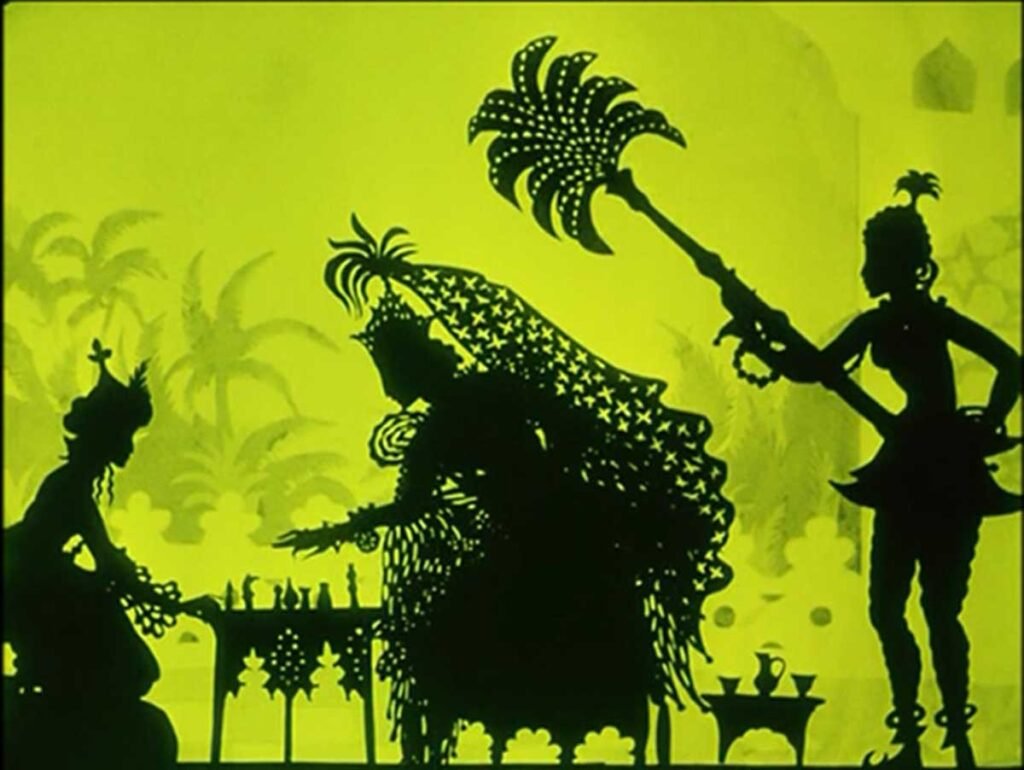
Die Abenteuer des Prinzen Achmed, or The Adventures of Prince Achmed, lays fair claim to being the earliest animated feature film in existence. If we do grant it that title, it beats the next contender by more than a decade. While Prince Achmed came out a century ago, in 1926, Snow White and the Seven Dwarfs, whose production was presided over by a certain Walt Disney, didn’t reach theaters until 1937. The latter picture holds great distinction in the history of cinema, of course, not least that of being the first feature made with cel animation: the dominant technique throughout most of the twentieth century, and one whose digital replacement has been lamented by classic animation enthusiasts. But the quivering silhouettes of Prince Achmed show an alternative.
The making of Snow White was, by the standards of the day, a vast undertaking, requiring Disney to marshal artistic and industrial resources at a scale then unknown in animation. Prince Achmed, by contrast, owes its existence mostly to the work of one woman: Lotte Reiniger, who first learned the craft of scherenschnitte silhouette-making as a little girl in Berlin.
Scherenschnitte was inspired by what was thought to be ancient Chinese arts of paper-cutting and puppetry, but when watched today, Prince Achmed or the other animations Reiniger created bring more readily to mind traditional Javanese wayang kulit shadow puppet theater: an aesthetic that, in a sense, suits the source material ideally.
The episodes that constitute Prince Achmed’s narrative are drawn in large part from One Thousand and One Nights, a text whose centuries-long evolution bears the marks of not just many distinct cultures across Asia and the Middle East, but also those of more dramatic transformation through its folktales’ cultural transposition into French, then other European languages. What Reiniger brings to enchanting handmade life isn’t any particular place at any particular time, but rather an elegant, mysterious, quite literally arabesque realm that never really existed. In other words, Prince Achmed takes place in what can only be called the Orient — which, now that the film has fallen into the public domain, we can all visit whenever we like. And if such visits happen to inspire a new generation of Lotte Reinigers in this world of market-researched mega-budget animation, so much the better.
Related content:
The First Animated Feature Film: The Adventures of Prince Achmed by Lotte Reiniger (1926)
Watch the Oldest Japanese Anime Film, Jun’ichi Kōuchi’s The Dull Sword (1917)
Based in Seoul, Colin Marshall writes and broadcasts on cities, language, and culture. He’s the author of the newsletter Books on Cities as well as the books 한국 요약 금지 (No Summarizing Korea) and Korean Newtro. Follow him on the social network formerly known as Twitter at @colinmarshall.
