

New Space Capitalism: The Entrepreneurial Path to the Stars
By Rainer Zitelmann
Skyhorse Publishing, 2026.
Pp. 304, $32.99 (hardcover).
The 1968 film 2001: A Space Odyssey was eerily prescient. On a mission to Jupiter, astronauts Frank and Dave get their news on the equivalent of an iPad, something that would not be invented until 2010. And when their onboard computer, HAL, goes rogue, the narrative anticipates today’s anxieties about artificial intelligence with uncanny precision.
The film also foresaw the expansion of business and commerce into space. One character travels to the moon on Pan Am. He stops at an orbiting Hilton, which includes a Howard Johnson’s “Earthlight Room” lounge. These things, unfortunately, have not come to pass. But that may change if Rainer Zitelmann has anything to say about it. His recent book, New Space Capitalism: The Entrepreneurial Path to the Stars, argues that expanding property rights and free markets beyond Earth’s atmosphere is our best hope for spurring a new space age.
“Space capitalism,” he writes, “is the only way humanity will ever be able to colonize Mars or mine asteroids.” While looking ahead, Zitelmann also shows how the space economy is already beginning to boom, despite challenges from what might be called space collectivism.
From Apollo to the Space Shuttle
When Neil Armstrong, Michael Collins, and Buzz Aldrin stepped onto the moon in 1969, Zitelmann was a 12-year-old space enthusiast. He published a newspaper that day and sold it to his German classmates, filling it with information about space and rockets.
It had only been six years since John F. Kennedy made a speech at Houston’s Rice University calling for a man to land on the moon before the end of the decade. Success required a national effort in which cost was no object. It was, in effect, a quasi-military contest with the Soviet Union that, at its height, consumed 4.5 percent of the US government budget.
Today, more than half a century after the fictional events of 2001: A Space Odyssey, we have neither commercial flights to the moon nor orbiting Hiltons. We have not even returned to the moon since the last Apollo mission in 1972.
In hindsight, it was probably naïve to expect otherwise. Beyond providing a morale boost, the Apollo program offered no practical benefits commensurate with its cost. On Earth, life went on. Wars, poverty, disease, and disasters continued as before, demanding scarce resources.
NASA understood this. As Wernher von Braun, sometimes called the father of the American lunar program, said at the time, “We have to show that spaceflight is useful, and even profitable, for people on Earth, and in fact, space projects should begin to pay for themselves.”
The space shuttle, which flew its first mission in 1981, was designed to be reusable and bring down costs. Over its 30-year lifespan, it provided impressive footage for evening newscasts, including spacewalks, docking with the International Space Station (ISS), and landing on Earth rather than dropping into the ocean. But it ultimately failed to remedy what Aldrin called “the high costs of space access.”
Zitelmann blames this on government inefficiency. He writes that the selection of Rockwell to manufacture the shuttle in 1972, for instance, was a political gift from President Nixon to California, an important swing state. Furthermore, cost-plus contracting ensured that the private firms working for NASA had little incentive to control costs.
The shuttle even failed to make space travel safer. Two in-air accidents claimed the lives of 14 astronauts. (The Apollo program had claimed three lives, and none in flight). In 2011, the shuttle program was discontinued, and American astronauts began hitching rides to the ISS on Russian rockets.
Enter SpaceX
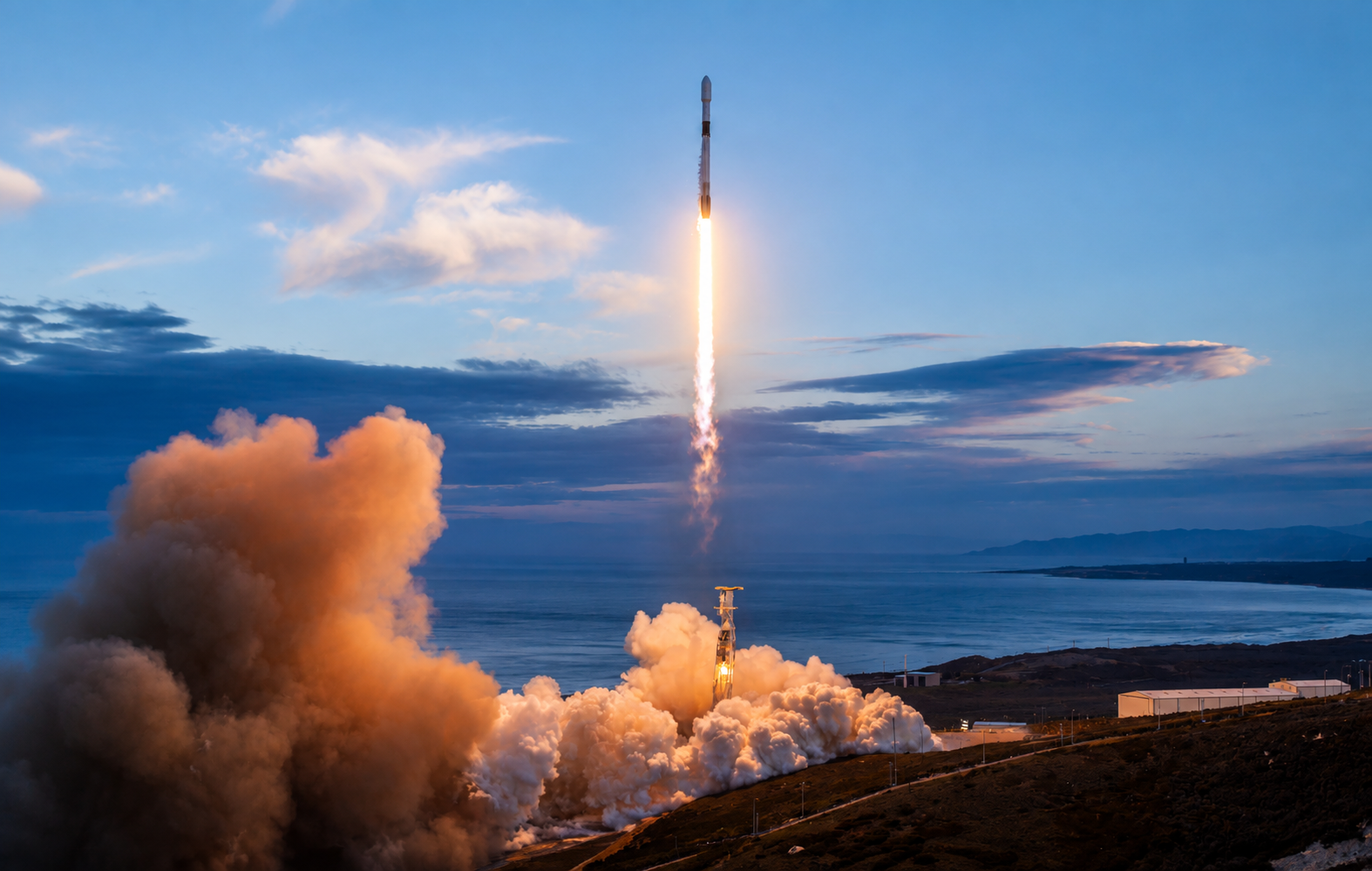
That changed on May 30, 2020, when Elon Musk’s company SpaceX carried two astronauts from Florida’s Kennedy Space Center to the ISS. It was the first crewed launch from U.S. soil since shuttle flights ended, and the first ever by a private company.
Rather than simply contracting with and directing the private sector, NASA had begun allowing businesses such as SpaceX to compete to carry payloads into orbit. So far, Musk has dominated this competition over rivals such as Jeff Bezos’s Blue Origin. Of 324 global space launches in 2025, SpaceX was responsible for 165. China was second with 88, and Russia third with 17.
Reusability is at the core of SpaceX’s business model. By reusing expensive rocket components, the company has driven its estimated cost of each launch down to roughly $15 million to $22 million, according to Zitelmann. That compares with about $1.5 billion to launch the space shuttle.
This has helped create a space economy that employed some 400,000 people globally in 2022, according to Zitelmann. Today, it plays a critical role in GPS navigation, weather forecasting, supply-chain logistics, and synchronized traffic lights.
The Next Space Economy
Zitelmann sees space as a major growth sector. One day in the not-too-distant future, scarce minerals might be mined from asteroids. Data centers might be built in space. Orbiting solar panels might transmit energy to Earth. The moon and Mars might be colonized as places for people to travel, live, and work—something both SpaceX and Blue Origin are already working toward.
But none of this is likely to happen without large private investments. Potentially standing in the way are agreements such as the 1967 Outer Space Treaty, which the US signed.
“Outer space,” it reads in part, “including the Moon and other celestial bodies is not subject to national appropriation by claim of sovereignty, by means of use or occupation, or by any other means.”
The Moon Agreement of 1979 goes further, declaring that “exploration and use of the Moon shall be the province of all mankind and shall be carried out for the benefit and in the interest of all countries, irrespective of their degree of economic and scientific development.” Though not signed by the US, it could throw a legal wrench into attempts to earn a profit in space.
Reinterpreting and renegotiating such agreements may one day fuel the legal specialty of space law. In the meantime, newer agreements push back on a collectivist notion of space.
In 2015, President Obama signed a bill allowing US citizens to own, transport, and sell legally obtained space resources. In 2020, Trump signed an executive order rejecting what Zitelmann calls “the notion of space as a global commons.” Now 70 nations have signed the Artemis Accords, which provide a further legal basis for the extractionion of extraterrestrial resources.
Radicals see this as a new colonialism, akin to that which enslaved and oppressed millions of people between the sixteenth and twentieth centuries. The difference, as Zitelmann points out, is that places like the moon, Mars and asteroids have no people, or beings of any type that we know of, to be oppressed.
Critical scholars such as philosopher Mary-Jane Rubenstein aren’t persuaded. In its drive to exploit space, she accuses the West of bigotry toward substances such as rocks that have the right to be left alone. Such arguments seem to regard humanity, and certainly capitalism, as a disease best quarantined on Earth. And while they may sound metaphorically spacey to most Americans, Zitelmann believes they are a danger if left unchallenged.
“Whether space capitalism has a future or not will first be determined on Earth,” he writes, “in the struggle between those who advocate freedom, property rights, and progress on the one hand, and those who espouse statism, egalitarian ideologies, and oppose progress on the other.”
One group that may not mind oppressing rocks is the government of China, which has emerged as the main competitor to the US in space exploration. In 2003, China put humans into orbit. In 2019, it became the first nation to land a craft on the far side of the moon. And in 2021, China built its own space station, which remains in use.
Zitelmann notes that China’s space program, like its economy, is a hybrid of government control and private business. Ultimately, he believes the winner of the new space race will be determined by which nation better empowers its private sector to take initiative and risks.
An Optimistic Future
For me, reading New Space Capitalism was a breath of fresh air. From 9/11 to social media addiction to the threat of artificial intelligence, the twenty-first century has not always offered much reason for optimism. It’s easy to feel pessimistic, if not dystopian, about the future. But a new space age offers a more hopeful vision. From lunar vacations to zero-gravity basketball, exciting possibilities may be closer than we think.
How soon such things become reality will, as the book argues, depend on whether we allow the profit motive to work beyond Earth’s atmosphere.
“Gravity may disappear in space,” Zitelmann writes, “but economic laws do not.”
