


On October 17, 2026, roughly 550,000 people marched across France to protest the high cost of living. By nightfall, cars were burning in Paris, the town hall in Limoges had been set on fire, and hundreds of people had been arrested. It was the country’s worst unrest in years, and it followed weeks of high school blockades that had already turned violent. The education minister reported that 24 schools had been burned or ransacked and more than 100 severely damaged.
Let’s face it, the French are no strangers to rioting in the streets. From the bloody revolution in the late 18th century to the Paris Commune of 1871 to the student uprising of May 1968, and more recently the suburban riots of 2005 and the Yellow Vest protests of 2018–19, one could almost call rioting one of the French national pastimes.
But all facetiousness aside, the recent riots in France may not be simply run-of-the-mill. They may portend darker things to come. That French students and young people are burning down buildings and looting stores because they are unhappy or opportunistic is true but doesn’t explain much. The proximate cause appears to be proposed austerity.
The government of Prime Minister Sébastien Lecornu proposed a 2027 budget with a €54 billion fiscal adjustment, giving credible notice that it intends to cut, not expand, government spending. The plan freezes most ministries’ budgets, public-sector pay scales, family allowances and housing aid, and it would freeze pensions above €1,260 a month. And many people are incensed (and incendiary) as a result.
Why would the French government propose such anathema as cutting national spending? It’s because they have a debt problem; or to be more precise, a borrowing problem. Long-term interest rates on sovereign debt have been rising across the world over the past few years from near 0 percent to 3, 4, or even 5 percent. While that may not strike you as a big increase, in relative terms that constitutes an increase of 1000 percent or even more. No country has escaped unscathed.
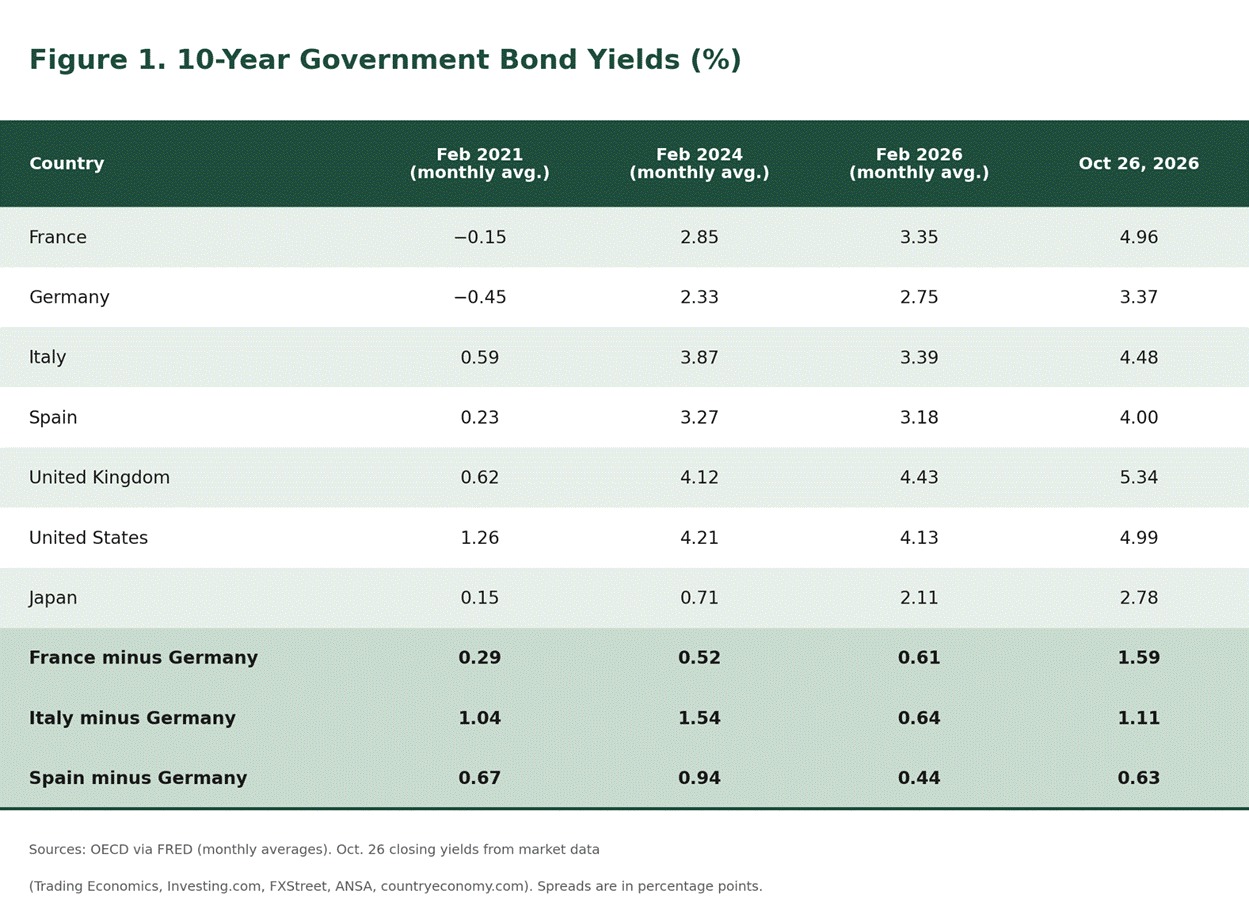
But in the past few months, France’s borrowing situation has become acute and threatens to grow altogether untenable. In October, the yield on France’s 10-year bonds topped 5 percent for the first time since 2002. What’s also interesting is the spread change in national sovereign debt rates. In February 2026, the French government only paid about 0.6 percent (60 basis points) more to borrow than Germany did. As of the end of October 2026, it was paying close to 160 basis points more.
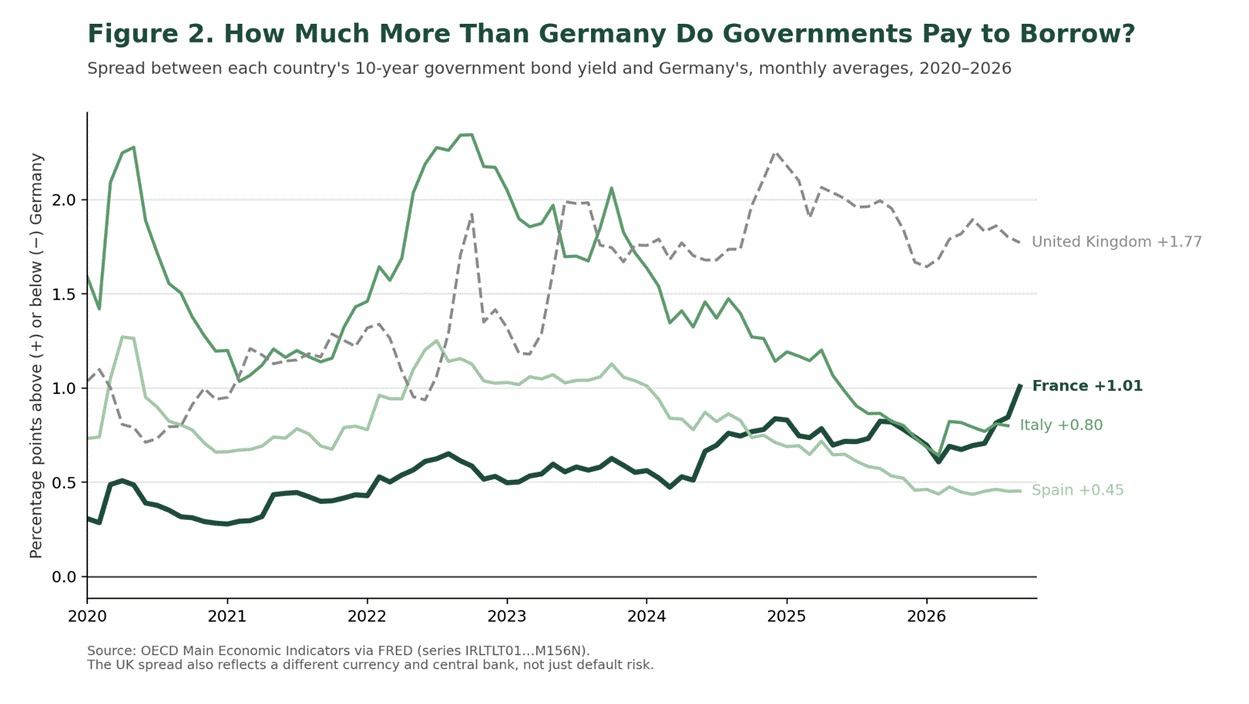
Such an increase in rates means heavily indebted governments must pay rapidly increasing debt service costs. The basic logic is simple. The French government sells bonds to investors willing to purchase them. Investors demand compensation (interest) for a combination of the opportunity cost of capital (what they could receive by lending their money somewhere else) and a risk premium (compensation for the risk that the French government won’t pay them back). Rising interest rates across the world show that the opportunity cost of capital has risen. But the widening spread between France and Germany stems from investors’ perception of its stability and risk of default.
The more euros that France wants to borrow, the more difficult it will be to pay them back with interest in the future. And, as perception of France’s inability to pay future debt obligations increases, the more expensive it will be for them to borrow. Instead of paying about 3.3 percent in February 2026, they now need to pay nearly 5 percent as of October 26th, 2026. As their financial position worsens, investors perceive a greater risk of default and demand higher rates, making it even more expensive to borrow. You can see why France (and other countries) may have a problem.
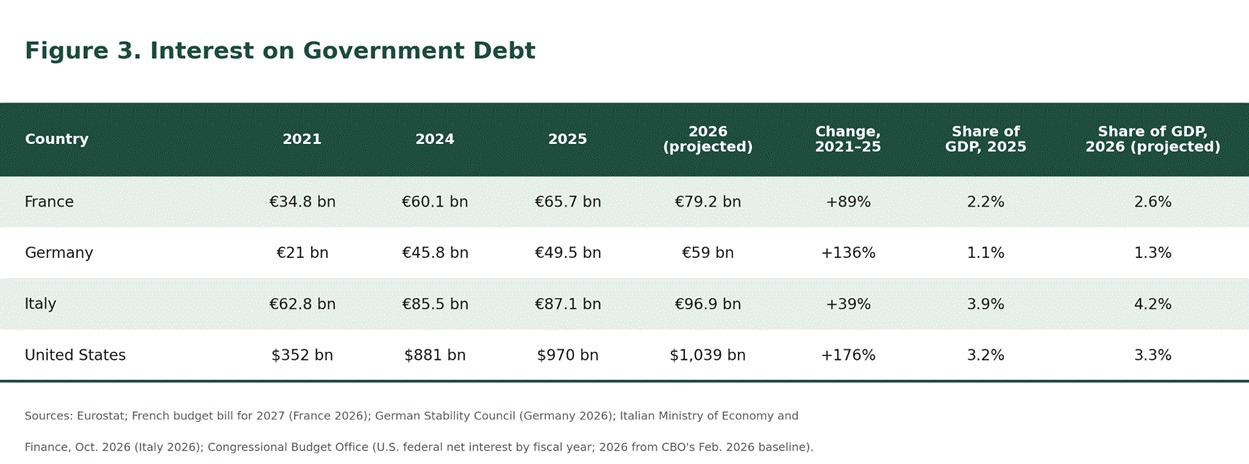
The French government realized that higher rates are a problem and proposed modest cuts, which the politicians in the National Assembly are resisting (though with less destruction than the rioters). The proposed cuts will bring the projected deficit down to 5 percent of GDP from 6.4 percent. If that restores confidence among investors, the French government hopes to bring down their risk premium and their borrowing costs too.
But an awful lot of people in France have gotten used to subsidized schools, tax-paid health care, short work weeks, and big pensions, and all the other government largesse (the French national government spends more than 50 percent of the country’s annual GDP) that has been doled out decade after decade. The legal workweek has been just 35 hours since 2000, and public pensions alone cost France about 14 percent of GDP compared with an average of under 9 percent across developed countries. And French beneficiaries will not go quietly into an austere night.
At the same time, their options are not what they once were. In the three decades after World War II, France built a fleet of nuclear reactors in about 15 years, early high-speed trains, the Concorde, the Ariane rocket, and even an early online network, the Minitel. But beginning with Mitterrand’s election in 1981, the country turned sharply collectivist. It nationalized major banks and industrial groups, lowered the retirement age to 60, shortened the workweek, and expanded the public payroll.
France has tried to undo Mitterrand’s legacy, with little lasting success. A 2010 law raised the retirement age from 60 to 62. In 2023, President Emmanuel Macron pushed it toward 64, but only by invoking a constitutional provision that let his government bypass a parliamentary vote. Months of strikes and street protests followed, some drawing more than a million demonstrators. Two years later, Prime Minister Lecornu traded the reform away to survive no-confidence votes, and the retirement age is now frozen at 62 years and nine months until at least 2028.
Taxes on productivity and wealth creation rose, red tape strangled business development, and as firing became more costly, unemployment climbed. As late as 1995, French and American GDP per capita were nearly even. Today Americans produce almost twice as much per person.
In the face of needed retrenchment, many people in France feel like victims with little hope for improving their conditions as the government’s spending power wanes and their cost of living increases. Though France’s case is acute, they are not an outlier. Italy, Spain, and other Eurozone countries, as well as the United Kingdom, find their public debt mounting and their populations increasingly resistant to austerity. The Greek debt crisis of a decade and a half ago was just a warm-up act compared to the scale and amount of unrest we will see if these countries undergo similar austerity measures.
Governments could soften the blow by deregulating now, because deregulate they must if they wish to maintain order and any semblance of prosperity. And there is reason to hope that their conditions post-austerity and deregulation will be better, though the transition can be painful. We’ve seen this movie before in the Nordic countries, in Canada, and in Australia.
Sweden ran a budget deficit of 11 percent of GDP in 1993, then cut spending and overhauled its pensions, taxes and budget rules, and it was running a surplus by 1998. Canada, which the Wall Street Journal mocked in 1995 as an “honorary member of the Third World” for its debt, cut federal program spending by nearly a fifth, balanced its budget by 1998, and halved its federal debt-to-GDP ratio over the next decade. Australia floated its dollar, slashed tariffs, deregulated its banks in the 1980s, then eliminated its national government’s net debt by 2006.
A century ago, coal miners carried canaries underground to detect poisonous gases like carbon monoxide, which they could neither see nor smell. The birds would collapse before the men felt any effects, giving the miners time to escape. Well, the French canary has keeled over. Will the Europeans and their governments change course and get out of the debt trap before real casualties mount?
The cost of government’s interest payments on national debt as a share of our GDP is already higher than France’s. And though the US government can issue new currency to fund its deficit spending, that is no real solution. In the long run it is simply an invitation to an ever more painful cycle of ever-increasing inflation.
Will Americans heed France’s difficulties and take the reform path of Canada, Australia, and the Nordic countries before that inflationary cycle begins? Let’s hope so.
