

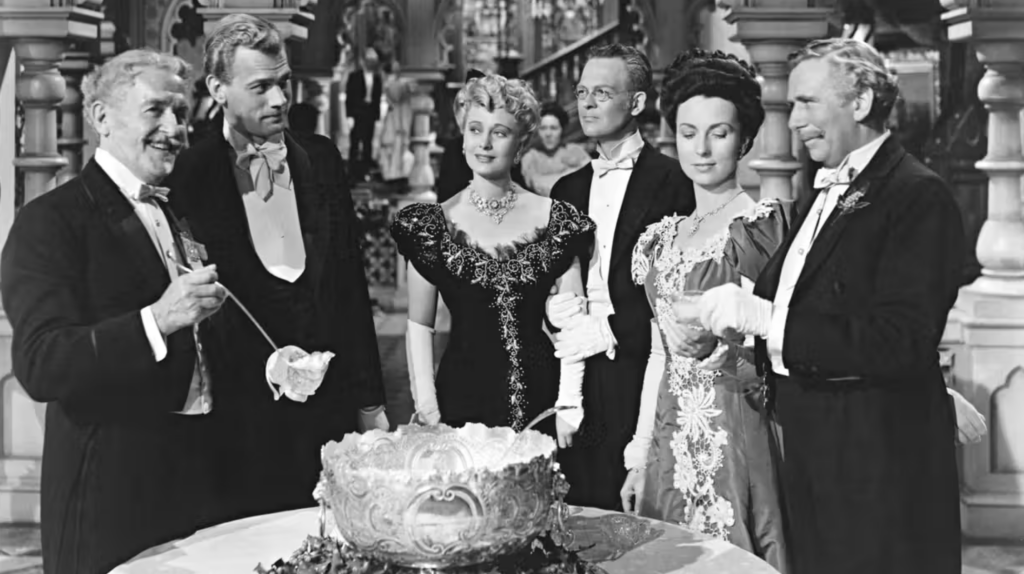
When television mogul Ted Turner died earlier this month, it gave cinephiles occasion to remember his brief but high-profile foray into colorization. In the mid-nineteen-eighties, he commissioned for broadcast colorized versions of more than 100 classic movies, from The Treasure of the Sierra Madre to It’s a Wonderful Life to Casablanca. It was only thanks to a clause specifying a black-and-white picture in Orson Welles’ contract with RKO that Citizen Kane never got the full Turner treatment. That blessedly failed project is now being invoked again in comparison with the startup Fable Studio’s enterprise, underway even now, of using artificial intelligence to restore Welles’ sophomore feature The Magnificent Ambersons, which was notoriously mutilated by the studio before its release in 1942.
The recut happened in Welles’ absence. After the attack on Pearl Harbor, he received what sounds like something more than a request from Nelson Rockefeller, then the government’s Coordinator of Inter-American Affairs, to go to Brazil and shoot a documentary about Carnival in the interest of “Pan-American unity.” Due to a disastrous test screening, as Welles explains in the clip from a 1982 Arena broadcast above, “it was thought by everyone in Hollywood, while I was in South America, that it was too ‘downbeat,’ a famous Hollywood word at the time.” Yet the entire film, to his mind, was about the downfall of the titular family, who lose their wealth and prestige as the society they knew slips out from underneath them during the transformations of the early automobile age: not a widely resonant theme, it seems, in mid-twentieth-century America.
“They destroyed Ambersons,” Welles says of the RKO’s recut, “and the picture itself destroyed me.” Yet even the Bowdlerized version has more than a few admirers. Among them is Edward Saatchi, the movie-loving advertising-company scion behind this AI restoration and/or reconstruction project. “His Amazon-backed generative‑A.I. platform, Showrunner, would feed off the data from the extant version of the film to prompt entire new scenes, based on voluminous production materials that survived, including scripts, photographs, and detailed notes,” writes the New Yorker’s Michael Schulman. “For emotional authenticity, Fable would first shoot live actors, then overlay the footage with the digitized voices and likenesses of the long-dead cast members.” The result has the potential to be unsettling on several levels at once.
As Schulman emphasizes, the film’s concern with the human cost of a technological revolution is hardly lost on Saatchi. “With all their speed forward, they may be a step backward in civilization,” says Joseph Cotten’s character, an early automobile investor, in a scene from the studio cut. “It may be that they won’t add to the beauty of the world or the life of men’s souls — I’m not sure. But automobiles have come, and almost all outward things are going to be different because of what they bring.” Even the human mind, he speculates, will be “changed in subtle ways,” a process clearly in effect by the forties. As far as the consequences of AI, we can already see how it’s begun changing the thinking of its early adopters. Saatchi himself displays an ambivalence about the technology, describing it as “potentially the end of human creativity” but also going full-speed-ahead with his unauthorized work on The Magnificent Ambersons — which, at the very least, he’s keeping in black-and-white.
Related content:
AI “Completes” Keith Haring’s Unfinished Painting and Controversy Erupts
Discover the Lost Films of Orson Welles
Based in Seoul, Colin Marshall writes and broadcasts on cities, language, and culture. He’s the author of the newsletter Books on Cities as well as the books 한국 요약 금지 (No Summarizing Korea) and Korean Newtro. Follow him on the social network formerly known as Twitter at @colinmarshall.
