


“Yet we were wrong, terribly wrong.”
That’s the jarring admission of Secretary of Defense Robert McNamara in his 1995 memoir In Retrospect about how poorly the Kennedy and Johnson administrations handled the Vietnam War. It is rare for a public figure to admit wrongdoing, and the frankness of his confession makes it all the more striking.
The mistake was, in fact, enormous. Ten years into the Vietnam War, the United States struggled to make progress against an entrenched enemy. In an effort to break the enemy’s resolve, McNamara championed a bombing campaign that lasted three years and killed tens of thousands of civilians because he believed “bombs dropped” and “villages cleared” were good stand-ins for “pressure applied.” He ignored what couldn’t be measured, like determination and morale. The results were disastrous: the campaign strengthened the enemy’s resolve, and the Vietnam War dragged on for another seven years, ending in American defeat.
This is the McNamara fallacy: when decisions are made based solely on quantifiable data, and all other kinds of evidence are ignored or dismissed. In its extreme form, the fallacy claims that what can be measured is everything, and what can’t be measured is nothing.
McNamara’s mistake sounds obvious in hindsight, but it’s a mistake we’re repeating today. The national conversation about inequality is similarly misplaced. Much like Vietnam-era statistics, inequality metrics are widely publicized, form the basis of policy, and distract from what really matters.
Start with a basic fact: inequality is not the same as poverty. Inequality concerns the distribution of income or wealth, not how well-off people are. There are poor countries with little inequality and rich countries with significant inequality. Distribution and average are entirely different metrics; you might as well infer latitude from longitude.
Yet how many times have you heard someone claim that a group suffers from “inequality,” or that “inequity” drives global crises in health or infrastructure? It’s an empty turn of phrase. To say a poor person suffers from income inequality is like saying someone struggling to climb a tree suffers from height inequality, but fewer tall people won’t bring a single branch closer.
Equality sounds nice, and big gaps invoke intense feelings of anger and injustice, but the emphasis on the distance between the rich and poor implies that making the rich worse off would somehow help the poor. Inequality isn’t the problem, but the big numbers make it easy to think otherwise.
Defenders of inequality metrics point out that inequality leads to disproportionate political access, resulting in the rich manipulating the government in ways that reduce competition and help industry incumbents. And while they are correct on both counts, inequality still isn’t the problem.
Imagine we had a system where contract disputes were settled with fistfights. Strength inequality would seem like a big problem: people who are five or ten times stronger than everyone else keep getting their way! There would be demands to limit gym time and protein consumption to shrink their muscles until everyone’s physique could be brought into parity. We’d have limited ability to move furniture, but it would make the system equal.
And after all that effort, we’d still have a problem because the real issue was never that the strong had a fighting advantage. The real issue was a system that rewards punching people. Once again, the inequality metric was a distraction.
Complaints about inequality that rely on political influence are really complaints about cronyism. Cronyism defies easy measurement, but it is what matters, and as long as the focus is on what’s easy to measure, we avoid tackling the underlying issue and the “solutions” just create bigger distortions.
But what about redistribution? Critics of inequality typically pair their concerns with some kind of tax-and-transfer system, and those funds would certainly help struggling families. If you take $1,000 from the rich and give it to the poor, the gap shrinks while the poor’s plight improves. Transfers, funded by taxing the super-wealthy, have a certain logic to them.
Even if the math worked, it’s not so simple. High taxes discourage work and encourage tax avoidance and evasion. The rich spend money on accountants (to find legal workarounds) or lawyers (to defend them if the government catches their illegal workarounds) rather than building new companies and ideas. They eschew high-risk investments when the high rewards that usually go with them are cut to a fraction. Getting rich is sometimes a matter of nepotism or corruption, and sometimes it’s a matter of hard work, thoughtful risk-taking, intelligence, out-of-the-box thinking, and all the things we associate with creating a more prosperous world. Punish that with higher taxes, and society suffers.
Economists call this the equity-efficiency trade-off. The economic pie can shrink as it’s cut more equally, so redistribution can leave the poorest people worse off, not better.
There are super-rich people who got their wealth completely from cronyism, and there are super-rich people who made their fortunes completely by creating and investing in things that make society wealthier. Most are in the vast gray area between: they have created companies that genuinely improved people’s lives but have also used governments to secure protections against competition. How much of each billionaire’s wealth grew the economic pie and how much was due to cronyism? The answer is as hard to measure as Viet Cong morale.
When the emphasis is on the gap between the rich and poor, hurting “the rich” becomes a goal in itself and leads to misidentified threats and misplaced efforts. For example, it’s not just the rich that benefit from cronyism. Occupational licensing restricts competition in jobs nowhere near the top of the income ladder: cosmetologists, taxi drivers, athletic trainers, travel guides, and countless others all drive up prices for everyone, low-income households included.
Unfortunately, tackling this particular problem won’t shrink the income gap because licensed salaries don’t reach the stratosphere. As long as anger is directed at the big numerical gaps, this very real problem doesn’t resonate. But taxing the super-rich, the very-rich, or even the somewhat-rich will “improve” inequality even as investment predictably falls. Inequality metrics decrease as the stated goals are quietly ignored.
Progressives often tout Europe’s low income inequality as evidence of the success of its generous social programs and broad, heavy taxes that pay for them. Those taxes, paired with a mangled mess of regulation, also stifle entrepreneurship and stunt firms that would otherwise grow. The end result is sobering. After factoring in both taxes and benefits, including health benefits, the median incomes of the largest European economies are 14 to 45 percent lower than America’s. Income might be more equal, but the typical person is worse off.
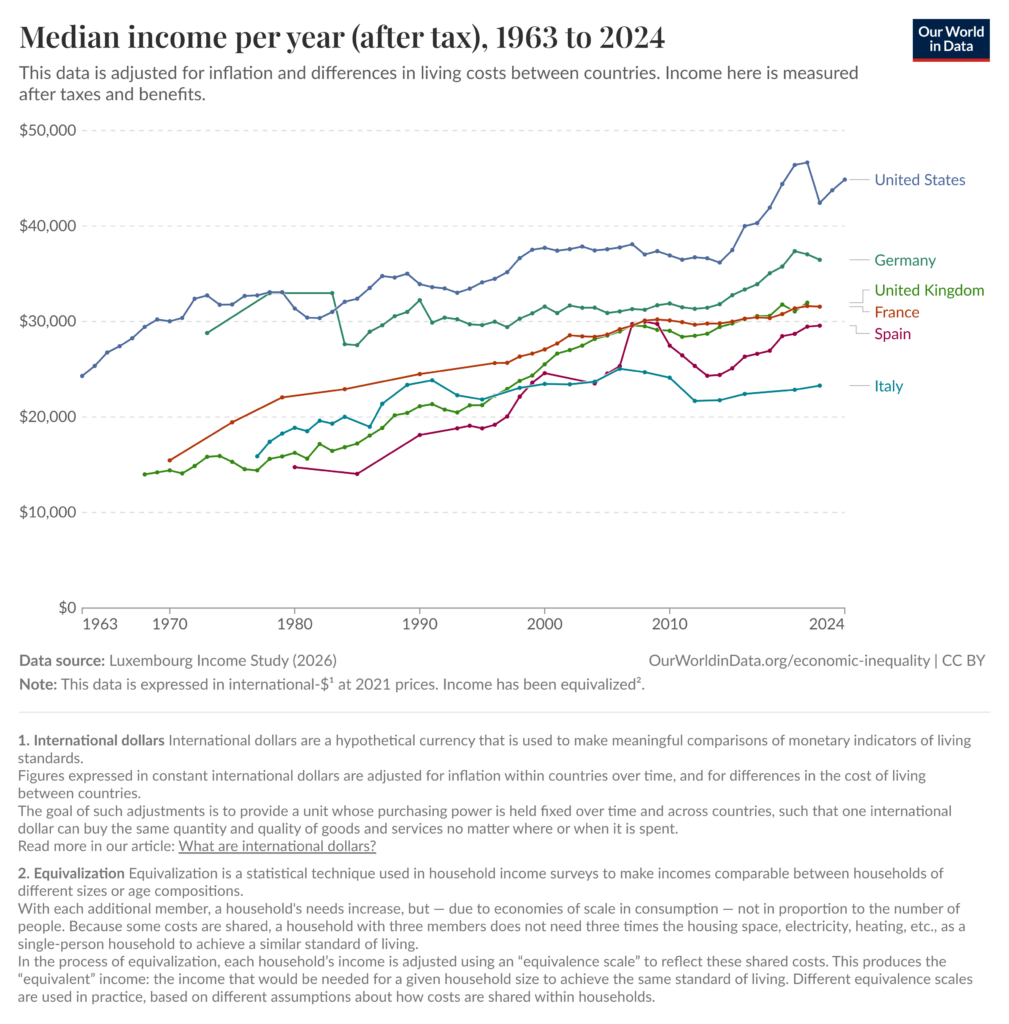
The focus on shrinking the measurable gap makes it harder to achieve much-needed regulatory reform. Robin Hood policies of redistribution might not help the poor, but they will definitely reduce inequality, and as long as that’s what’s prioritized, the real problems linger.
McNamara wrote his memoir because he hoped we would learn some lessons from his terrible mistakes during the Vietnam War. His honesty is a breath of fresh air in these hyper-partisan times. Let’s not ignore it.
