

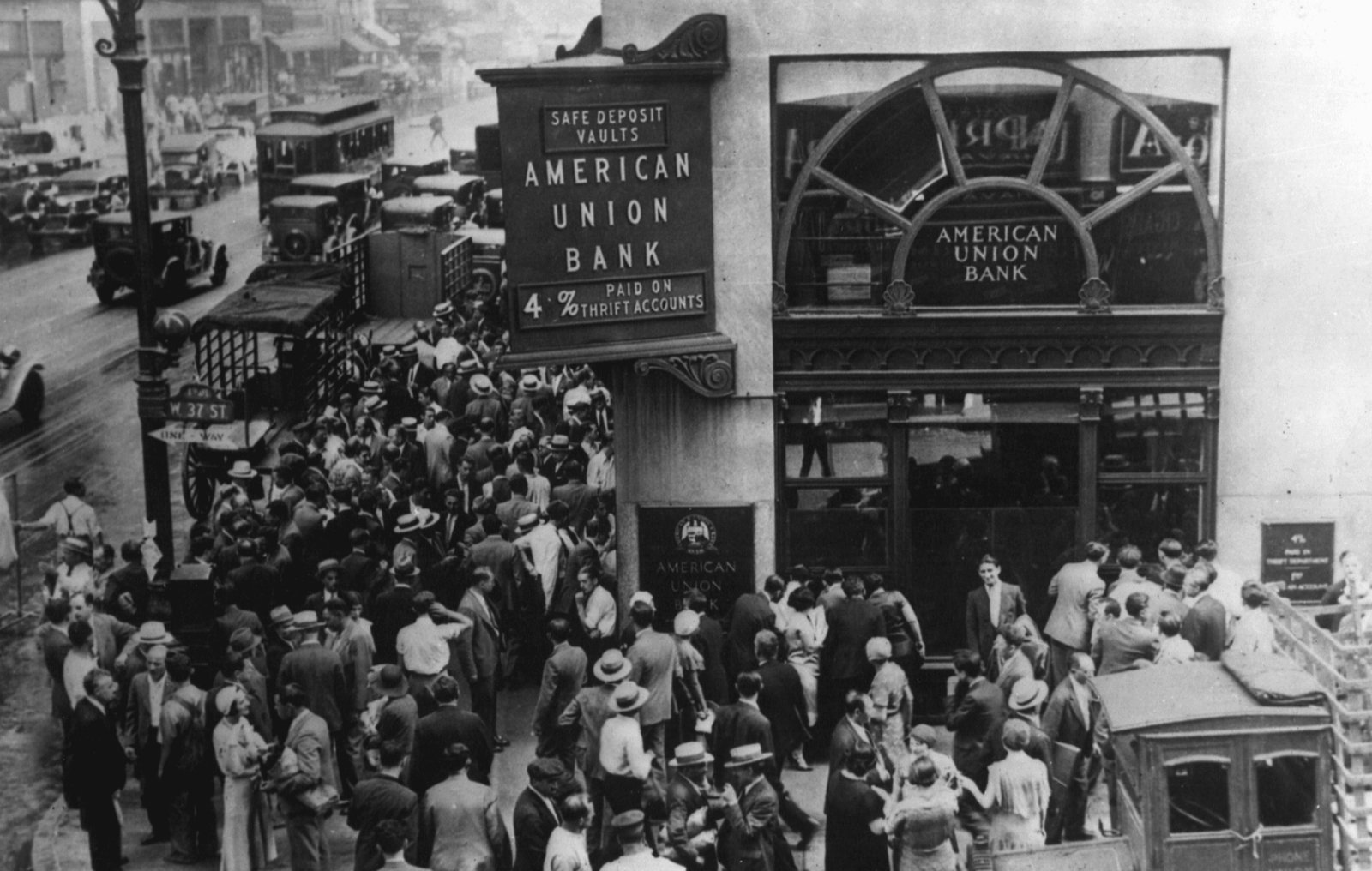
To most Americans, October is “scary” because of Halloween. Economists recall another scary day: Black Tuesday, October 29, 1929. Over that Monday and Tuesday alone, the US stock market plummeted by almost 25 percent, eventually falling 89 percent from its peak by 1932. The crash is widely recognized as the start of the Great Depression, the most severe economic downturn in US history.
Grade school textbooks may teach that the Great Depression was caused by Wall Street’s speculative excess, and that is part of the story. But the length and depth of the Depression were largely caused by flawed government policies, especially misguided monetary policy by the Federal Reserve.
The Unsustainable Boom
The seeds of the disastrous Depression were sown in the boom of the “roaring twenties.” The Austrian theory of the business cycle that originated with Ludwig von Mises and Friedrich Hayek describes how an unsustainable boom (generally driven by expansionary monetary policy) can result in a bust. Loose money pushes down interest rates and encourages borrowing for projects that would not be profitable at normal borrowing costs. When rates return to their neutral levels, the faults of malinvestment are revealed. Business profits fall, and with them, spending and employment.
Examining the events of the Great Depression, Lawrence H. White and I found that the boom and bust are consistent with Hayek’s theory. From 1921 through 1929, the money supply grew at an average rate of 4.6 percent per year, which, in Hayek’s view, outpaced the needs of the economy. This monetary expansion appears to have driven the well-known stock market boom and crash of the 1920s, and caused similar problems in industrial production and real estate.
The Inevitable Bust
By 1928, officials at the Federal Reserve recognized that the economy was growing beyond its sustainable rate. They decided to intervene by slowing the rate of money growth and, they hoped, the economy. The effects of their actions, however, were more severe than anticipated. The tightening exposed the overleveraged investments across the economy, which stunted spending, plunged the price level toward deflation, and tipped the economy into recession.
While this monetary contraction is sometimes attributed to the gold standard, the fault lies with the Fed. Fed officials were actively managing gold flows into the banking system with the intent of manipulating the economy. As future Fed Chairman Ben Bernanke and his coauthor Harold James described in 1991, “The initial contractions in the United States and France were largely self-inflicted wounds; no binding external constraint forced the United States to deflate in 1929.”
The same is true of the international contraction. Many countries around the world experienced simultaneous economic contractions as gold was drained from their monetary systems. The root cause was not the gold standard itself, but rather gold hoarding by the Federal Reserve and the Bank of France, which prevented the efficient function of the international gold standard and dragged much of the world into depression.
The Collapse of the Banking System
The economic downturn was magnified by a series of bank failures from 1930 through 1933.
These failures were partly due to risk-taking and central bank-induced malinvestment, but were primarily caused by another faulty Fed policy.
Since the Fed was created to serve as the lender of last resort, it could have intervened to support struggling banks following the initial 1930 panic by providing liquidity to the banking system. It failed to do so. As Milton Friedman and Anna Schwartz explain in their seminal book A Monetary History of the United States, 1867-1960, the lack of liquidity caused banks to hoard deposits, leading to a collapse in credit and a series of bank runs and panics.
By 1933, roughly one-third of US banks had failed, and more than $7 billion in deposits had evaporated. This collapse in financial intermediation accelerated the downturn and drove the economy into depression, resulting in the deepest and longest recession in US history. Real GDP fell by 29 percent, and the unemployment rate reached 25 percent. The recession officially lasted 43 months, about 2.5 times as long as the average US recession.
The Slow Recovery
The Great Depression was unique in American history not only for the depth of the economic contraction but also for its length.
John Maynard Keynes famously argued, contrary to the view of classical economists, that free markets do not necessarily facilitate recovery from economic downturns. Recessions can persist because markets fail to intermediate savings and investment. Markets do not, in Keynes’s view, provide sufficient incentives to guide businesses’ investment decisions. Instead, managers are lured by their “animal spirits” to overinvest during boom times and to be excessively frugal during recessions.
Keynes’s solution was to increase government spending to help kick-start the economy and encourage recovery.
Based on these same principles (although not on Keynes’s work in particular, as George Selgin points out), President Roosevelt’s New Deal aimed to spur an economic recovery. As White documents, advisors to the administration believed that falling prices were harming businesses and especially farmers, and that raising prices by limiting supply could help facilitate the recovery. This was a mistake. Although it is true that prices may rise as a result of strong spending and growth, FDR’s advisors wrongly believed that raising prices by restricting production would somehow benefit consumers.
Through the National Industrial Recovery Act (NIRA) and the Agricultural Adjustment Act (AAA), the administration instituted policies that reduced the supplies of food and labor. The NIRA required wages to be raised to unsustainable levels, increasing business failures and worsening unemployment. The AAA directed farmers to destroy their crops and to kill and dispose of their livestock, which decimated the nation’s food supply.
FDR’s supply-reducing policies had severe negative consequences for the economy.
Before it could recover to pre-Depression level, the economy relapsed into a second recession, sometimes known as the “Roosevelt recession,” from 1937 to 1938. In total, the two events lasted 108 months, more than five times the length of a typical US recession.
The second recession ended in 1940, but the years of World War II were not ones of material prosperity — that returned only after the war’s end, when the wartime restrictions and harmful New Deal policies were ended. While many believe economic recovery required government intervention, these misguided government policies themselves stalled the recovery and lengthened the Great Depression.
The Roosevelt administration nearly adopted a monetary policy that would actually have helped.
As Sebastian Edwards documents, the US Treasury had worked out an agreement with several foreign central banks to coordinate injections of gold into their banking systems as well as our own, expanding the money supply and encouraging recovery. At the last minute, however, Roosevelt called off the deal, because he preferred to conduct monetary policy by setting the price of gold himself.
What Caused the Great Depression?
The Depression was a correction from the unsustainable boom of the 1920s, magnified by the bank failures of the early 1930s, both of which were monetary in nature. Then, just as things began to turn upward, the harmful policies of the New Deal stunted the recovery and pushed the economy back into recession.
October is a month for scares and fear. But as President Ronald Reagan once said, “the nine most terrifying words in the English language are: I’m from the Government, and I’m here to help.” Such is the case with the Great Depression. Although they were intended to help, harmful government policies, especially from the Federal Reserve, caused, deepened, and lengthened the Great Depression.
