


On July 1, 2026, 46 states rang in Fiscal Year 2027. New York started FY 2027 April 1, Texas will start FY 2027 on September 1, and Alabama and Michigan will start FY 2027 on October 1. Whatever the calendar, many state leaders enter the year with less room for error than they enjoyed during the federal transfer surge six years ago.
As states face sluggish population growth, policymakers must be ready to face a new fiscal landscape. The states best positioned for that landscape will be those that protect economic freedom by keeping taxes, spending, regulation, and long-term obligations under control. States that answer slow growth with government expansion will enter the next downturn with fewer options.
Population trends are increasing pressure. From 2024 to 2025, population growth rates slowed in 48 states as international migration declined. Only Montana and West Virginia were able to attract Americans from other states at a rate that outpaced the decline in domestic migration.
More concerning is the nationwide slowdown in long-term growth rates across the states. Consistent, long-term decline threatens tax bases, labor markets, and budgets. At the same time, Americans continued moving across state lines. South Carolina led the nation in recent growth, while California lost residents.
These movements matter because people carry income, consumption, and entrepreneurial energy with them. A state that loses residents and businesses loses workers, consumers, entrepreneurs, and, ultimately, taxpayers. Government spending pressures, however, do not automatically fall at the same pace as a shrinking tax base. Much of state spending is “locked in” to promises made years ago: debt service on bonds, pensions and benefits to public employees, Medicaid, infrastructure, and public payrolls.
This competition is real. Households compare cost of living, including taxes, along with job prospects. Employers compare labor markets and the cost of doing business, including taxes and regulations. A state that makes work, investment, and construction easier has a better base than one that punishes growth.
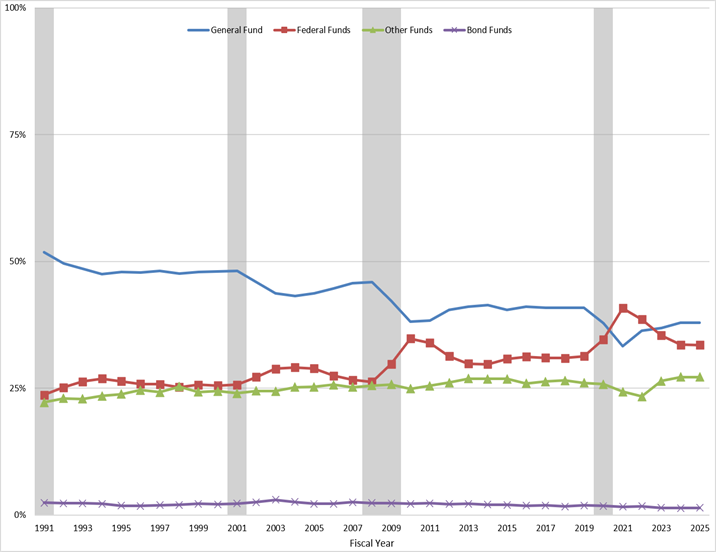
Over the past several years, states have masked many of these spending problems with extraordinary surges in federal transfers. Figure 1 shows the latest spending data from the states by revenue sources.
National Association of State Budget Officers data, modified by the author.
Note: State expenditures are capital inclusive.
In FY 2021, with federal stimulus packages from the pandemic steadily flowing, federal funds accounted for 40.8 percent of total state expenditures. That share steadily receded, but dependence has not disappeared. Across all states, federal funds for FY 2025 totaled $1.077 trillion, or 33.5 percent of total state expenditures. On an average-state basis, federal funds accounted for 34.1 percent of spending, only slightly below general funds at 35.1 percent.
This gives Washington substantial influence over state budgets due to the strings attached to federal funds. Federal transfers arrive with rules, preset priorities, and maintenance-of-effort expectations. Federal transfers allow Washington to influence state and local policy beyond direct legislation. They soften state budget constraints, distort spending priorities, and weaken accountability. States can expand programs without bearing the full political cost because federal taxpayers outside of the state help finance them. Voters then struggle to see who is responsible for spending growth, federal mandates, or future shortfalls.
That exposure is dangerous in a period of slow population growth and fiscal stress. As Washington adjusts transfer programs, states will face hard choices: raising taxes, cutting spending, borrowing, or some combination of the three. States that built ongoing commitments on temporary aid will be most exposed. The adjustment will be hardest where federal dollars supported recurring commitments.
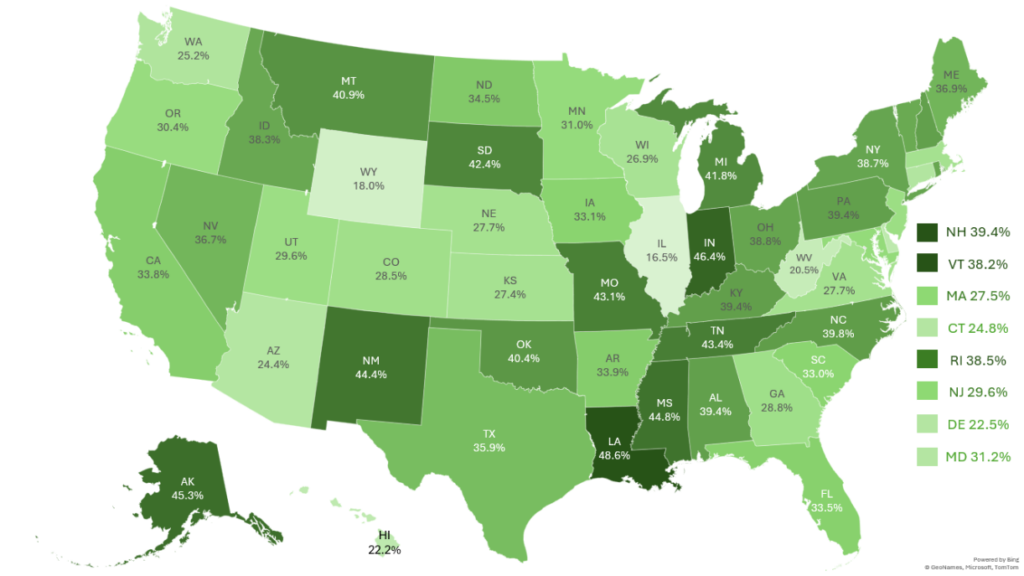
Federal dependence, however, impacts all fifty states. Figure 2 shows federal funds as a percentage of total state spending for FY 2025.
National Association of State Budget Officers data, modified by the author.
Note: State expenditures are capital inclusive.
As Figure 2 shows, federal dependence cuts across the partisan divide. The two states with the largest dependence on federal transfers, Indiana (46.4 percent) and Louisiana (48.6 percent), are red states. Indiana has experienced 18 years of Republican trifectas between 1992 and 2026 while Louisiana has experienced eight Democrat trifecta years and eight Republican trifecta years during the same period.
Federal exposure is shaped by numerous factors. A high federal share may mean different things in different states. In a leaner state budget, such as Indiana, federal funds can occupy a larger share because own-source spending is lower. In a high-spending state, such as New York, federal funds may instead help sustain a broader set of programs. Regardless, changes to federal transfers will require painful decisions from state leaders.
Additionally, the type of government may affect how state leaders respond to federal cuts. Since 1992, divided government has declined and trifecta governments (single-party control of the executive and legislative branches) have become more common. As of January 2026, 39 states have trifecta governments (23 Republican, 16 Democratic) while only 11 have divided governments. The duration of continuous, unified government matters more than party label alone.
The longer a single party remains in power, the more opportunity it has to build durable commitments, reward allies, and entrench interest group coalitions. That does not mean every durable trifecta will spend recklessly. It means voters should ask whether unified government has been used to restrain commitments or to hard-wire them into future budgets. States with large long-term obligations will have less flexibility when revenues slow, federal transfers change, or the next downturn arrives.
As FY 2027 kicks off for most states, state leaders must be mindful of the changing demographic and budgetary landscape. The best protection is a return to government that focuses solely on, in the words of Adam Smith, “Peace, easy taxes, and a tolerable administration of justice.”
