

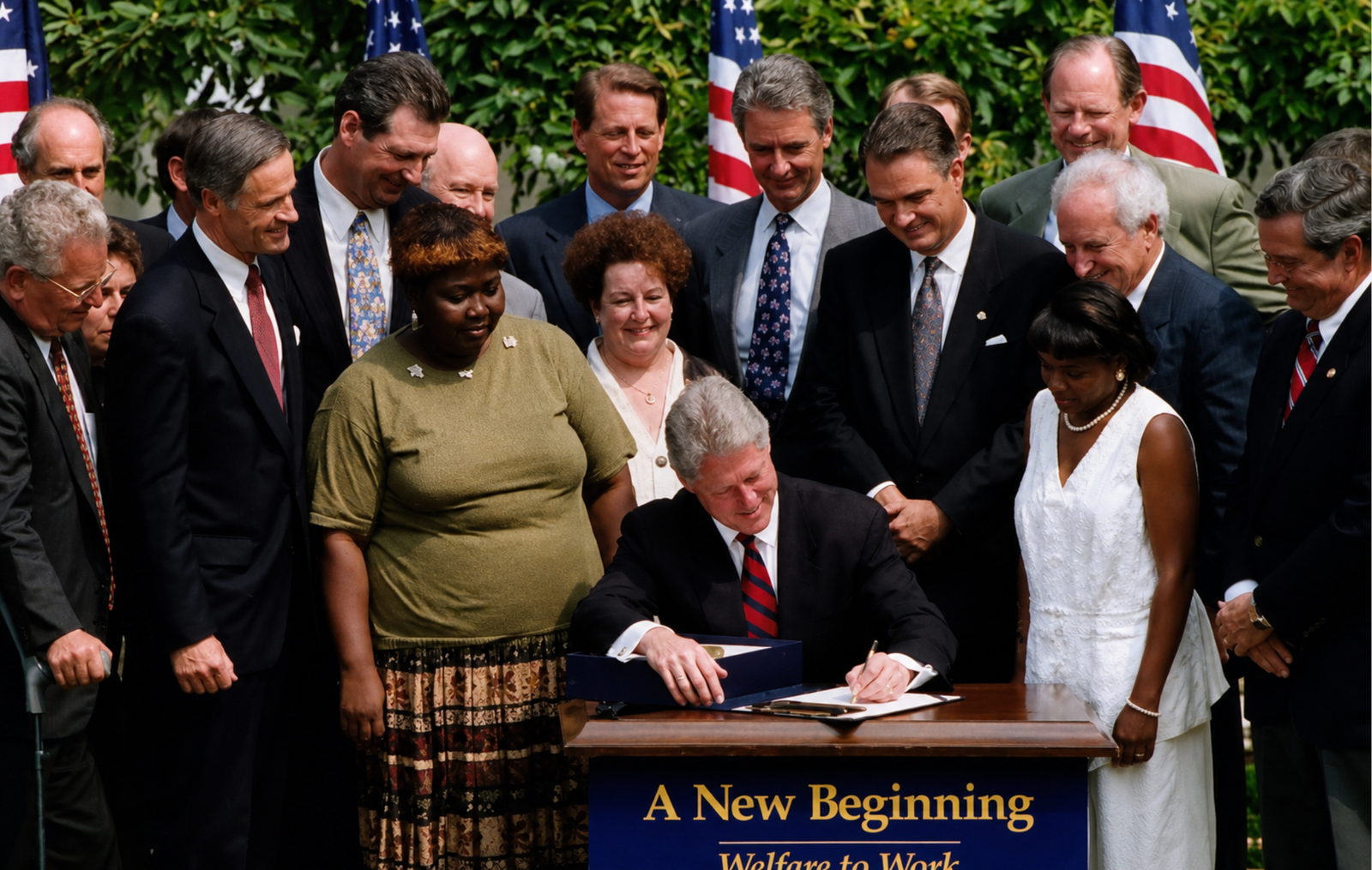
Thirty years ago this week, President Bill Clinton signed the Personal Responsibility and Work Opportunity Reconciliation Act (PRWORA) into law. Its passage marked a key milestone in the US debate around the welfare state and its incentives with respect to work and family life. Republicans’ near-unanimous aye votes were joined by substantial support from moderate congressional Democrats. Critics on the left were far less enthusiastic.
Clinton’s signature was met with praise from the political right, who had won a majority in Congress with its 1994 “Contract with America,” promising welfare reform. Then-Speaker of the House Newt Gingrich exclaimed in a CNN/Time interview that “you could make a pretty good case that this is the most significant Congress since the Great Society of 1965-66, and I don’t think that’s hyperbole.” He further rejoiced that PRWORA “ended the welfare entitlement after 61 years and reestablished the work ethic while returning control to local and state governments.”
In protest of the bill’s passage, three senior administration officials — Mary Jo Bane, Peter Edelman, and Wendell Primus — resigned from the Department of Health and Human Services. Edelman lamented, “I have devoted the last 30-plus years to doing whatever I could to help in reducing poverty in America. I believe the recently enacted welfare bill goes in the opposite direction.”
Among its chief goals, PRWORA ended the program Aid to Families with Dependent Children (AFDC) and related programs. Cash assistance would instead be dispensed through a new Temporary Assistance for Needy Families (TANF) block grant, transferred to the states to use at their discretion. Further, the bill’s passage “ended the entitlement to assistance for needy families with children and established time limits and modified work requirements for families receiving assistance.”
By its own text, the PRWORA also:
- altered the nation’s policies governing child support enforcement
- reauthorized, restructured, and increased funding for child care programs
- altered both the Food Stamp Program (now the Supplemental Nutrition Assistance Program [SNAP]) and child nutrition programs
- changed the eligibility rules that applied to disabled children in the Supplemental Security Income (SSI) program
- established a framework restricting benefits to only citizens and certain groups of legally present noncitizens across federal public benefits and means-tested assistance programs
In March 1994, 5.1 million American families received Aid to Families with Dependent Children (AFDC). As of December of 2025, that total was just under 925,000. While caseloads began declining before the legislation was signed, the decline accelerated after its passage. The TANF program saw similar declines in usage. For every 100 families in poverty, 21 received TANF benefits in 2023, a significant decline from 68 in 1996.
In recent retrospectives on the thirtieth anniversary of its passage, supporters of the legislation typically regarded the declining number of dependent households as an indication that fraud, waste, and abuse were mitigated and that the incentives to join and stay in the labor force have been largely successful. One exulted “the real mean wage and salary income of never-married mothers rose sharply and has now doubled pre-reform levels.”
Whatever successes the PRWORA achieved, bureaucratic maneuvering can alter the landscape of the welfare state. As the Obama administration responded to the 2008 recession, the United States Department of Agriculture (USDA) offered states a shortcut to food stamp eligibility. Under this “categorical eligibility” federal limits on income and savings were waived for households already enrolled in other programs.
While limiting paperwork duplication for those in dire straits is a worthy goal, that new guidance expanded eligibility for SNAP and undid many of the PRWORA reforms. In fact, households were “made categorically eligible through receiving or being authorized to receive a minimum TANF- or Maintenance of Effort-funded benefit or service, such as being given a brochure or being referred to a social services ‘1-800’ telephone number.” In 2011 the USDA provided guidance making anyone who received a simple notice of TANF non-cash benefits eligible. In the aftermath of these administrative decisions, SNAP participation rose to 47.6 million participants — fully 15 percent of Americans — in 2013. By 2019, that fell back to 35.7 million.
Not to be outdone, in 2012 the Department of Health and Human Services (HHS) allowed states to create exemptions from the work participation requirements set forth in the PRWORA. This maneuver came to the attention of legislators and was eventually rescinded in 2017. If the rule had stood, another of the key elements of the 1996 reform would have been eroded over time.
Further agency attempts to expand benefits faced congressional disapproval. The 2014 Farm Bill that demonstrated that although bureaucracies can alter the scope of benefits, Congress still has the ability to restrain rising expenditures. In 2021 the Thrifty Food Plan sought to raise maximum benefits, lauding the latitude the 2018 Farm Bill had granted, “instead of imposing a requirement that the Thrifty Food Plan update be cost neutral, USDA, following the 2018 Farm Bill, based its reevaluation entirely on data and evidence on the cost for which resource-constrained households can purchase a healthy, practical diet.” As a result, the program would cost at least $180 billion more in the federal budget over eight years.
Reversing the USDA’s attempts to sidestep cost-neutral expenditures, Section 10101 of the One Big Beautiful Bill Act of 2025 required future reevaluations to toe the budgetary line, only adjusting for inflation, thus stripping a large part of its discretionary powers.
The past 30 years demonstrate that reforms that scale back government intervention are far from permanent. The story isn’t over when the chief executive signs off. Agencies retain and often exercise substantial discretion over how programs are administered. They’ve shown a tendency to expand their scope of mission, budgets, and the reach of the welfare state, even when Congress has attempted to restrain them. Those concerned about the effects of an expanding welfare state should be on guard against both the legislature and the agencies distributing other people’s money.
