

Far from excessive, and not a copy-and-paste error, each “Your Mother” in director Bassam Tariq’s “Your Mother Your Mother Your Mother” carries pointed weight. It references the Islamic hadiths that recall the Prophet Muhammad’s answer to the question, “Who deserves the best of you?” To this, Muhammad answers, “Your mother,” three times, then “your father.”
For Latif (Mahershala Ali), a father of three who has just lost his wife, that kind of response sounds more like judgment than a balm, each successive “your mother” a blow to the body and soul. That triptych response exposes the gulf of his own inadequacy: as much as he tries to play the role of provider and protector, he will never be able to care the way his kids’ mother has.
To complicate matters, Latif’s chosen vocation, a hit man for hire, awkwardly clashes with the time he spends praying for mercy and peace at the neighborhood Mosque. When his handler threatens to expose his work to his Houston community unless Latif takes out a Korean Christian extremist pastor, Hwan Yoon (John Cho)–sporting a gold grill and big cowboy hat–the hit man has to choose between more blood or exposure.
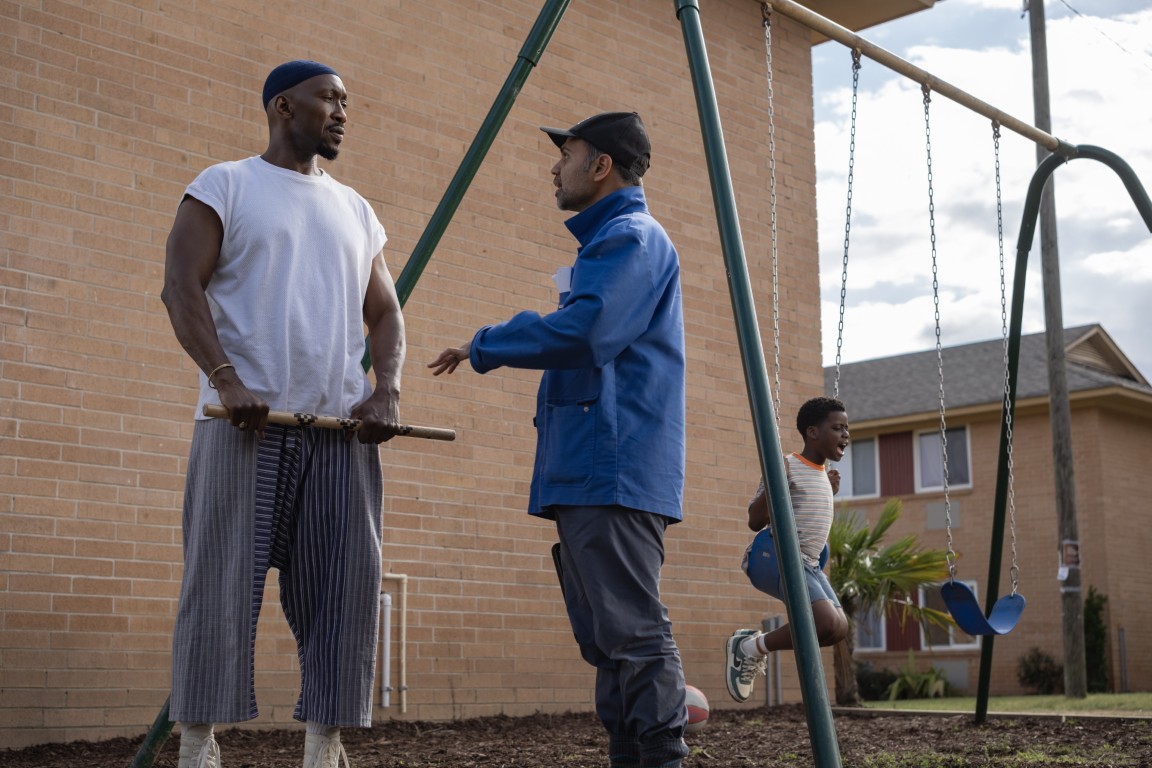
Photo Credit: Jaclyn Martinez
It would be easy to distill the central conflict of Tariq’s film into one between Christians and Muslims (it would overlook the crucial role a group of Mormons, in the throes of Bible study, play in a late sequence in the film), and “Your Mother Your Mother Your Mother” complicates that notion by showing how the Latif and Hwan are both sides of the same shekel. As Yoon also kills in God’s name, he just uses guns and has the backing of zealots; how different is his work from Latif’s smaller-scale executions? Both men believe they are doing God’s work, searching for the divine in a world that seems so broken and bereft of grace.
That Hwan is Korean is also a significant choice. In past interviews, Tariq has expressed that it was important for the antagonist to be a “colonized Asian” because he wanted “someone who’s got this inferiority complex built into their system of being, where you feel like you’re always taken over by the whites … So then what you do is you end up taking on affectations of other cultures, and something that happens a lot in Houston—particularly Asian communities—is we take on Black affectations.”
Additionally, Tariq’s witty script knows the buy-in to this world that he asks of his audience, and often leans into bits first almost as a way to get surface-level reactions out of the way; Latif is referred to as “Black ISIS” by an enemy assailant while Hwan is clocked as “Kimchi Jesus” by Hatty, the nephew of Latif’s handler, Mike (Laith Nakli).
For Tariq, whose debut feature, “Mogul Mowgli,” focused on another character whose dedication to a larger mission is fractured by personal loss, he views “Your Mother Your Mother Your Mother” as an extension of the themes he has long loved to dissect in his work. “I think it takes courage to believe. I think what devotion looks like in all of its imperfections is deeply human, and that is what I love to explore,” he shared.
After the film’s rapturous premiere at this year’s Toronto International Film Festival, Cho and Tariq spoke with RogerEbert.com over Zoom about crafting the film’s inventive fight sequences (hint: petroleum jelly and glass shards), crafting and playing characters who have to contend with answered prayer, and, for Cho, how Hwan subverts and channels his own relationship with faith.
This interview has been edited for length and clarity.
A question I keep wrestling with around this film is the connection between devotion and extremism, or, phrased differently, how extreme devotion can lead someone to become increasingly dogmatic. In your portrayal of Hwan, though, John, you imbue his extremism with a measure of sincerity.
John Cho: Bassam and I made that decision in tandem. Story-wise, it made sense that Hwan had to be ardently faithful and counterbalance Latif. It wouldn’t work if he were just a charlatan. The conflict only worked because these two people believed in seemingly opposing ideas and then saw what happened. I find even their shared experience at the film’s end fascinating: they have to interpret it for themselves, in their own way.
They both witnessed something that isn’t easily explained, and together they’re left with that question mark. It is one of my favorite scenes: two people so assured in how the universe works confronted for a moment with something they cannot explain.
This may be a personal deep cut here, but John, I had friends and family who were part of an extreme Korean Christian community while at Berkeley. Even if it manifested differently than Hwan’s “ministry,” it felt like you were channeling, or at least tapping into, something culturally specific to Korean culture, cults, and Christianity.
JC: What you are referencing is the reality that rigorous devotion can be cultural. When you combine it with dogma, a desire for community, and a longing to connect with other people… a lot can happen. That mix echoes what the film is about: the distance between the perfect, divine version of how to live life and the version we actually live on planet Earth, with sometimes terrible, flawed people. In the gap between the heights of Mount Olympus, what God may decree, and how that gets lived out in the valley below, there’s plenty of room for interpretation by people with the best and worst intentions.
Bassam, a large part of your work has been giving cinematic real estate to those entrenched in extremist thought. Your 2019 documentary film “Ghosts of Sugar Land” was more personal because you traced your friend Warren’s arc, but what keeps drawing you to this theme? Or has your approach to depicting people in the throes of devotion changed since you started your career?
Bassam Tariq: My friend, Warren–who in the film we called Mark because we did not know if he was a narc or not … we actually thought he was part of the CIA. He was really earnest in his belief. I have always been drawn to people who, in embracing a faith different from their own, jettison a whole experience or sometimes divorce themselves from a certain community. It takes courage to do that. I think it takes courage to believe. I think devotion, in all its imperfections, is deeply human, and that is what I love to explore.
To circle back to the ending, 2 Corinthians 5:7 says, “for we walk by faith, not by sight.” To me, the film captures something profound: what happens when your faith becomes sight? John, it feels like with Hwan, you capture the kind of awe that only comes when it feels like you see answered prayer, or when you see a miracle for the first time.
BT: I think we live in such a materialist world that we want empirical evidence for everything. I think the unseen requires you to move. I think so much of where we are right now is paralysis because people are so in their heads, on their devices, and want things to happen to them. For anything to happen to you, you have to move. You have to take those steps. Faith requires movement and action.
JC: The film explicitly references multiple faiths, of course, but I do see dogma everywhere right now. Everything is becoming dogma. We think in binaries, like devices where things are in zeroes and ones. That is our formation, and I think the point in life is to care for each other, be in communion, and ultimately exist as a community. Faith communities can model it, but it is susceptible, like everything in culture, from politics to culture, to becoming a binary. What are we supposed to do with that?
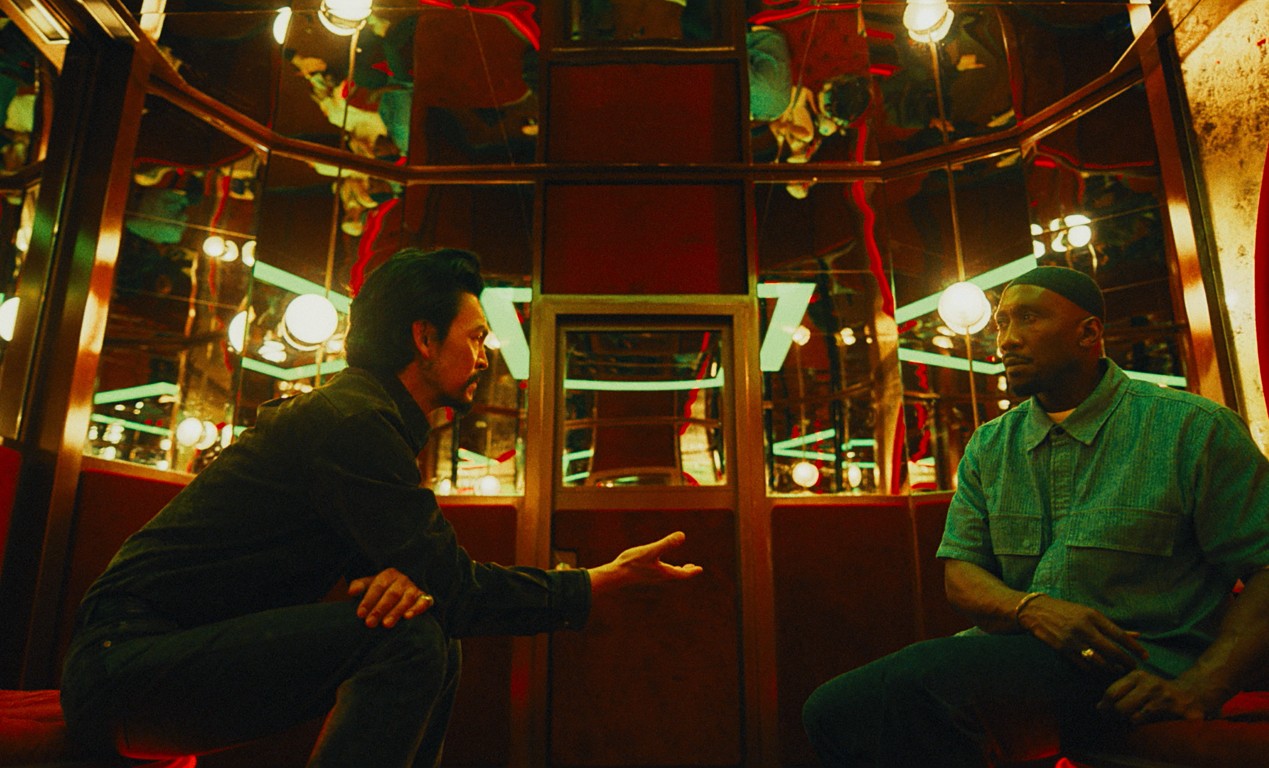
Photo Credit: Courtesy of Amazon MGM Studios
Your note about community is a poignant one, John, because Riz Ahmed’s Zed and Mahershela Ali’s Latif are both characters who feel ostracized by the communities that they serve and have to come to terms with the fact that they need to realize they’re links in a chain; they don’t have to fill certain shoes alone. What do you find restorative about community that you want to continually depict in your work?
BT: It’s funny because I really hate community too. I love where I come from, but I also run away from it. That is what humbles and frustrates me. The photo work I saw by Jamel Shabazz, a photographer who photographed the hip-hop community in the 1980s, has inspired me. His work is pedestrian; it’s just snapshots of people. Through his work, though, you can tell he loved his people, and because he loved them, he wanted to photograph them. That in and of itself was the art. It wasn’t, “Well, I’m going to wait for the light to come here or do this fancy set up,” … he took a picture and said, “These are my people; this is as they are; they exist, and I love them.”
That “come as you are” approach is my goal: to get to a place where I can just be and be happy with where I’m at. But I think I have a lot of friction that I’m constantly, I think, contending with.
There is a deleted scene where Latif’s son, Qadir, asks why Latif does not use a gun, to which Latif replies, “The sword requires you to move with intention.” I know Mahershela has said that to use a sword means that you’re not allowed to “separate yourself from the repercussions” of your actions because to kill with it is so personal. For you, though, John, your character seems to have no problem with a firearm, so I’m wondering if you feel there’s a “philosophy” of firearms that characterizes Hwan.
JC: What I kept coming back to with Hwan and guns was that using a gun felt “natural” … what does it take for someone to get to a place in their life where killing in that way is normalized? I kept thinking about Samson in the Old Testament and how he used the jawbone of a donkey to kill the Philistines. For him, he was trying to achieve his mission whenever and however he could, using whatever was at his disposal. That singular drive drove him, and I saw it at play with Hwan. Guns are the natural extension of getting things done in our culture, and so using them is as natural as starting a campfire. There’s almost a purity to his use that contrasts with how methodical and thoughtful Latif is with his weapon of choice.
The unique thing about Latif, though, is that he is not wedded to the sword. I need to hear how you came up with the petroleum jelly-glass shard combo. I thought I had seen every way to kill someone on screen before, but this was new.
BT: I never wanted to lose sight of the fact that Latif is a dad. To treat diaper rash, he probably had to have lots of that jelly on hand. When I think about my own experience as a father, the thing I kept always finding in my bags was petroleum jelly because you need it for something, whether it is for a rash or just another area of the butt. I actually hate petroleum jelly, and I remember when my kid got done with diapers I said: “I don’t ever want to touch this thing again because I guess everyone in my family is going to have really dry skin.” I was so happy to be done with that phase, so using it for this film, I kept thinking about how the sequence could serve as a final swan song for the jelly.
JC: To me, petroleum jelly is a very Houston thing. My mother used Vaseline for everything back then. She would’ve put it in sandwiches if she could have. So when I saw that scene where Latif slathered that on his gloves to grab glass, I kept thinking, “God damn, this movie is Houston.”
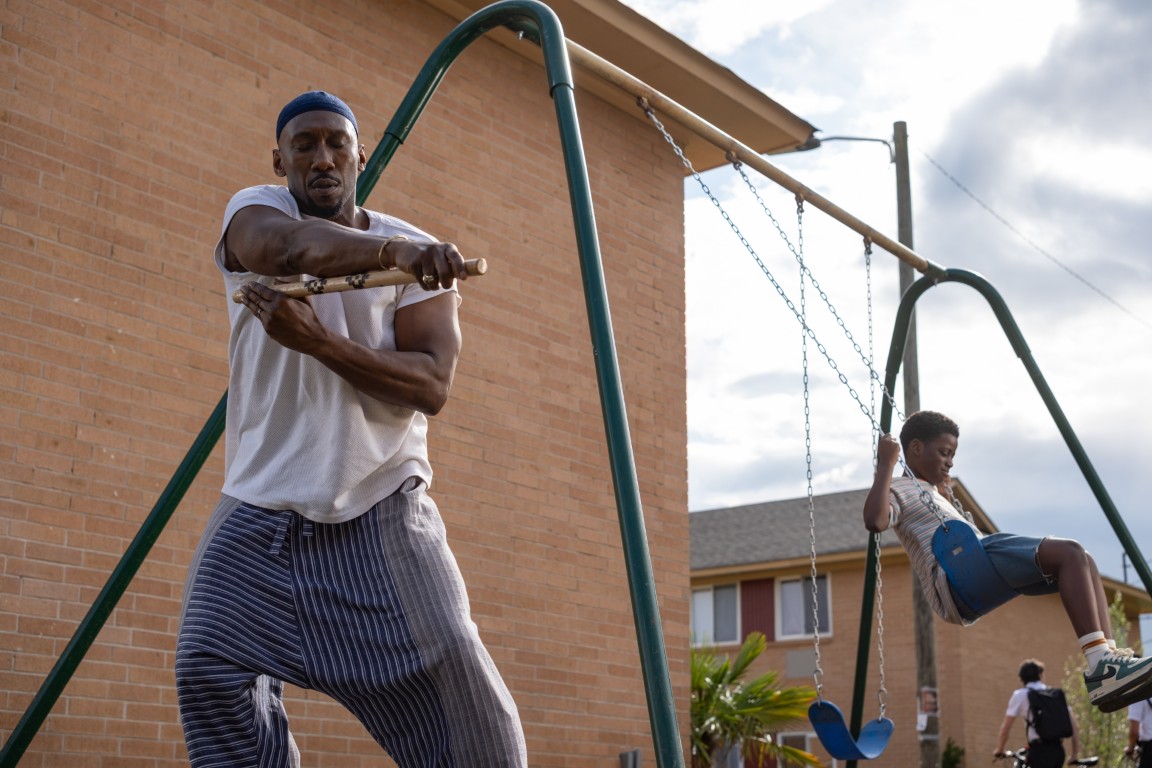
Photo Credit: Jaclyn Martinez
Maybe in the sequel, you can use the sword skills you learned in “Star Trek” more, John. I noticed the film features a lot of blown-out windows, which gives certain sequences, like in the mosque and the mansion, a blinding, cold, holy light in a way.
BT: I want to shout out two people: Katelin Arizmendi, our DP, and Akin McKenzie, our Production Designer. They always worked in tandem to figure out where the lighting would go, and you can really see their intentionality in how they lit the prayer scenes in the mosque. For observant Muslims, you’re always aware of the light in the room because the sun tells you the time and what type of prayer you should be doing. What was it like for you, though, John, to be in these spaces?
JC: I was definitely focused on the production design. I kept focusing on how the film feels and looks, atmospherically, like Houston. With the exterior light, you can tell it captures that very specific type of Texas humidity and heat. When we were shooting the fight in the strip club, I was thinking, “What are we doing with the lights in here in this mirrored room? How are we photographing this fight? Is it going to limit us?” But everything was set ablaze in the best way. It never felt generic, and there was always a sense of place.
I’m glad you mentioned “place,” John, because I know your father’s church in Houston was part of the Church of Christ denomination and that its philosophy around worship was “based on the absence of the mention of musical instruments in the New Testament.” It feels like spectacle is so endemic to how Hwan runs his congregation, so what was it like to play a character in a different key than how your conception of worship was framed?
JC: In my dad’s church, that minimalism was rooted in this sense of “Let’s strip down praise to what it is. It should just be people singing to God, and that’s it.” Hwan is very much a maximalist; he is thinking about what he could add. I remember having this conversation with my dad at a young age when I asked why our church didn’t have a piano, guitar, or drums. His response then has stayed with me, and I’m not sure if he was just giving in to teenage me, but he said something to the effect of, “This is what I’m doing, but I generally believe whatever edifies people is what we should be doing.”
I did think of that moving forward; Hwan also is like, “Whatever language is going to be useful in communicating to these people, this is the vocabulary I want to use.” His wardrobe, his affect, it’s all geared around this idea of “How can I get through to these people in their cultural context?” Everything is maximized to that, and he’s adopted a cultural attitude of “any means necessary.” In some ways, in Houston, the quickest way to people there is through loud music, a cowboy hat, etc.
To paraphrase what Paul says in 2 Corinthians, Hwan becomes all things to all people. I’m thinking about what you shared about working on “Columbus” and how Eero Saarinen designed the North Christian Church’s architecture in a way that made you rethink the possibilities of corporate worship. I wonder how much Hwan is thinking about whether his church spaces can win over hearts.
JC: Yeah, that church was very special because they had built it so that the preacher was below the congregation and the congregation surrounded each other, which I thought was a beautiful way to enter a space. Instead of seating congregants in rows facing the pastor, they arranged them so everyone faced everyone else. There was this sense that “the church is us.” The pastor was below the congregation. “We are the church; he is the servant.” That’s an example of a building leading you to conceive of your faith differently, and while Hwan’s setup is different, it subverts what you might expect, too.
“Mogul Mowgli” ends with Zed and Bashir sharing a moment in a bathroom, and then “Your Mother Your Mother Your Mother” opens in a bathroom. Was that intentional?
BT: One thing I’ll say about endings: maybe I knew “Mogul Mowgli” would end with the father and son singing to each other. We didn’t know if it worked because we had no money, and we had to do this scene in this little constructed space. I remember Riz was hesitant about it because he’s like, “Okay, so we start at the beginning of the film, I’m on the stage performing for this crowd, and then at the end, I’m going to perform for just my dad. … that’s a weird way to end the movie.” I was like, “It’s going to work, you just have to try it.”
I think at that point, everyone was so tired they just gave in. It worked out that where we end, two people who don’t know how to speak to each other can still have this moment of connection. They embrace, yell, all the while they have shit on their hands. It is a funny, weird, and strange way to end.
With “Your Mother Your Mother Your Mother,” I knew we’d end in the bedroom. We also built that bedroom, because we couldn’t film it on location. They wanted to film that in the second week of production. I was like, “There’s no way in hell … this is the last thing that we’re going to film. I don’t care what we have to do, how it’s going to cost us. But this can’t be in the middle or anything. It has to be one of the last things.” It made sense because, wherever the characters went, the actors had to surrender, and that closing scene culminates that surrender.
I know everyone has a different philosophy on acting, but I believe that, when we’re making the film, we’re all also journeying through something similar. I really believe it. So when Latif, Mahershala, or Fatiha surrender, I see that moment as all of us finding that together.
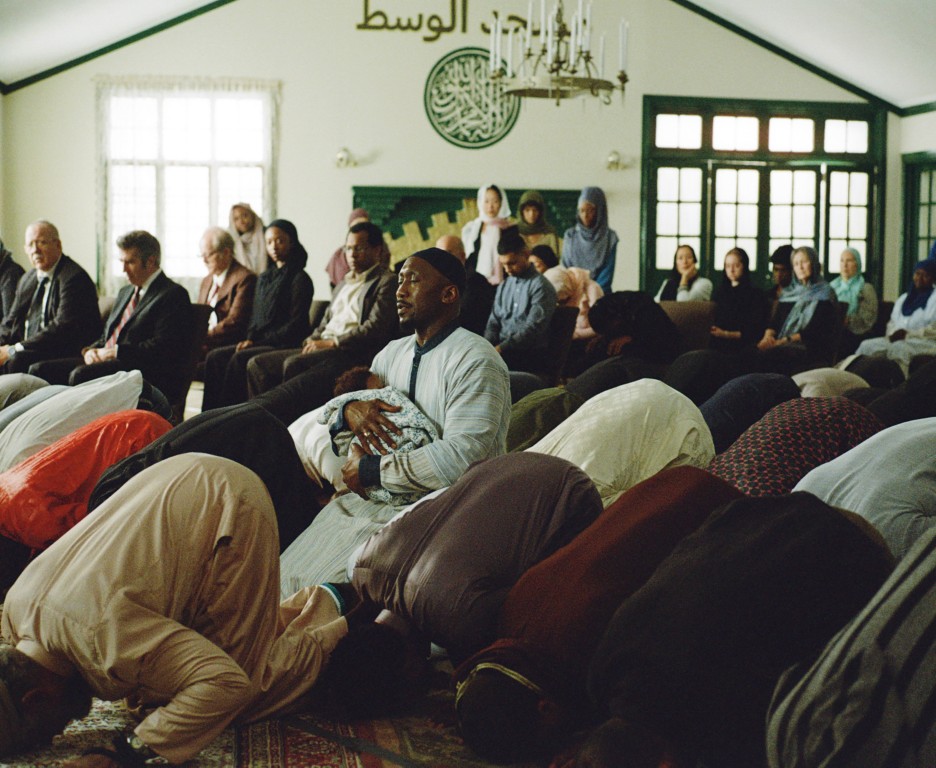
Photo Credit: Jaclyn Martinez
What I find fascinating about the film is how you subvert Western tropes while also mixing in samurai ones. You swap the revolver for a blade or the hat for the keffiyeh. Tell me more about how you layer and subvert such iconic images.
BT: Samurai films are very similar to Westerns. What I loved about samurai films, in particular, was how much the characters dealt with duty and responsibility. I thought, “What is that modern take on it?” Because I’m Muslim, I was like, “How would those ideas manifest through this Islamic lens?” I thought of “Ghost Dog” and how that character looks at his book and the Scripture he references. I wanted something I knew well, and I wanted to revere it. At the same time, I wanted to subvert it so it wasn’t just Hallmark-esque or propaganda-esque. I also want to challenge the religion because I think the best of cinema does that. It allows us to all feel a bit uncomfortable.
JC: When I read the script, I wasn’t aware of what Mahershala would look like or what my costume would look like. But visually, seeing the signifiers, like the rearranged mosaic pieces, was so satisfying. It complicates the idea that what you are seeing on-screen is a stereotype. It is meaningful to complicate what is expected.
