


What Is A Learning Experience Platform (LXP)?
A Learning Experience Platform (LXP) is a digital system designed to personalize and improve how employees learn at work. It focuses on the learner, using AI, data, and content recommendations to deliver relevant learning experiences instead of fixed training paths. In simple terms, it helps people learn what they need, when they need it.
So, what is an LXP? LXP stands for Learning Experience Platform, a modern learning tool. Unlike traditional training systems, which give control to administrators, an LXP puts the learner in charge. While older tools like LMSs focus on course assignment and tracking, an LXP emphasizes discovery, engagement, and personalization.
The LXP’s meaning is often described as a more modern evolution of corporate learning. It acts as a system that brings together content from multiple sources, such as internal courses, external articles, videos, and curated resources. This makes learning more flexible and self-directed. Unlike traditional systems, an LXP does not just manage training but actively shapes the learning journey.
Why Learning Experience Platforms (LXPs) Emerged
A Learning Experience Platform emerged to address major gaps in traditional corporate learning systems. For many years, organizations relied on LMSs that were mostly compliance-driven and admin-led. These systems worked well for assigning mandatory training, but they often failed to engage learners or support continuous skill development. Learning was structured, rigid, and focused on completion rather than experience.
At the same time, the workplace changed. Companies are now focusing on self-directed learning, where employees take charge of their own development. This shift stems from the need for skills-based organizations to continually improve their capabilities, rather than simply tracking course completions. As a result, learning has become less about simply checking off boxes and more about developing real, flexible skills.
This shift created demand for a more flexible system, leading to the rise of the corporate learning experience platform. Unlike traditional tools, an LXP learning model focuses on personalization and engagement. Modern LXPs also use AI-driven recommendations to guide learners toward relevant content across multiple sources. This makes learning more continuous, personalized, and aligned with real job needs, rather than fixed training schedules.
Key Features Of A Learning Experience Platform
A Learning Experience Platform is designed to make learning more personal, flexible, and aligned with how people actually work. Unlike traditional systems, an LXP focuses on the learner’s experience rather than just delivering courses. To understand its value, let’s take a look at an LXP’s features.
AI-Powered Personalization
One of the core features of an LXP is AI-powered personalization. A modern LXP uses AI to recommend learning content based on a person’s role, skills, interests, and behavior. Instead of forcing every employee through the same training path, the system delivers:
- Personalized content recommendations.
- Adaptive learning paths that adjust as users progress.
This is a major shift from older LXPs, where learning was static and one-size-fits-all. With AI, the Learning Experience Platform becomes dynamic and continuously evolving, helping employees learn what matters most to their growth.
Content Aggregation And Curation
A strong Learning Experience Platform brings together learning content from many sources. This includes both internal company materials and external content from trusted providers. Key capabilities include:
- Aggregating internal training resources, documents, and onboarding materials.
- Integrating external content such as MOOCs, videos, podcasts, and articles.
This feature is especially important in modern LXP software, where learning is not limited to a single library. Instead, employees can access a broad ecosystem of knowledge, all in one place. This makes the software feel more like a learning hub than a traditional training system.
Social And Collaborative Learning
Another important feature of an LXP is its focus on social learning. People learn better when they interact, share, and discuss ideas with others. A corporate Learning Experience Platform often includes:
- Peer-to-peer content sharing
- Discussion boards and learning communities
- Social engagement tools like comments and recommendations
This transforms the learning platform into a more connected environment where learning happens through interaction, not just consumption.
User-Generated Content
Modern LXPs also allow employees to become contributors, not just learners. This is known as user-generated content. Employees can:
- Upload training materials.
- Share best practices.
- Create short learning modules or guides.
This feature strengthens internal knowledge sharing and helps organizations scale learning without relying only on formal training teams. It also makes the learning experience system more authentic and practical.
Skills Intelligence And Analytics
A key differentiator in advanced LXP systems is skills intelligence. This feature helps organizations understand what skills exist, what is missing, and how learning is improving over time. Capabilities include:
- Skill tracking across roles and departments
- Data-driven insights for L&D leaders
- Visibility into skill gaps and development progress
This turns the Learning Experience Platform into a strategic tool for workforce planning, not just training delivery.
Seamless Integrations
Finally, a modern LXP must work well with other systems. Most organizations already use an LMS, so integration between LMS and LXP is critical.
A good LXP software integrates with:
- Learning Management Systems (LMSs)
- HR systems
- Content libraries and external platforms
This ensures both systems can coexist: the LMS handles compliance and structured training, while the LXP focuses on experience, discovery, and engagement.
Benefits Of A Learning Experience Platform
A Learning Experience Platform is designed to improve how employees discover, engage with, and apply learning. Unlike traditional systems that focus on course delivery, an LXP focuses on the learner experience itself. This shift creates measurable value for organizations, especially in terms of engagement, skills development, and business performance. Below are the key benefits of a Learning Experience Platform and why it has become central to modern learning solutions.
Increased Engagement
One of the most immediate benefits of a Learning Experience Platform is higher learner engagement. Traditional training systems often rely on assigned courses, which can feel mandatory and disconnected from daily work. In contrast, an LXP creates a more dynamic experience by recommending relevant content based on interests, roles, and behavior.
This personalization encourages employees to explore learning voluntarily rather than passively completing required modules. When learning feels relevant and easy to access, engagement naturally increases. This directly impacts talent retention because employees are more likely to stay in environments where they feel supported in their growth.
Personalized Learning Journeys
A key strength of the LXP is its ability to deliver personalized learning journeys. Instead of one-size-fits-all training, LXPs use AI and data to tailor content to individual needs. Employees can follow learning paths that align with their current skills, career goals, or project requirements.
This personalization improves both motivation and learning effectiveness. Employees are not overwhelmed with irrelevant content, and they can focus on what matters most to their development. From a business perspective, this leads to stronger capability building across teams and improves overall workforce readiness. Personalization is one reason many organizations consider LXPs the best learning experience solution for continuous development.
Faster Upskilling And Reskilling
In today’s fast-changing business environment, organizations need employees who can quickly adapt. A Learning Experience Platform supports faster upskilling and reskilling by making learning more accessible and targeted. Instead of waiting for scheduled training programs, employees can access relevant content immediately when skill gaps appear.
LXPs also aggregate content from multiple sources, including internal knowledge bases and external providers, which speeds up learning cycles. This has a direct impact on workforce agility, enabling organizations to respond faster to market changes, new technologies, and evolving job roles.
Stronger Learning Culture
A corporate Learning Experience Platform helps build a stronger learning culture by making learning part of daily work, not a separate activity. Features like content sharing, social learning, and user-generated content encourage employees to contribute and collaborate.
When learning becomes social and continuous, it shifts from a top-down process to a shared responsibility across the organization. This cultural shift improves long-term employee development and supports talent retention, as employees feel they are growing within the organization rather than stagnating.
Better Alignment With Business Goals
A modern LXP system connects learning directly to business priorities. Through analytics and skills tracking, organizations can see how learning activities translate into performance outcomes.
This alignment ensures that learning investments are not isolated but contribute directly to strategic goals such as productivity, innovation, and capability development. For leadership teams, this visibility makes it easier to justify learning investments and refine learning solutions over time.
Learning Experience Platform Vs. LMS: What’s the Difference?
Understanding the difference between a Learning Experience Platform (LXP) and a Learning Management System (LMS) is essential for any organization building a modern learning strategy. While both support corporate learning, they are designed with very different philosophies. One is built around administration and structure, while the other is built around the learner’s experience and personalization. In simple terms, the debate between Learning Experience Platforms and LMSs is not about which is better overall, but about the type of learning experience an organization wants to enable.
Core Differences
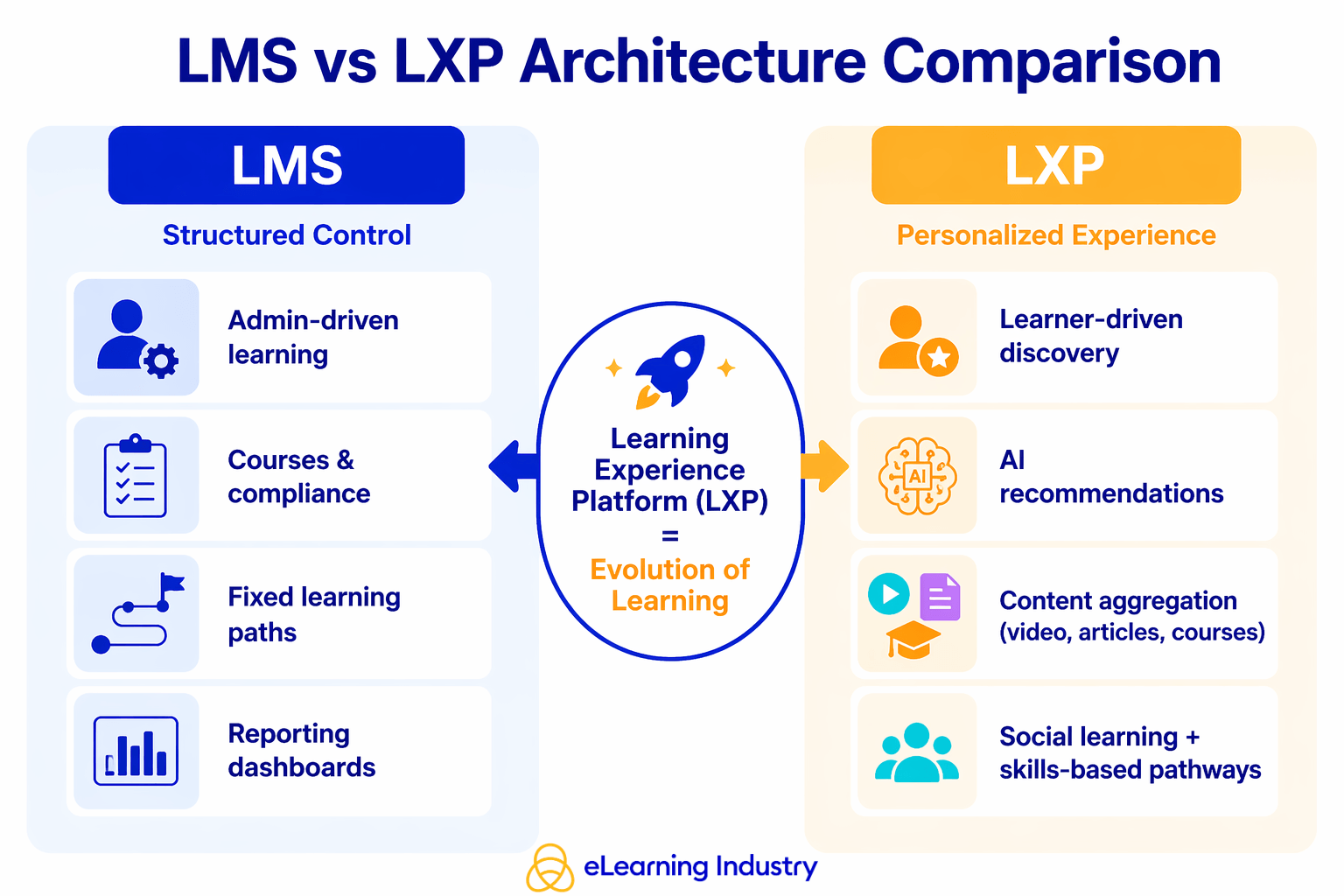
At the core, an LMS and an LXP serve different purposes. An LMS is traditionally used to deliver, track, and manage formal training programs. It is highly structured and often required for compliance training. An LXP, on the other hand, focuses on how employees discover, consume, and engage with learning content in a more personalized way.
Here is a simple breakdown:
LMS (Learning Management System) |
LXP (Learning Experience Platform) |
| Admin-driven | Learner-driven |
| Structured courses | Personalized learning pathways |
| Compliance focus | Experience and engagement focus |
| Top-down learning model | Self-directed learning model |
An LXP is designed to act more like a learning ecosystem, where content is curated from multiple sources and adapted to the learner’s needs. Meanwhile, an LMS functions more like a control system for assigning and tracking training. This distinction is why the LMS and LXP conversation is becoming so important in modern L&D strategy.
When To Use LMS Vs. LXP
Choosing between an LMS and an LXP depends on the learning goals of the organization.
An LMS is typically the right choice when the focus is on compliance vs. growth learning. For example, industries that require strict regulatory training, such as healthcare, finance, or manufacturing, rely heavily on LMS platforms to ensure employees complete mandatory certifications and safety training. In this case, structure, tracking, and reporting are essential.
On the other hand, an LXP is better suited for voluntary L&D-driven environments. If the goal is to encourage continuous skill-building, curiosity, and personalized development, an LXP provides a more flexible and engaging approach. It allows employees to explore content based on interests, roles, or recommended skills rather than assigned courses.
This is why many organizations today do not choose one over the other but instead define clear roles for each system.
LMS And LXP: Complement, Not Replace
A common misconception in the discussion of Learning Experience Platforms vs. LMSs is that organizations must choose one system and abandon the other. In reality, LMS and LXP platforms often work best together.
Most modern learning ecosystems use an LMS for compliance, reporting, and structured training delivery, while an LXP enhances engagement, discovery, and personalized learning experiences. This combination allows organizations to balance control with flexibility.
For example, an employee might complete mandatory compliance training through an LMS, then use an LXP to explore leadership courses, articles, or skill-based content tailored to their role. This blended approach ensures both organizational requirements and employee development needs are met.
As corporate learning continues to evolve, the relationship between LMS and LXP is becoming less competitive and more collaborative. Organizations that understand how to integrate both systems effectively are better positioned to build scalable, engaging, and future-ready learning environments.
Types Of LXPs And Use Cases
LXPs are not one-size-fits-all systems. Different organizations use them in different ways depending on size, goals, and industry needs. Understanding the main types of LXPs helps L&D and HR leaders choose the right approach for their workforce.
Enterprise LXPs
Enterprise-level LXP solutions are designed for large organizations with complex learning ecosystems. These systems usually integrate with multiple tools, including HR systems and existing LMS platforms. They focus on scalability, global learning delivery, and advanced analytics. Enterprise LXPs often support thousands of employees and multiple business units, helping standardize learning while still offering personalization.
SMB-Focused LXPs
For small- and mid-sized businesses, LXPs are typically lighter and easier to deploy. These platforms focus on simplicity, affordability, and fast adoption. SMB-focused LXPs often emphasize ready-to-use content libraries and quick setup rather than deep system integrations. This makes them a practical entry point for organizations starting their digital learning journey.
Industry-Specific LXPs
Some LXP solutions are tailored to specific industries such as healthcare, retail, or technology. These platforms include pre-built learning paths, compliance modules, and curated content relevant to the sector. Industry-focused LXPs help organizations deliver more relevant LXP training by aligning learning directly with job roles and regulatory requirements.
Common Use Cases
LXPs are used across a wide range of L&D scenarios:
- Onboarding: New employees can access personalized learning paths to understand roles, tools, and company culture more quickly.
- Leadership development: LXPs support leadership growth through curated content, mentorship resources, and skill-based learning journeys.
- Skills transformation: Organizations use LXPs to close skill gaps by recommending targeted learning paths aligned with evolving business needs.
- Internal mobility: Employees can explore new roles and required skills, supporting career growth within the organization.
Overall, the LXP’s flexibility makes it suitable for businesses of all sizes and learning goals, from structured LXP training programs to fully personalized learning ecosystems.
Top LXP Platforms To Know
When organizations search for the top LXP platforms, they are usually not just looking for a list of tools. They are trying to understand what Learning Experience Platforms look like in practice and how different solutions approach personalization, content delivery, and learner engagement. The reality is that there are many LXPs in the market, and they vary significantly in design, depth, and strategic focus.
What Defines The Best LXP Platforms?
When evaluating the top learning experience platform options, several core characteristics consistently matter across the industry:
- UX quality: The most effective LXPs offer a simple, intuitive experience that encourages daily use. Learners should be able to find and consume content without friction.
- AI maturity: Strong LXP software uses AI to personalize recommendations based on skills, behavior, and learning history.
- Content ecosystem: Leading platforms act as learning hubs, connecting users to diverse content sources rather than limiting them to a single library.
- Integration flexibility: A modern LXP system must work alongside existing LMS platforms, HR systems, and performance tools to support a connected learning environment.
In practice, the strongest LXP solutions are those that combine these elements into a cohesive experience. Rather than replacing traditional systems, they extend them, helping organizations build more adaptive and learner-centered ecosystems.
Conclusion
A Learning Experience Platform is not a must-have for every organization right away. Some teams can continue working effectively with their current one or even an LMS setup without urgency to switch. However, LXPs become especially valuable for scaling organizations and for those focused on skills transformation initiatives, where personalized, continuous learning is critical. Instead of replacing an LMS, the LXP acts as an evolution of learning experience software, enhancing engagement and discovery. In most cases, an LXP complements existing tools, supporting long-term workforce growth rather than replacing established learning structures.
