

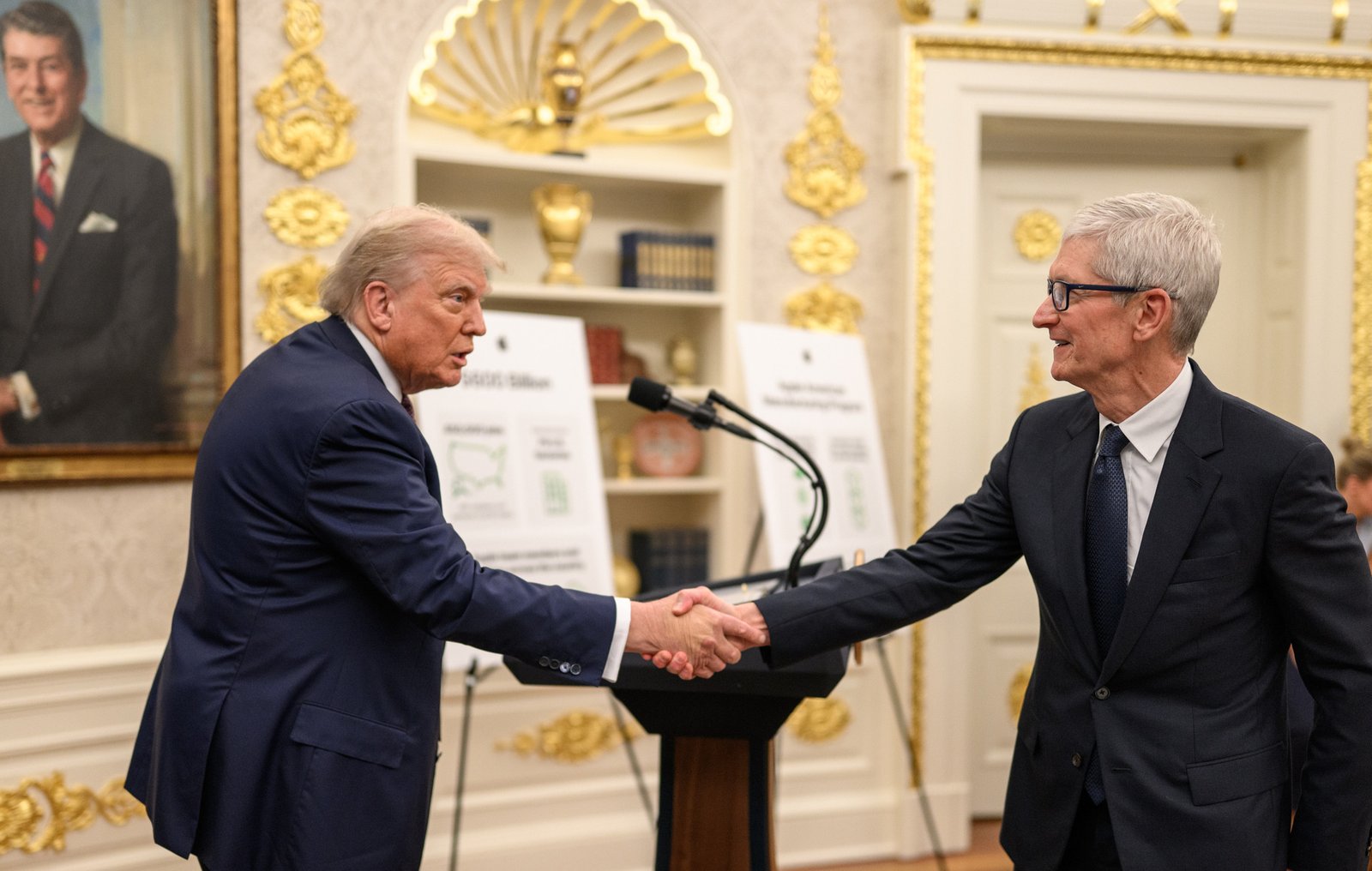
On August 6, 2025, Tim Cook stood in the Oval Office and announced that Apple would increase its US investment pledge from $500 billion to $600 billion, as he handed President Trump an engraved gift. He also left the meeting with an announced exemption to the tariff on imported microchips. This came just a few months after administration officials carved out exemptions for smartphones, computers, and semiconductors, which the administration warned were temporary and could change over the coming weeks. Today, Tim Cook is no longer the CEO of Apple, instead taking on a role formally known as Executive Chairman of Apple’s Board of Directors. Informally, however, he is being called the “Trump Whisperer.” Apple’s own announcement of the transition notes that “as executive chairman, Cook will assist with certain aspects of the company, including engaging with policymakers around the world.”
In other words, Cook has stepped away from some of his duties as CEO while taking on a role that gives him more latitude (flexibility?) to engage with policymakers around the world, including those who control tariffs and exemptions.
Economists have described this phenomenon for decades. Mancur Olson provides the cleanest such description as “concentrated benefits, diffused costs.” The benefits of protectionism are concentrated on a particular industry, while the costs are spread among a diffuse consumer base. The protected industry has every incentive to spend money lobbying for these benefits, sending lawyers and consultants to Washington to ensure their adoption. Consumers, most of whom live far from Washington, have no such incentive. The cost of travel to DC to meet with a Congressman or regulator can easily exceed the $1500-$2,000 each household is expected to pay for tariffs. Even though consumers bear the brunt of the tariffs, it makes little sense for them to invest in fighting hard against any particular proposal in Washington.
Protection for Some, Exemptions for Others
What Apple and scores of other companies make clear is that extra profits from excluding foreign competition (costs paid by American buyers) isn’t the only prize industry lobbyists are after. The largest companies run through the exact same rent-seeking process again. The second time through, they argue for exemptions from the very tariffs they backed. And this is where the real money can be made.
First, tariffs make importing goods more expensive. This, in turn, allows domestic firms to raise their prices without fear of losing market share. A tariff on steel, for example, leads to higher domestic prices for steel. Then, industries adversely affected by the tariffs lobby for exemptions for themselves. Apple has done this, but so too have other industries. On June 1, President Trump signed a proclamation that adjusted the Section 232 tariffs on steel, aluminum, and copper to help relieve farmers of some of their burden. One industry gets the protection of the tariffs while another gets exemptions, protecting them from the tariffs. A firm that wins an exemption can continue buying its inputs at the lower, world price while their rivals pay the higher, domestic price.
This isn’t a new phenomenon. During President Trump’s first term, the Commerce Department created a process by which firms could request exclusions from the Section 232 tariffs on steel and aluminum. By January 2021, 153,831 such requests had been filed by just 941 firms. Why such a small number of firms? Consider what it takes to actually file a request. You’ll need lawyers and trade consultants who know how to actually put together a well-formatted request and staff who know their way around a federal docket to make sure that the request reaches the correct person. Larger companies, with their Rolodex of contacts in Washington, can make sure that their requests reach certain people with whom they already have a standing relationship. Smaller firms have none of these. What’s more, domestic producers were allowed to object to a competitor’s request, meaning that not only were firms able to request exemptions for themselves, but they were able to sabotage one another’s requests as well.
Likely Objections
“But Dave, if tariffs are so bad, wouldn’t exemptions actually be a good thing, and the more exemptions, the better? That would mean that the bad thing applies to fewer things!” I suspect that something akin to this will be somewhere in my inbox in the coming days.
Intuitively, that logic makes sense. We can all imagine some form of ideal policy being made, even if the details of that image are fuzzy, just like we can all imagine unicorns. Duke political scientist, Michael Munger, proposed the aptly named “Munger Test” to suss out the problems here. The test hinges on one fundamental question: can you name a specific person who, in the current system of creating these exemptions, will actually do so? And once that question gets asked, the problems are easy to identify.
“Ok, fine. Maybe we can’t get the ideal set of exemptions, but still… aren’t exemptions a good thing, even if they’re implemented imperfectly?”
Again, unfortunately, this falls apart too. Discretionary exemptions do little to reduce the overall burden of tariffs. Instead, they tend to redirect and further concentrate it on those who cannot get an exemption. Jeff Tooze, who currently serves as the Vice President of Global Customs & Trade at Columbia Sportswear, said in 2019, “I have a whole team of people that work together with the designers and developers and merchandisers and with customs, actually, and to ensure that during the design process that we’re considering the impact of tariffs.” Smaller businesses have none of these. Instead, they pass along whatever amount of the tariff they can to their customers and absorb the rest themselves. The result is that smaller firms, which make up the bulk of the firms who cannot get exemptions, face both higher input costs and competition from larger, more connected firms who have a cost advantage in the form of an exemption. A broad tax with no exemptions at least affects everyone equally.
To address this, the current administration has abandoned the exclusion process from their first term, pointing out that it “resulted in exclusions for a significant volume of imports, in
a manner that undermines the purpose of the section 232 measures and threatens to impair national security.” Regrettably, as Tim Cook’s example highlights, this did not mean that exemptions were no longer available. Instead, getting an exemption largely depends on your ability to secure a meeting with trade officials or, in some cases, the president himself.
Far from draining the swamp, this expands it.
What Couple Apple Have Done with $600 Billion Instead?
Still, my would-be correspondent has one more reply:
“Alright, you win. Exemptions don’t work. But look at what Apple did! They’re investing $600 billion! That’s thanks to the tariffs!”
True, Apple did announce a $600 billion investment. But the question we need to ask is “where is the $600 billion coming from?” Legally, Apple cannot conjure money out of thin air, so that money must be coming from somewhere within Apple’s balance sheets. Frédéric Bastiat teaches us to look at “what is seen and what is not seen.” What is seen here is the ribbon cutting of the new factory being opened.
What is not seen is everything that Apple would have done with that money if it weren’t for the threat of tariffs. This could include hiring more engineers to build faster, more powerful chips. Or perhaps further developing software that would further enhance their products compared to competitors. Or maybe Apple could have figured out new production methods that would drive costs down and make their products more affordable. We’ll never know what that money would have been used for. The cost of forgoing whatever Apple would have done with that money, however, is just as real as a factory being built.
Building the Economy Around Favors
The troubling part of all of this isn’t so much the tariffs themselves, but what it says about how to generate wealth. In a productive economy, wealth is generated by creating a product that people want to buy and by pleasing one’s customers. But in a rent-seeking society, wealth is generated by pleasing the people who hand out the favors. The customers still matter, but they are no longer of primary concern. When the surest pathway to prosperity runs through the Oval Office, that is the path that people will increasingly take. Tim Cook’s $47 million compensation package isn’t for producing anything, it’s for managing a president.
This is the real cost of these exemptions. Every hour a company spends lobbying for an exemption is an hour it’s not spending making its products cheaper. Every hour they spend building a relationship with a well-positioned trade official is a dollar that is not spent researching the next great innovation. As long as lobbying pays better than creating, lobbying is what we should expect from businesses. If we want to see less of this, then we need to eliminate the scope for politicians to dole out favors.
