

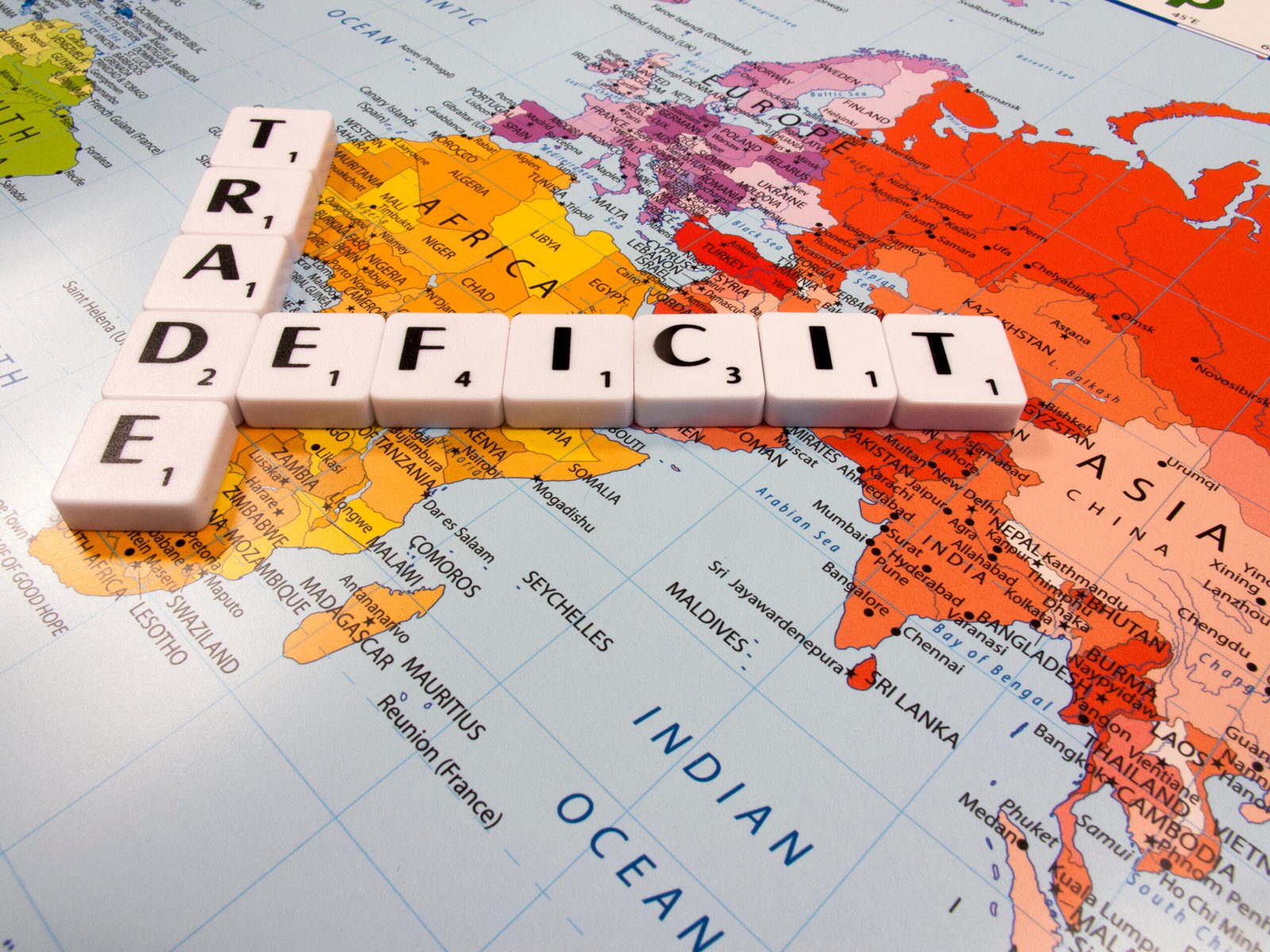
Language matters. Words have not only technical meanings; they also summon particular attitudes and impressions. And sometimes these attitudes and impressions differ significantly from the words’ technical meanings.
In no domain of economic policy is the confusion created by the divergence of words’ technical meanings from the attitudes and impressions conveyed by those words greater than in the domain of trade policy.
Trade Deficit
The most obvious, commonly used confusing term is “trade deficit.” “Deficit” inherently sounds bad. Everyone instinctively resists being in any kind of “deficit.” But those of us who understand the technical definition of “trade deficit” know that this “deficit” is merely the result of an accounting convention by which inflows into a country of money are counted as “positive” while outflows of money are counted as “negative.”
Yet as many economists, including the Nobel laureate Vernon Smith, have pointed out, if the convention were instead (as it could be) to count as a positive the monetary value of imports – and as a negative the monetary value of exports – then so-called “trade deficits” would instead be “trade surpluses.”
The words “trade surpluses,” alas, are more difficult to demagogue than are the words “trade deficits.”
Concessions
Another technical term that conveys a misleading impression is “concessions,” which means agreements by governments to lower their trade barriers in exchange for other governments agreeing to lower their barriers.
As the excellent trade-policy scholar Daniel Griswold summarizes, in trade agreements, “exports are a benefit and imports a ‘concession.’” The technical term “concession” is thus used to describe those instances in which governments allow their citizens to trade more freely. Greater freedom of trade and the additional goods and services that it makes available are bizarrely rendered as costs – as burdens – that the people of the home country endure in order to obtain the benefit of greater ease of exporting.
Dumping
Yet another term that distorts understanding is “dumping.” To accuse foreigners of “dumping” goods on our market is to suggest that foreigners are harming us by discarding their trash on our shores or otherwise burying us in things that we’d prefer not to have. No sane person wants to be dumped upon!
This suggestion is completely mistaken. The great trade economist Douglas Irwin notes that “the government’s definition of ‘dumping’ is a lower price charged in the United States than in a foreign exporter’s home market.” And so what really occurs with so-called “dumping” is that the people of the home country are offered the opportunity to buy particular goods at prices lower than foreigners must pay. If the practice of charging differentially lower prices in the US was called not “dumping” but “competitive pricing” or “bargain pricing,” perhaps domestic firms would have less success at persuading the government to use regulations against “dumping” to secure protection from vigorous foreign competition.
There is, after all, no economic reason why any particular good should sell in one country at a price identical to its price in another country.
Plenty of factors explain why, say, a particular model of automobile might sell for less in the US than in the producer’s home market. American demand for that model might simply be lower—perhaps because tastes differ, or because the US retail market is more competitive and offers more alternatives. It’s also possible that auto retailing in the US faces fewer costly government rules than abroad.
Whatever the reason, when imports sell here at lower prices than they do elsewhere, Americans benefit. These lower prices are a gain, not a problem to be “protected” from. Yet by labeling the practice of selling exports at differentially lower prices as “dumping,” policymakers create an unjustified bias against foreign competition.
‘Made in’ Labels
“Made in China” — or Canada, Malaysia, Namibia, or anywhere else — is now a misleading label. In today’s global economy, most goods and services are produced with ideas and inputs drawn from dozens of different countries. As I wrote in this space a few months ago,
In today’s global economy, the great majority of the manufactured goods that you consume consist of parts and ideas from around the world, including the US. A “Made in” label on some good tells you only where that good’s final assembly occurred. Bath towels at Target labeled “Made in Turkey” might well be made of cotton grown in Texas, dyed with pigments from Germany, woven on a loom made in India, and shipped to the US on a freighter made in Korea that is carrying a shipping container manufactured in Denmark. That label would be more accurate if it instead read “Final Processing Done in Turkey” — or, more accurate still, “Made on Earth.”
Americans Trade With
As a linguistic shorthand, we often describe countries as exporting, importing, and trading.
“Germany exported $1.5 trillion of goods last year.”
“Ireland is among the world’s leading suppliers of pharmaceutical products.”
“America trades with China.”
“The Netherlands ran a trade surplus.”
We know what these sentences mean: Individuals — alone or in voluntary groups called firms — in one country engage in commerce with individuals in another. But the aggregate outcomes of all this commerce are then described in ways that imply each country itself engaged in these transactions, as if the results reflect a conscious collective choice made by its people.
Because all international commerce is carried out by individuals, and because each individual believes he or she is made better off by each transaction voluntarily conducted with foreigners, it’s difficult to see how the overall outcome could be negative. Mistakes aside — and there’s no reason to think Americans make more errors than non-Americans — every commercial exchange with a foreigner yields a gain for the American involved. The sum of these gains cannot plausibly be a negative number.
Yet it’s an easy, if careless, step from portraying trade as something done by large collective entities to concluding that these entities make choices contrary to the interests of their own people. “America,” for instance, is said to buy such large quantities of imports that most Americans supposedly suffer as a result. Somehow, “America” is acting against Americans. But once we recall that importing is done not by “America” but by individual Americans, the idea that we suffer net losses from importing becomes absurd.
It’s trite but true that language matters and can mislead. Nowhere in economic policy is this more evident than in trade.
