

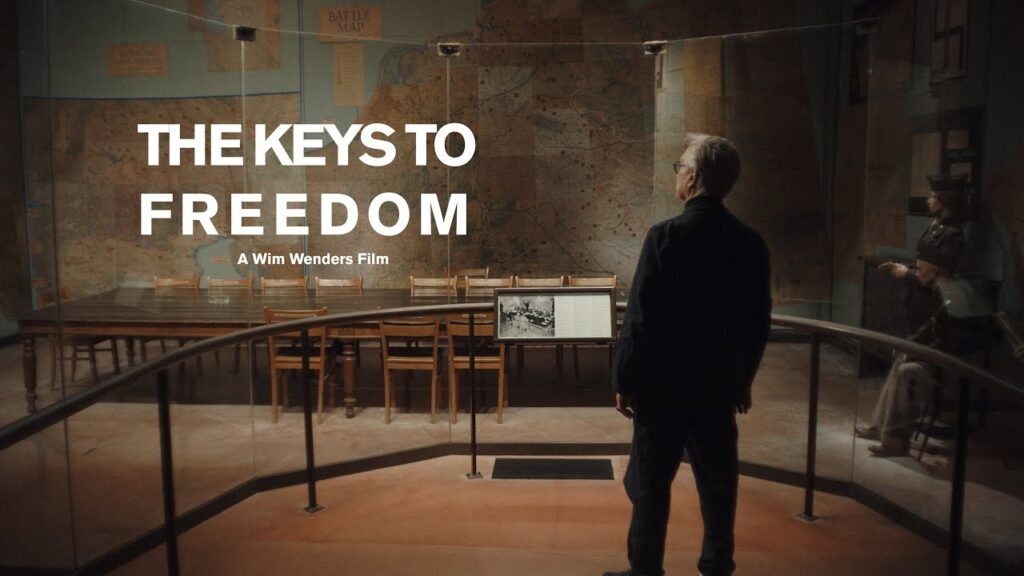
World War II officially ended on September 2, 1945. It followed, by less than three weeks, an equally momentous event, at least in the eyes of cinephiles: the birth of Wim Wenders. Though soon to turn 80 years old, Wenders has remained both productive and capable of drawing great critical acclaim. Witness, for example, his Tokyo-set 2023 film Perfect Days, which made it to the running for both the Palme d’Or and a Best International Feature Film Academy Award. Back on V‑J Day, it surely would’ve been difficult to imagine a Japanese-German co-production seriously competing for the most prestigious prizes in cinema — even one directed by a known Americaphile.
Wenders has long worked at revealing intersections of history and culture. Seen today, Wings of Desire seems for all the world to express the spirit about to be liberated by the fall of the Soviet Union, but by Wenders’ own admission, nobody working on the movie would have credited the idea of the Berlin Wall coming down any time in the foreseeable future.
In his new short film “The Keys to Freedom,” he commemorates the 80th anniversary of the Second World War’s conclusion by paying a visit to a school in Reims. Commandeered for the secret all-night meeting in which German generals signed the documents confirming their country’s total surrender to the Allies, it hosted the end of what Wenders called “the darkest period in the history of Europe.”
Closing up the temporary headquarters, Allied commander-in-chief Dwight D. Eisenhower returned its keys to the mayor of Reims, saying, “These are the keys to the freedom of the world.” As much as these words move Wenders, he also fears that, even as the Russia-Ukraine war roils on, younger generations of Europeans no longer grasp their meaning. Born into societies protected by the United States, they naturally take peace for granted. “We have to be aware of the fact that Uncle Sam isn’t doing our job for very much longer, and we might have to defend this freedom ourselves,” Wenders explains in a New York Times interview. The end of World War II marked the beginning of the so-called “American century.” If that century is well and truly drawing to its close, who better to observe it than Wenders?
Related content:
Filmmaker Wim Wenders Explains How Mobile Phones Have Killed Photography
Based in Seoul, Colin Marshall writes and broadcasts on cities, language, and culture. His projects include the Substack newsletter Books on Cities and the book The Stateless City: a Walk through 21st-Century Los Angeles. Follow him on the social network formerly known as Twitter at @colinmarshall.
