

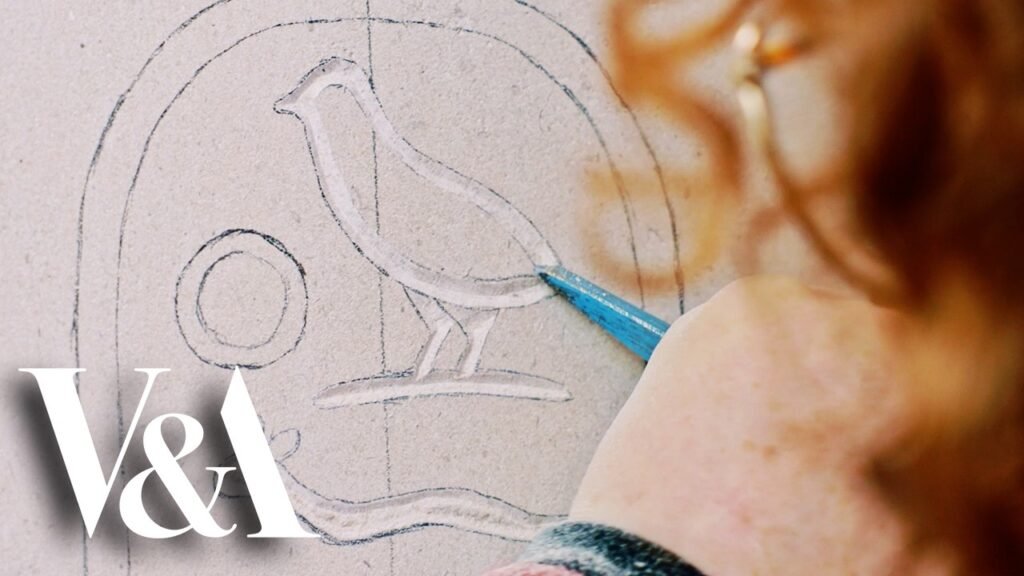
In ancient Egypt, writing hieroglyphs was a highly specialized skill, one commanded by only a small fraction of the population. The fact that there were more than 1,000 characters to memorize probably had something to do with that, but the variety of surfaces on which hieroglyphs were written couldn’t have made it any easier. Depending on the occasion, ancient Egyptians used papyrus, wood, metal, and pottery shards as writing surfaces. The most monumental or religiously important texts, however, got carved into stone, thus ensuring the words a kind of eternal life — a particular concern in the cases of tomb walls and sarcophagi.
There may be little call to write hieroglyphs today, but the techniques to do so haven’t been lost. In the new video above from the Victoria and Albert Museum, sculptor and stone carver Miriam Johnson demonstrates how to carve into stone the name of Pharaoh Khufu, who built the Great Pyramid (and indeed, was buried in it).
The first step is to write that name, surrounded by its cartouche, on a sheet of carbon paper. This isn’t the brush and ink that the ancient Egyptians would have used, granted, but for the rest of the project, Johnson sticks to the old-fashioned ways. With the image transferred, and using nothing more than a mallet and a chisel, she carves the hieroglyphs into the stone not just once but twice.
The first time, Johnson carves in “sunken relief,” a technique that involves cutting the image out of the surface of the stone. The second time, she renders Pharaoh Khufu’s name in “raised relief,” which requires cutting out everything but the image, creating the effect of the hieroglyphs rising out of the stone. With the former “you see more of the shadows”; with the latter, “you’ve got more opportunity of putting more texture into the characters.” Seen in a state of completion — by a layman, at least — Johnson’s carvings wouldn’t look out of place in a museum exhibit on ancient Egypt. Even if tools manufactured in the twenty-first century produce a few subtle differences from the real thing, give these stones a millennium or two to age, and they’ll surely look even more convincing.
Related content:
How to Read Ancient Egyptian Hieroglyphs: A British Museum Curator Explains
What Ancient Egyptian Sounded Like & How We Know It
You Could Soon Be Able to Text with 2,000 Ancient Egyptian Hieroglyphs
Watch a Masterpiece Emerge from a Solid Block of Stone
Based in Seoul, Colin Marshall writes and broadcasts on cities, language, and culture. He’s the author of the newsletter Books on Cities as well as the books 한국 요약 금지 (No Summarizing Korea) and Korean Newtro. Follow him on the social network formerly known as Twitter at @colinmarshall.
