


Not All LMS’s Are Designed For External Complexity
Here is a telling question to ask at your next board review: What does it cost when a customer stops engaging with your training program? Most organizations don’t know—because most organizations aren’t measuring it. They track completion rates and quiz scores. They count the number of partners who logged in last quarter. What they rarely count is the revenue attached to the customers and partners who quietly disengaged, decided the content wasn’t worth their time, and redirected their attention toward a competitor’s product line.
That’s the real cost of a broken external training program. It doesn’t show up as a support ticket. It shows up in declining renewal rates, underperforming reseller channels, and distributor networks that push someone else’s product because they understood it better. The question isn’t whether personalized external learning matters—it clearly does. The question is whether your platform was ever designed to deliver it.
The real cost of a broken external training program doesn’t show up as a support ticket. It shows up six months later in your renewal numbers.
The Architecture Problem No One Talks About
When an external training program underperforms, the diagnosis almost always points to the content. The modules aren’t engaging enough. The translations are off. The interface feels clunky. These things matter—but they’re rarely the root cause.
The deeper problem is architectural. Most LMS platforms were designed for one kind of learner: the employee. They assume you know who is logging in, what role they hold, and what they need to complete. Completion can be enforced. Roles are defined in your HR system. The learning population is finite, relatively stable, and legally obligated to show up. External training breaks every one of those assumptions simultaneously.
Your distributor in Southeast Asia is not your employee. They have no obligation to complete anything. They have competing priorities, time pressures you can’t control, and a fundamentally different motivation for learning—commercial self-interest, not compliance. If your training isn’t immediately useful to them, they close the tab and don’t come back. Nobody fires them for it.
The External Learner Reality
A single partner training program may need to serve master distributors seeking strategic depth, regional agents with local compliance obligations, frontline resellers who need quick point-of-sale answers, and end customers arriving with wildly different prior knowledge—simultaneously, across dozens of markets and languages.
The platforms built for employees handle this badly—not because they’re poorly made, but because they were built for a different room. Extending them to external audiences is like bringing office furniture to a stadium: technically possible, practically inadequate.
Where Engagement Actually Goes
The divergence between internal and external training engagement is stark—and it happens fast. Internal programs, where completion is mandatory, maintain relatively stable participation. External programs built on generic, one-size-fits-all content see dramatic drop-off within the first few weeks, as learners either find the material irrelevant to their role or quickly exhaust what’s useful to them.
Adaptive programs—those that adjust content based on demonstrated knowledge and learner context—hold engagement at significantly higher levels throughout the program lifecycle. The difference isn’t marginal; it’s the gap between a program that changes behavior and one that generates activity metrics.
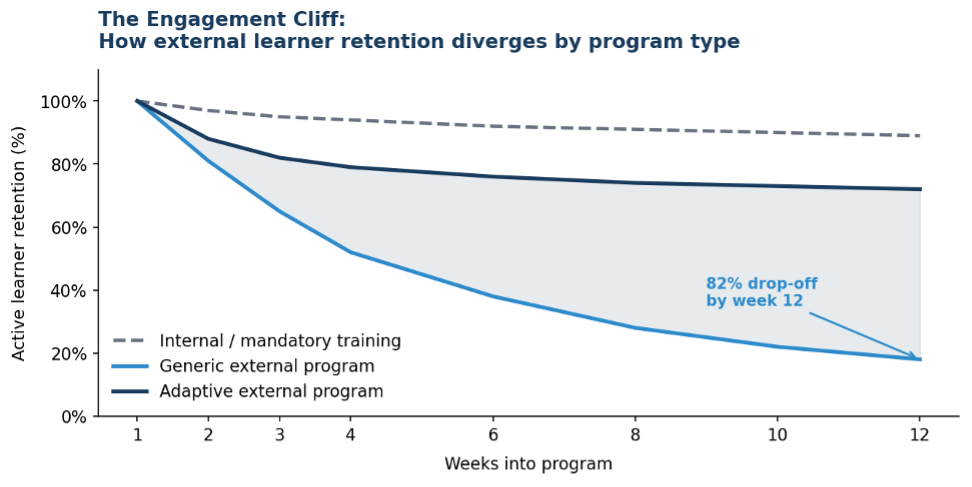
Figure 1: Active learner retention by program type over a 12-week period. Generic external programs lose the majority of learners before the program concludes; adaptive programs retain more than 3 times as many.
The implication for revenue is direct. An external learner who disengages at week three hasn’t absorbed your product positioning, hasn’t completed the certification that makes them a more confident advocate, and hasn’t built the habit of returning to your platform when they need answers. That’s lost commercial influence, compounded across every market you operate in.
The Personalization Shortcut That Backfires
Most platforms attempt personalization through one of three mechanisms: rule-based pathways, manual admin segmentation, or recommendation engines. In theory, each of these works. In practice, each hits a specific wall when applied to external audiences at scale.
Rule-based pathways depend on clean, stable role data. Partner networks don’t have it. Job titles vary across organizations, reporting structures shift, and roles rarely map neatly to the categories your platform was built around. The result: experts wade through introductory material they mastered years ago, while beginners get dropped into advanced content without context. The system misfires—and the learner blames the training, not the categorization logic.
Manual segmentation works at small scale. It collapses when you’re managing programs across 50, 100, or 190 countries. The administrative overhead becomes someone’s entire job, consuming the capacity that should go toward building better content.
Recommendation engines are only as intelligent as the data they’re trained on. When that data comes from internal employees, it doesn’t translate to distributor networks with different motivations, learning habits, and commercial contexts.
The temptation at this point is to layer AI on top of whatever architecture already exists. But AI amplifies the underlying logic—it doesn’t replace it. Shallow learner data plus rigid content structure plus AI still produces something closer to educated guesswork than genuine personalization. AI amplifies the logic underneath it. If that logic was built for employees, AI-driven personalization for external learners is still just educated guesswork.
The Competency Cost of Getting It Wrong
The business case for getting this right isn’t abstract. Adaptive learning—where content and sequencing adjust to what each learner actually knows—consistently reduces time-to-competency across every learner type. The reduction is significant: typically 40% to 45% faster ramp time compared to static, one-size-fits-all programs.
For a master distributor, that’s the difference between productive commercial conversations in week 8 versus week 14. For a frontline reseller, it’s the difference between confidently recommending your product this month or defaulting to the competitor’s offering they already know.
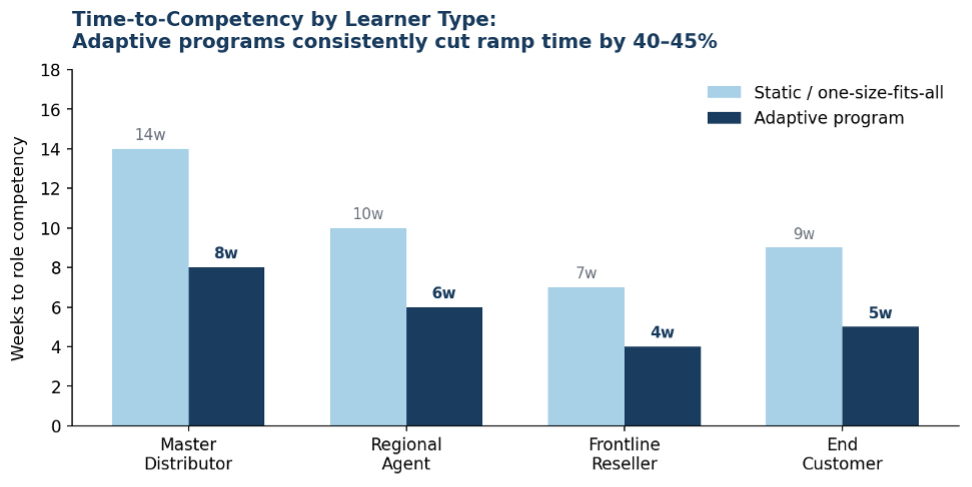
Figure 2: Weeks to role competency by learner type. Adaptive programs deliver faster ramp times across all external learner categories, with the largest gains for complex roles.
Multiply those gains across hundreds of partners and tens of thousands of end customers, and the business impact is substantial. The inverse is also true: every week a partner spends in a misaligned training journey is a week they’re operating below potential—and building confidence with a product other than yours.
What Purpose-Built External Learner Training Actually Looks Like
The distinction between a repurposed employee platform and one built for external complexity isn’t a marketing difference; it’s a structural one. There are four capabilities that separate them in practice:
- Diagnostic entry points that test prior knowledge on arrival, rather than assuming it
Onboarding questionnaires that assess role, goals, and existing competencies—then automatically route learners to content appropriate for where they actually are. - Continuous adaptation at the content level
Retesting after modules, looping back to fill retention gaps, and dynamically adjusting what’s required versus recommended based on demonstrated knowledge. - Role-based environments
Not just different content, but different interfaces, credentials, and access structures for different learner types. A master distributor and a frontline reseller have different commercial relationships with you. Their training environments should reflect that. - AI-supported global delivery
Automated translation, video transcription, and learning assistants that help partners navigate complex material in their own language—without requiring a content team in every market.
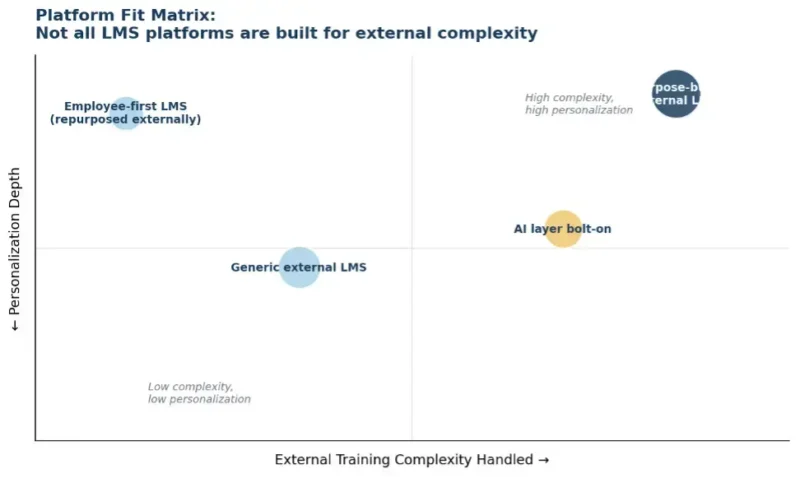
Figure 3: Platform fit by external training complexity and personalization depth. Purpose-built external LMS platforms occupy the high-complexity, high-personalization quadrant; employee-first platforms—even with AI bolt-ons—do not.
The matrix above reflects a simple reality: the platforms designed for employees can be stretched toward external use, and AI additions can add a layer of intelligence on top. But neither combination reaches the upper-right quadrant—the space where complex, multi-market, multi-role external programs actually need to operate.
The Decision Most Organizations Delay Too Long
Most organizations don’t realize their LMS is the problem until they’ve already built a significant amount on top of it. Programs are running. A few markets are live. Completion rates look acceptable on paper. Then they try to scale—add ten more markets, double the partner network, launch in a new product category—and nothing moves without enormous manual effort.
Admin work multiplies. Localization backlogs grow. Advanced partners disengage from content calibrated for beginners. And the completion metrics that looked fine start to reveal themselves as measurements of activity, not competency.
At that point there are two choices: keep patching with workarounds that add complexity without solving the core problem, or rebuild on infrastructure designed for this from the start. The first is cheaper in the short term. The second is cheaper in the long term—and the longer the delay, the wider the gap.
The honest question to ask isn’t whether your current platform can handle external learner training. Technically, almost any platform can. The question is whether it was built to handle it well—at the scale, the complexity, and the speed your business actually requires.
Image Credits:
- The images/graphs within the body of the article have been supplied/created by the author.
